Homes
Whose Pipe Is It When It Fails Inside a Wall Between Two Condominium Units?
A leak in a wall between two units produced four months of argument and a five figure repair. Every answer was already in a document both owners received at closing.
- Words
- 1,365
- Written by
- Grant Weatherby
- Filed
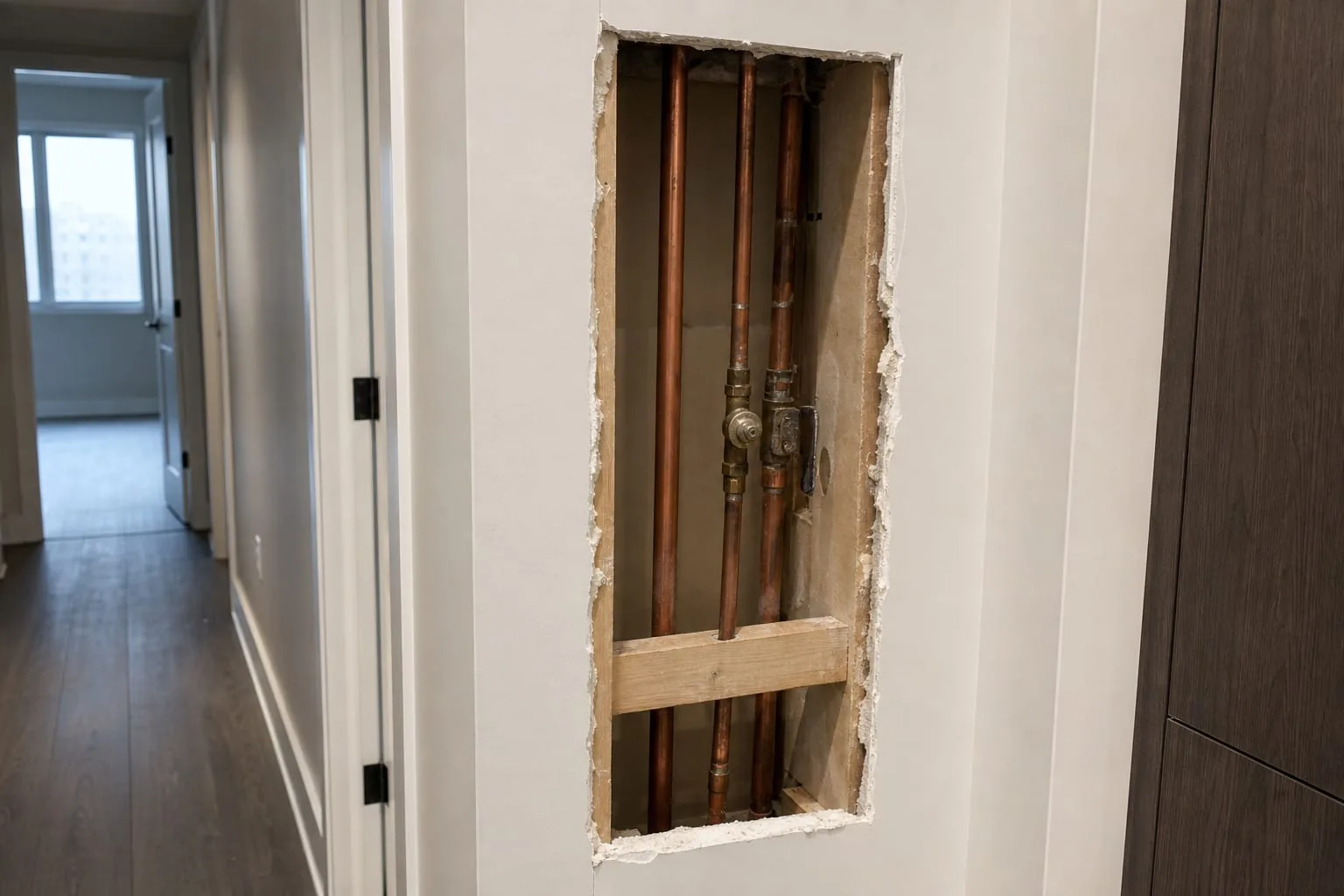
A supply line failed inside a common wall in a twenty eight unit building and water ran for several hours into the unit below before anybody was home to notice. Two units damaged, a wall opened, and an argument about who pays that ran from February through to June. Nothing about it required an attorney to resolve. Every answer was already sitting in the declaration, the bylaws and the insurance certificate, all three of which both owners had received at closing and neither had ever opened.
The Three Documents, and What Each One Settles
Condominium governance runs on a hierarchy and reading the documents out of order produces nothing but confusion. The declaration is recorded against the property and defines what physically belongs to whom, creating the units, describing their boundaries and designating common elements and limited common elements, which makes it the document that answers the question about the pipe. Nothing in the other two can contradict it, and any argument that starts somewhere else has started in the wrong place.
The bylaws govern how the association operates, covering the board, the budget, assessments and the procedure for maintenance and repairs, so they say who arranges work and how it is paid for within the ownership scheme the declaration established. The rules are adopted by the board and cover conduct, and they cannot override either document above them, which is worth knowing when somebody waves one across a hallway. Three documents, three jobs, and almost every dispute in a small building turns on confusing the first with the second.
The Boundary Clause, Which Decides Most of It
Every declaration contains a definition of the unit boundary, usually in a single paragraph. The common formulation makes the boundaries the undecorated interior surfaces of the perimeter walls, floors and ceilings, includes the finishing materials applied to those surfaces, and excludes all structural components, pipes, wires, conduits and other utility installations lying within them. Read that last clause carefully, because under it the pipe inside the wall is not part of the unit even though it sits inside that unit's wall and serves only that unit.
The owner's property, in other words, begins at the paint. Some declarations use a different boundary entirely, defining the unit as everything from the centerline of the walls inward, or as including any utility installation exclusively serving that unit, and those are meaningfully different answers to the same question. Which is why the general rule neighbors repeat to each other in the elevator is worthless. The answer exists only in the specific document recorded against the specific building, and it takes a few minutes to find.
Limited Common Elements, the Category People Miss
Most declarations create a middle category covering components that are common elements while serving only one unit or a small group of them, which typically means balconies, patios, the windows of a unit, a dedicated heating unit, or a branch of plumbing serving one stack. The significance is that limited common elements frequently carry a split responsibility, and the clause allocating it sits somewhere separate from the boundary clause rather than alongside it.
Typical wording says the association shall maintain, repair and replace the limited common elements, and that the cost shall be assessed against the unit or units to which they are assigned, which means the association arranges the work and the individual owner pays for it. Owners routinely read the first half of that sentence, conclude the matter is somebody else's, and are then surprised by an assessment three months later. Both halves are doing work, and the second half is the one with a dollar figure attached to it.
Where the Money Actually Came From
In this building the declaration used the undecorated surfaces boundary, so the pipe was a common element and repairing it was the association's obligation and the association's cost. That settled about a fifth of the total. Everything else was damage, and damage is governed by insurance rather than by the maintenance clauses, which is the distinction that took four months to become clear to everybody involved and which explains why both owners spent the spring arguing past each other.
The association's master policy covered the building, and the critical question was what it covered inside the units, which depends on the policy form and on a clause in the declaration most people never look for. Master policies are commonly written on one of three bases: bare walls, meaning structure only; single entity, meaning structure plus the original fixtures and finishes as built; or all-in, meaning structure plus fixtures and improvements. This building carried a single entity form, so the original cabinetry and flooring in the lower unit fell inside the master policy while upgraded flooring installed three years earlier did not.
That distinction is where a unit owner policy earns its premium, because its job is to cover the gap the master policy leaves rather than to duplicate what the association already carries. An owner who has never established which of the three forms their building uses cannot know what size that gap is, and most agents will size it correctly in one phone call given the answer. The improvement that felt like a private decision three years ago turns out to have been an insurance decision as well, taken without anybody realizing a decision was on the table.
The Deductible, Which Is the Expensive Detail
Master policy deductibles on multifamily buildings are large, frequently far larger than an individual owner expects, and the declaration or bylaws will state who bears one. Common language makes any deductible under the association's property policy the responsibility of the owner of the unit in which the loss originated. That single sentence moved a five figure deductible onto the upper unit owner, where the pipe failed, despite the pipe itself being a common element the association was obliged to repair.
Both of those things are true simultaneously and they feel contradictory until you see that one clause allocates maintenance while the other allocates insurance cost. Loss assessment coverage exists for exactly this situation, being an endorsement on a unit owner policy that pays assessments levied by the association, including deductible assessments, up to a limit you choose. It costs very little, most owners do not carry it, and the upper unit owner in this case did not, which is why the number came out of savings.
The Half Hour That Would Have Prevented Most of It
Every owner in a condominium should do this once. Find the boundary definition in the declaration and note whether the unit begins at the surface, at the centerline or somewhere else. Find the list of limited common elements and check which are assigned to your unit and who pays for them. Then get the master policy certificate and establish whether it is bare walls, single entity or all-in, which is also the question a lender's underwriter asks. The Department of Housing and Urban Development's remit over federally backed housing finance is the reason a project has to satisfy certain conditions before some loans can be written against a unit in it.
Take that answer to whoever writes your unit owner policy and ask two questions: does my coverage begin where the master policy stops, and do I carry loss assessment coverage at a limit that would absorb the master deductible. Both questions have short answers and both fixes are inexpensive. If the board will not act on something, the bylaws contain the route, usually setting out how an owner makes a formal written request, when the board must respond, and which records an owner may inspect.
The association repaired the pipe and rebuilt the wall, the master policy covered the structure and the original finishes in both units, the upper owner paid the deductible out of pocket, and the lower owner's own policy covered the upgraded flooring. Every part of that outcome was determined before the pipe failed, by documents sitting in two closing folders. Four months of argument produced exactly the allocation that half an hour of reading would have identified in February, which is worth acting on now, while nothing anywhere in the building is leaking.
Grant Weatherby
Grant writes about what has changed lately and what it means.