Health
First Denial Letter? Compare the Four Appeal Routes Before You Write Anything
A refused claim has more than one route out, and the reason printed on the denial decides which one works. Here is how the options compare and what paperwork each needs.
- Words
- 1,206
- Written by
- Tobias Renfrew
- Filed
The first denial letter most people get is not really a letter. It is a form with a reason code, a paragraph of plan language, and a sentence near the bottom telling you that you have the right to appeal. People read that sentence and start writing. That is the wrong first move, because there are at least four different ways to challenge a refused claim, they are not interchangeable, and the one that works is determined by the reason printed on the form rather than by how strongly you feel about the bill.
Sorting that out takes an afternoon. The afternoon is worth it, because a letter sent down the wrong channel does not just fail. It burns one of a limited number of clocks.
The reason code picks the route, not you
Denials fall into two broad families, and almost everything else follows from which family yours is in.
Administrative denials are about how the claim was submitted. Wrong procedure code, missing modifier, the provider billed as out of network when they are in network, coordination of benefits unresolved because the insurer thinks you have other coverage, prior authorization obtained but not attached. These are errors in paperwork, not judgments about your care. They are also the most common thing a first-timer is holding.
Clinical denials are judgments. Not medically necessary. Experimental or investigational. Level of care not supported. Out-of-network with no in-network exception granted. Here the insurer is saying it reviewed the substance and said no.
An administrative denial is usually fixed by the billing office in a phone call and a corrected claim. A clinical denial needs an argued appeal with records attached. Writing a passionate three-page appeal about medical necessity when the actual problem is a transposed diagnosis code wastes weeks, and the weeks come off your appeal window.
So the first job is forensic, not persuasive. Find the reason code, find the plain-English reason, and match them. If they disagree, call and ask the representative to read you what the system shows. Write down the date, the time, the name, and the reference number of the call. That note becomes evidence later.
The four routes, side by side
| Route | Best for | Who decides | What it costs you |
|---|---|---|---|
| Provider billing correction | Coding errors, network status, missing prior auth, duplicate claims | The provider's billing office, then the insurer's claims system | One or two phone calls. No appeal clock is used. |
| Internal appeal | Clinical denials, benefit interpretation, anything the plan decided on the merits | The insurer, using a reviewer not involved in the first decision | A written submission and usually 30 to 60 days of waiting |
| Peer-to-peer or expedited review | Urgent or in-progress care, continued hospital stay, pending surgery | The insurer's medical director, speaking to your treating physician | Your doctor's time. Fast, often days. |
| External review | Clinical denials upheld after the internal appeal is exhausted | An independent review organization outside the insurer | A form and a deadline. The decision binds the plan. |
A fifth option sits alongside rather than inside the sequence: a complaint to your state department of insurance, or, if your coverage comes through an employer's self-funded plan, the federal side. The Department of Labor is responsible for oversight of employer-sponsored group health plans, and which bucket your plan falls into changes who regulates it. Ask human resources one question: is the plan fully insured or self-funded? The answer takes thirty seconds to get and tells you which regulator has any authority over your complaint.
Note what the table shows about order. The billing correction route is free and does not consume an appeal. Run it first, always, even when you are fairly sure the denial is clinical. Billing offices find errors in their own submissions more often than anyone expects, and a corrected claim that pays is faster than an appeal that wins.
Six documents that do most of the work
First-timers tend to over-write and under-document. The appeal that succeeds is usually short and heavily attached. Build the folder before you build the argument.
- The denial letter itself, complete, including the back page. The appeal instructions, the address or portal, and the deadline are frequently on the side nobody scans.
- The explanation of benefits for the same date of service. Compare the two. They sometimes give different reasons for the same refusal, and that discrepancy is an argument on its own.
- The plan document, meaning the summary plan description or evidence of coverage, not the marketing summary. You are looking for the exact clause the insurer is relying on and the definitions section that explains the terms in it.
- The claim file. You can request the records the insurer used to decide, including the clinical criteria applied and the credentials of the reviewer. Ask in writing. This is the single most underused tool available to a person appealing for the first time, and it frequently reveals that the reviewer never saw a key record.
- A letter of medical necessity from the treating physician, for clinical denials only. The useful version names the plan's own criteria and says how your case meets each one. The useless version says the patient needs this.
- Proof of submission. Portal confirmation screenshot, fax confirmation page, or certified mail receipt. Keep it with the appeal, not in a separate pile.
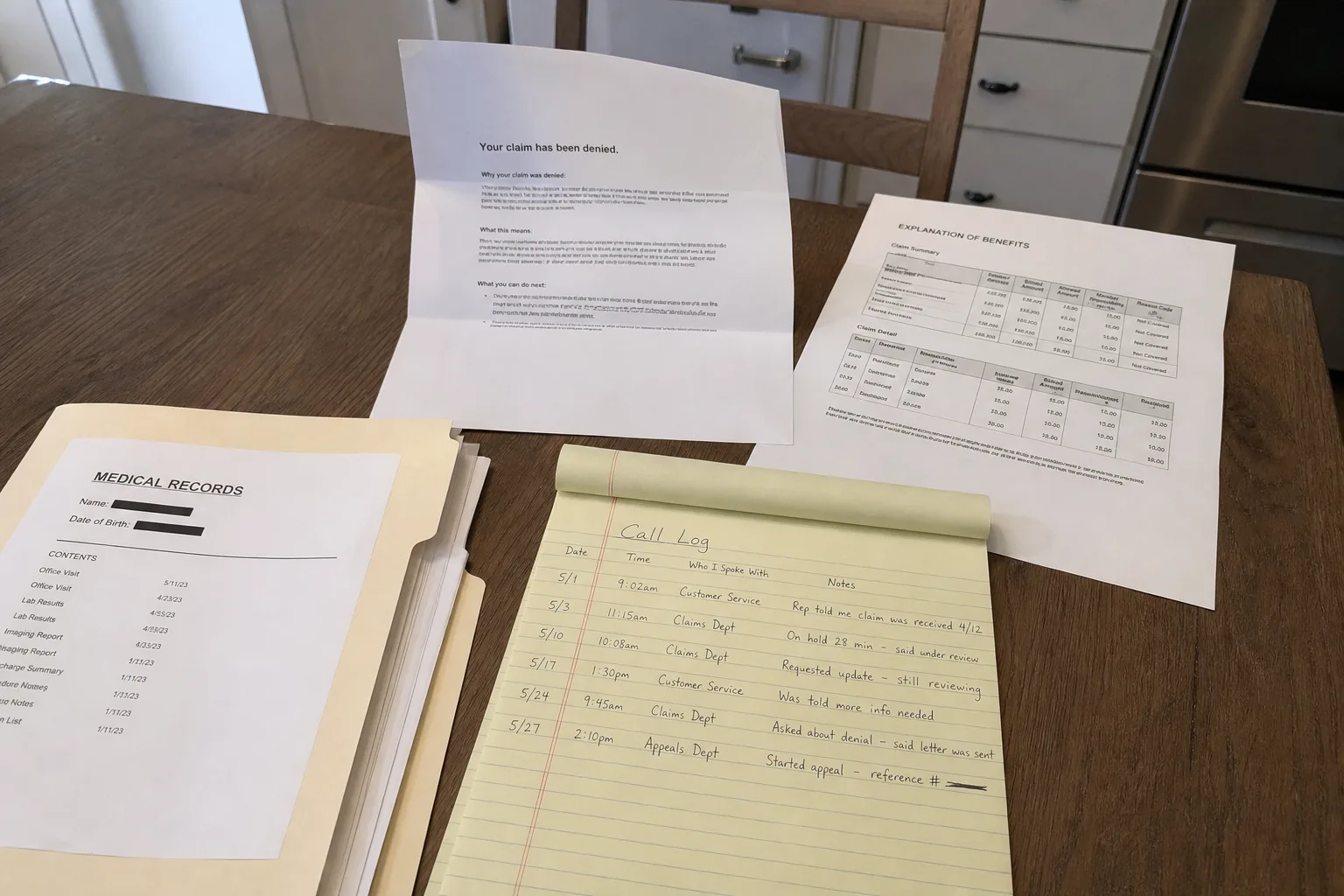
Add one more thing that is not a document: a one-page log. Date, who you spoke to, reference number, what they said, what they promised. Keep it in the front of the folder. When a deadline is later disputed, the log is what settles it.
The order, and the clocks attached to each step
Sequence matters because external review is generally only available after internal appeals are exhausted. Skip a step and the independent reviewer sends you back.
- Days one to three: read the denial, compare it to the explanation of benefits, call the billing office. If it is a coding or network problem, stop here and let them resubmit.
- Week one: request the claim file in writing. Do this even while the billing office works, because it takes time to arrive and you want it before you write.
- Weeks one to two: if care is urgent or ongoing, ask the treating physician's office to request a peer-to-peer review. This runs in parallel and does not replace the written appeal.
- Before the stated deadline: file the internal appeal. Short cover letter, numbered attachments, one clear statement of what you want the plan to do.
- After an upheld denial: file for external review within the window given in the second letter. That window is often shorter than the first one.
Two dates govern everything: the insurer's deadline for your appeal, and the plan's deadline to respond to you. Write both on the folder in marker. Missed response deadlines on the insurer's side are themselves grounds for escalation.
None of this requires an attorney for a first attempt, and most of it requires no specialist knowledge at all. It requires knowing which of four doors you are standing in front of, getting the file the decision was made from, and keeping a record of every contact. People who do those three things overturn denials regularly, and they do it with a manila folder and a legal pad.
Tobias Renfrew
Tobias covers complaints, claims, and the paths open once something has gone wrong.