Commerce
Quoted a Low Pick Fee? Where the Rest of a Fulfillment Invoice Comes From
A fulfillment quote prices a narrow slice of the work. Here is what sits outside it, which rules actually bind, and how to test a rate card before you sign.
- Words
- 1,374
- Written by
- Grant Weatherby
- Filed
The quote that arrives from a third-party logistics provider is usually one page, sometimes two, and it is built to be read in under a minute. A per-order pick fee. A per-additional-item fee. A storage rate per pallet or per bin per month. A receiving rate. Somewhere near the bottom, a line that says shipping is billed at cost plus a percentage, or at the provider's negotiated rates. That page is accurate. It is also incomplete, and the incompleteness is structural rather than dishonest: the quote prices the labor the warehouse controls, while most of what you end up paying is determined by parcel carriers, by the shape of your orders, and by exceptions nobody can forecast from a spreadsheet.
What has moved in the last few years is not the pick fee. It is everything attached to the parcel. Carriers have reworked surcharge tables more often, extended peak-season charges across longer windows, and tightened the rules on how a billable weight gets calculated. A rate card signed on the old assumptions produces a different invoice now. If you are comparing providers this quarter, the comparison that matters is not which pick fee is lower.
The quote prices the warehouse, not the shipment
Break a fulfillment invoice into its parts and you typically find four buckets: inbound receiving, storage, outbound labor, and transportation. The quote covers the first three in detail because they are measurable and repeatable. The fourth is where the money goes.
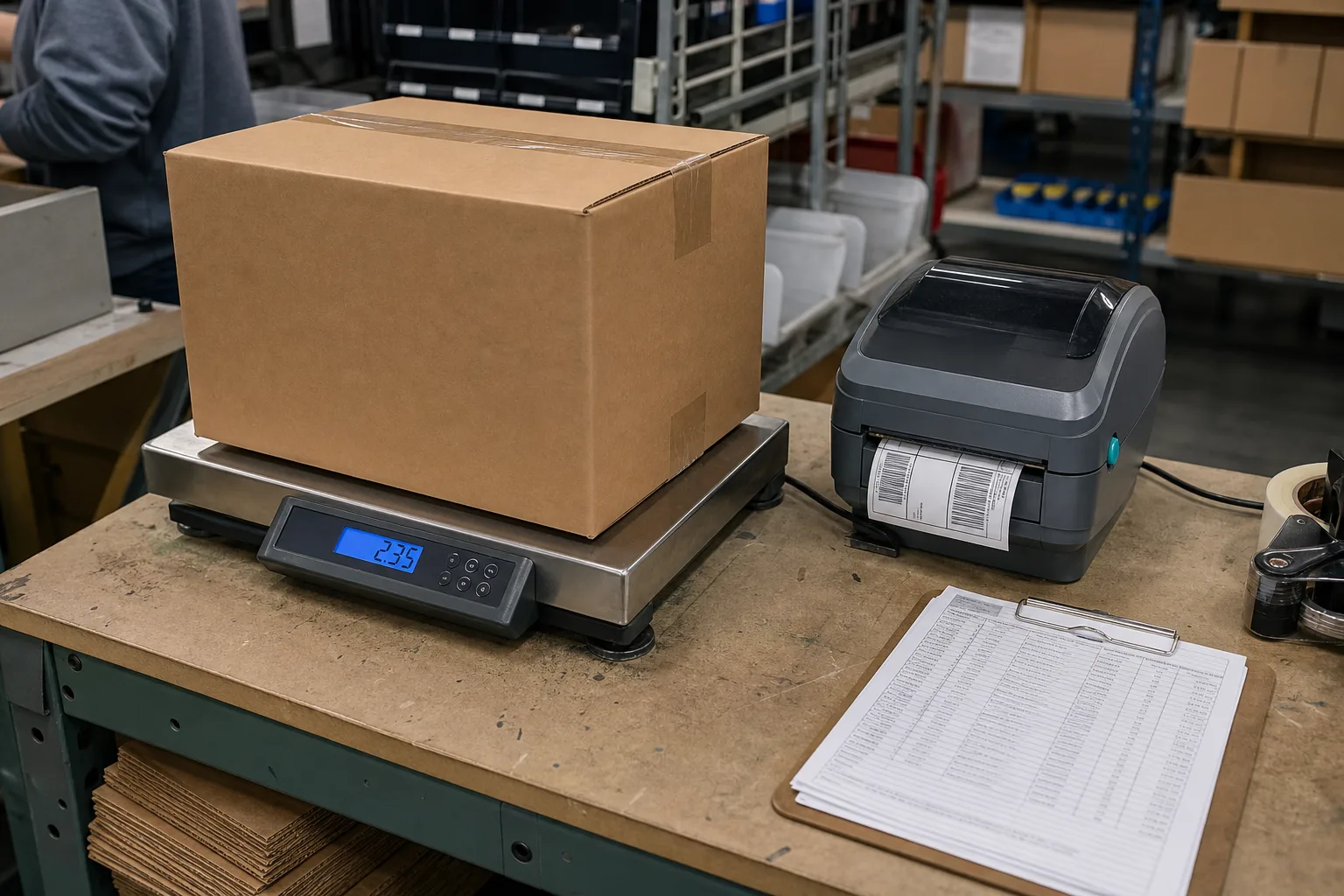
Transportation is billed on billable weight, which is the greater of actual weight and dimensional weight. Dimensional weight is the box volume divided by a divisor the carrier sets. Change the divisor and a light, bulky product gets more expensive overnight without anything about your operation changing. Most merchants who feel blindsided by a fulfillment bill were blindsided by this and not by the pick fee.
On top of billable weight sit the accessorials. Residential delivery. Delivery area surcharge, and the extended version of it. Address correction. Additional handling, which triggers on length, girth, packaging material, or weight thresholds. Large package surcharge. Fuel, applied as a percentage of the base and of many surcharges, recalculated on a schedule. Peak or demand charges applied by volume tier or by date range. None of these are hidden. They are published. They are just not on the page your provider sent you, because they are not the provider's charges to set.
The practical question to ask a prospective 3PL is narrow and answerable: for a sample of fifty real orders from my last ninety days, what would my total landed cost have been on your rate card, accessorials and fuel included? A provider who can produce that in a week is showing you how their billing works. One who cannot is telling you something too.
The extras that come from inside the building
The warehouse side has its own list, and it is more predictable once you know the names.
- Minimums. A monthly minimum spend, a minimum pick fee per order regardless of contents, or a minimum storage commitment. These decide whether a slow month is cheap or not.
- Special projects. Anything that is not pick, pack, ship. Kitting, bundling, relabeling, inserting a promotional card, applying a country-of-origin sticker, repacking a damaged case. Usually billed hourly, often with a one-hour minimum per request.
- Receiving that does not match the ASN. Unlabeled cartons, mixed SKUs on a pallet, a container that arrives floor-loaded instead of palletized. The receiving rate on the quote assumes a clean inbound. The exception rate assumes it is not.
- Returns. A per-return processing fee is standard. What varies is whether inspection, repackaging, and restocking are inside that fee or billed separately, and what happens to an item judged unsellable.
- Long-term storage. Some providers escalate storage on units aged past a threshold. If you hold seasonal inventory, this line is worth more attention than the base storage rate.
- Packaging. Boxes, void fill, tape, and labels are consumables. They may be billed at cost, at cost plus a markup, or bundled into the pick fee. Find out which.
None of this is unreasonable. A warehouse that absorbs unlimited exceptions into a flat rate is either mispricing you or mispricing someone else to cover you. The useful posture is to assume every exception has a price and ask what it is before you need it.
The rules and protections that actually apply
Fulfillment sits in a gap between several legal regimes, and knowing which one covers what changes how you negotiate.
Your obligation to the end customer is yours alone. The Federal Trade Commission is responsible for the rule governing merchandise ordered by mail, phone, or internet, which sets expectations around shipping within the time you promised and around what you owe a buyer when you cannot meet it. Your 3PL's service level agreement does not transfer that obligation. It only gives you a contractual remedy against the provider if they miss. Read the SLA for what the remedy actually is: a credit against the fee for the late order is common, and it will never cover the refund you issue downstream. If same-day cutoffs matter to your promise page, pin the cutoff time, the holiday schedule, and the exception for carrier pickup failures into the contract.
Goods held in a warehouse are a bailment, governed in most states by Article 7 of the Uniform Commercial Code as adopted locally. The warehouse receipt and the contract terms set the liability limit, and that limit is usually expressed per pound or per package, not per invoice value. A provider who loses a pallet of high-value small goods may owe you a fraction of what the pallet was worth. If your cost per pound is high, either negotiate a declared value or carry your own inventory coverage and confirm it names goods in the care of a third party.
Transportation liability is separate again, set by the carrier's contract of carriage, with its own declared value limits, exclusions, and filing deadlines for claims. A lost parcel claim is a carrier process. Find out who files it, how long they have, and whether the credit comes back to you automatically or only if you ask.
Then the exit terms. Inventory is leverage. The clause that governs notice period, final invoice, outbound transfer fees, and the provider's lien on your goods for unpaid charges decides how hard it is to leave. Negotiate that at signing, when both sides are agreeable, rather than at the point you want out.
How to read a quote so the invoice matches it
Three moves do most of the work.
First, run your real order profile through the rate card before you sign, including the long tail. Average order value hides the orders that cost you money: the single lightweight item shipped residential across the country, the oversized item that trips additional handling, the order with eight line items that eats pick fees.
Second, ask for a glossary of every billing code that can appear on an invoice, not just the ones on the quote. A provider's billing system has a finite list. Request it. Then ask which codes appeared on the average account last quarter.
Third, build a shadow calculation for the first ninety days. Take the invoice, break it into buckets, and compare each against what the quote implied. The gap is the real rate, and it is almost always the transportation and exception buckets that move. Ninety days of that gives you a number you can plan against and a basis for a sharper conversation at renewal.
Providers who are confident in their pricing tend to welcome this. The ones who build clean onboarding processes do it because surprise invoices generate churn, and churn is expensive on their side too. A merchant who arrives with a sample order file and a list of questions is easier to serve than one who arrives with an assumption.
The pick fee is the number that gets compared across three quotes on a Tuesday afternoon. It is also the smallest variable in play. Spend the extra week on billable weight, the accessorial list, the liability limit, and the exit clause, and the quote you sign becomes something close to the bill you get.
Grant Weatherby
Grant writes about what has changed lately and what it means.