Education
Training in One State, Working in Another? How to Price the Route Before You Enroll
Tuition is the easiest number in a training decision and the least useful. Here is how to build the full demand in hours and dollars, and how state rules change it.
- Words
- 989
- Written by
- Tobias Renfrew
- Filed
The tuition figure on a program page is the one number a school controls completely. Almost everything else that will cost you (required clock hours, supervised practice, the state exam, the license itself, the months you cannot work full time) is set by a licensing board, a county health department, or a union-affiliated apprenticeship committee. Those bodies do not publish on the school's website. When a student calls me angry about a program, the complaint is rarely that the school lied. It is that the school answered the question it was asked and nobody asked the harder one.
So ask the harder one first, before you sign an enrollment agreement that is difficult to unwind.
Get the board's number before you get the school's
Every licensed occupation has a government body that defines the minimum: hours of instruction, hours of supervised or on-the-job work, the exam, and the application. Cosmetology, HVAC, electrical, practical nursing, real estate, massage therapy, insurance adjusting. The requirement is a published rule, and it is almost always available from the state agency without talking to anyone.
Pull that rule yourself. Write down four things: total required hours, how many must be classroom versus supervised field work, the exam provider, and whether the state recognizes training completed elsewhere. Then compare it to what the school tells you.
A good program hands you this comparison unprompted. The admissions conversation includes a sentence like "the board requires this many hours, our program delivers that many, and the gap is covered by the externship." A barely adequate program describes its own curriculum in its own units and leaves you to do the arithmetic. Neither one is breaking a rule. Only one of them is telling you what you are buying.
The cost sheet nobody builds for you
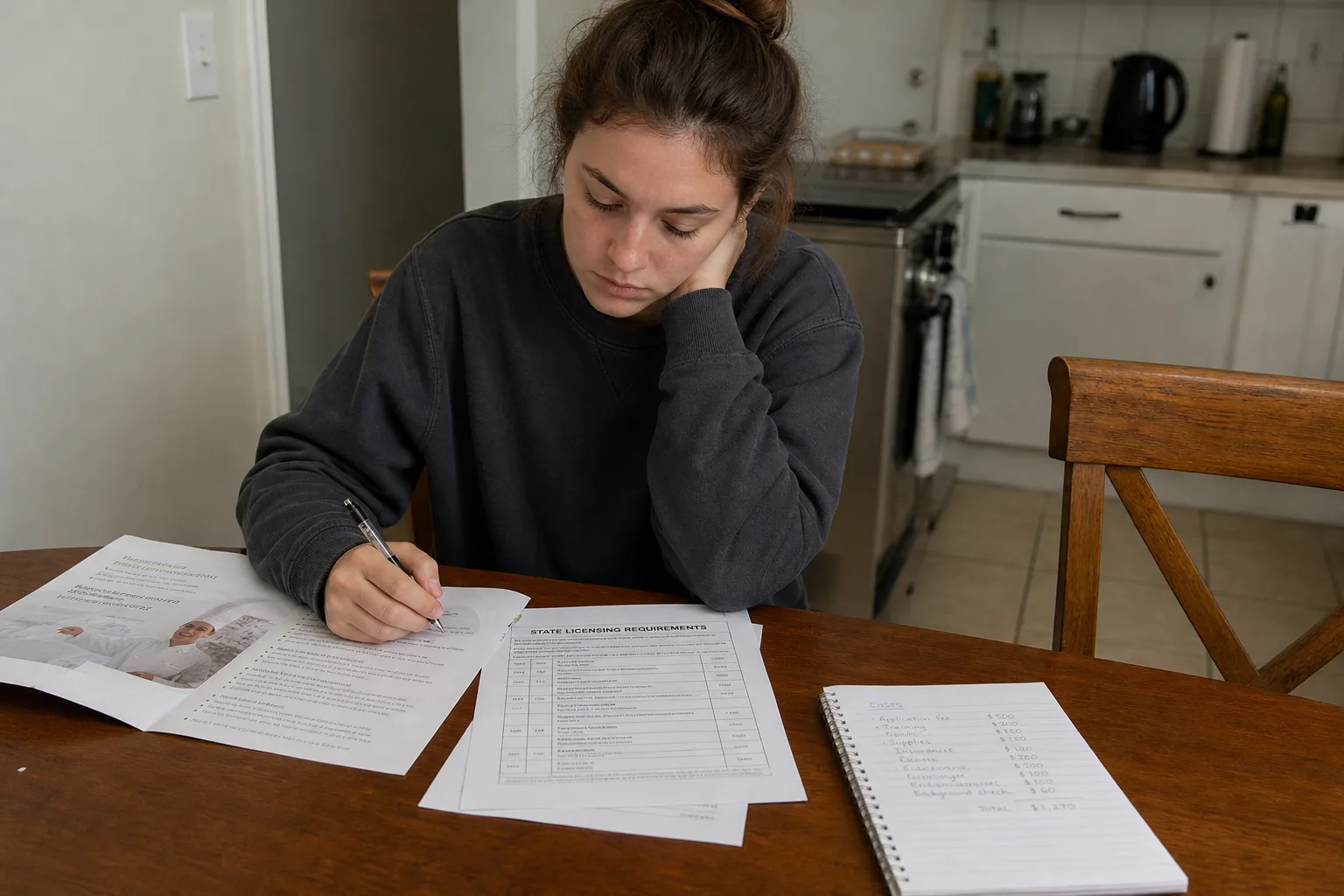
Tuition is the headline. The rest tends to arrive in sequence, and each piece is defensible on its own:
- Books, tools, kit, uniforms. Sometimes bundled, sometimes a separate invoice in week two.
- Background check and fingerprinting, often required before a clinical or field placement.
- The exam fee, paid to a testing vendor, not the school. Retakes are extra.
- The license application fee, paid to the state.
- The first renewal, which can land within a year of licensure in some states.
- Continuing education before that first renewal.
Then the expensive one: the hours you are not earning. If the route requires 600 hours of supervised practice and the placement runs weekday daytime, the real price includes the shifts you give up. For apprenticeships the arithmetic flips, because the on-the-job hours are paid, but the classroom hours usually are not and the wage starts low. The Department of Labor oversees the registered apprenticeship system, and programs inside it follow a published wage progression tied to hours completed. That schedule is worth reading before you choose between the two routes, because it tells you what the middle years look like, not just the end.
Add it all up on one page. A good school will sit with you and fill in the lines it knows and say plainly which lines it does not control. That sentence, "we don't set that fee, here is who does," is a reliable signal.
Where the state line changes the answer
This is the part that produces the disputes I see most often. A student trains in one state, moves for a job or a spouse, and discovers the hours do not transfer cleanly.
Required hour totals for the same occupation can differ substantially between neighboring states. Some states accept out-of-state training hour for hour. Some grant a license by endorsement if you held an active license elsewhere for a set period, which means a fresh graduate who never got licensed in the training state has no endorsement path and starts over. Some require a state-specific law or jurisprudence exam on top of the national one. Some count only hours earned at a school approved by that state's board, and approval does not travel.
Local rules can narrow it further. Certain trades require a county or municipal competency card to pull permits, separate from the state license, with its own exam and its own experience documentation.
If there is any chance you will work elsewhere, ask the school two specific questions: do your graduates get licensed in neighboring states, and what documentation do you issue to prove hours? The useful answer involves a detailed transcript broken down by subject area and clock hours, signed and sealed, which is what a receiving board actually wants. A program that can only produce a certificate of completion has given you a document that proves you attended something.
Read the withdrawal terms as if you will use them
Life interrupts training more often than people expect. The enrollment agreement decides what happens then, and state law often sets a minimum refund schedule that a school cannot contract around. Those schedules are typically tiered by percentage of the program completed, and they drop fast.
Before signing, find three things in the paperwork: the refund schedule, the leave of absence policy, and the complaint procedure. A good program states which state agency licenses it and where to file, because it is required to and because it expects the question. That disclosure is also your practical remedy later. State approval agencies and attorney general consumer divisions handle complaints about schools, and a documented timeline beats a recalled conversation every time.
Keep your own copies of everything with an hour count on it: attendance records, externship logs, supervisor signatures. If a board ever questions your total, your file is the evidence.
The programs worth your money behave the same way at the start as they do in a dispute. They name the authority, show the arithmetic, and put the hours in writing in a form someone else will accept. Ask for all three in the first conversation and you will learn most of what you need to know.
Tobias Renfrew
Tobias covers complaints, claims, and the paths open once something has gone wrong.