Personal Finance
Insuring a Ring? Five Checks That Separate a Usable Appraisal From a Worthless One
An appraisal is a dated opinion written for one purpose. Here is how to tell whether yours will actually support a claim, and when to ask the carrier for an update.
- Words
- 1,004
- Written by
- Alma Sandoval
- Filed
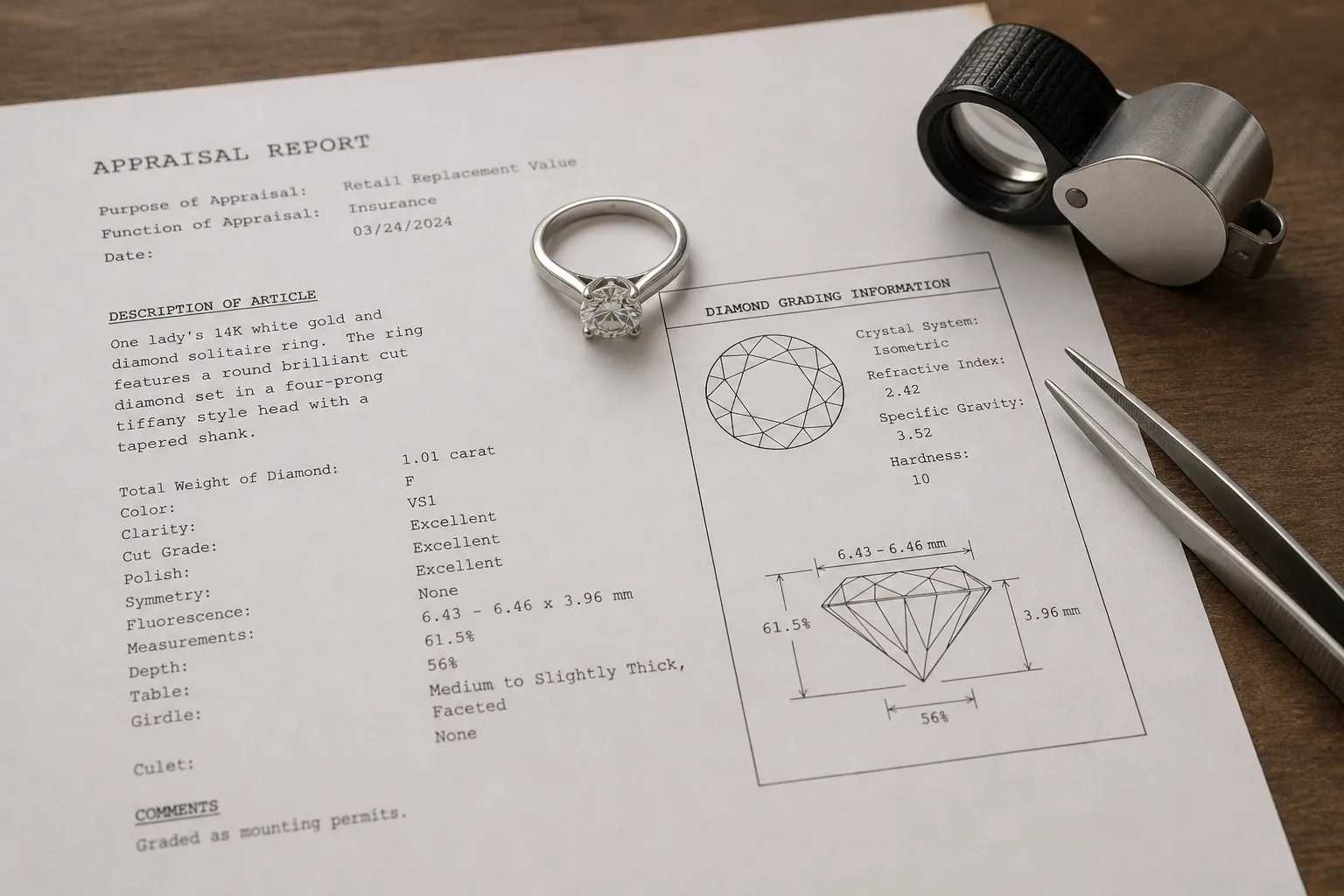
The document in your safe deposit box has a number on it, a signature, and a date. Only one of those three is doing serious work when you file a claim, and it is not the number. Appraisals are opinions written for a stated purpose on a stated day, and the gap between a good one and a barely adequate one shows up at exactly the moment you cannot fix it. The useful time to look is now, while you still have something to ask for.
1. Check which purpose the appraisal was written for
An appraisal is not a universal valuation. It is prepared for a defined use: retail replacement value, fair market value for an estate or a charitable deduction, or liquidation value for a divorce settlement. Those numbers can differ by a wide margin on the identical ring, and they are supposed to. Retail replacement answers what a comparable item would cost to buy today from a comparable source. Fair market value answers what a willing buyer would pay a willing seller.
Insurers want the first one. If your document says fair market value, or says nothing at all about intended use, you have a piece of paper that an underwriter may accept at binding and a claims examiner may question later. The fix is cheap at the front end. Ask the appraiser to state the intended use and the definition of value in plain language on the face of the report, and ask your agent to confirm that language is what the policy contemplates before you pay the first premium on the schedule.
2. Check who signed it, and what sat behind the signature
This is where the size of the provider starts to matter, and not in the direction people assume. A sole appraiser who holds a graduate gemologist credential and carries an accredited designation can do outstanding work. A large firm with multiple staff appraisers, an in-house lab, and documented peer review offers something different: continuity. If the appraisal is challenged in four years, somebody is still there to answer the phone, the work file still exists, and the methodology is institutional rather than personal.
Ask the organization directly whether the report will be reviewed by a second appraiser, whether the work file is retained and for how long, and whether the person doing the grading is the person signing. At a large operation those questions have crisp answers because the workflow is written down. At a counter inside a store that also sells jewelry, the answer is often that the appraiser works on the sales floor, which creates an obvious tension about the number. The Federal Trade Commission is responsible for how jewelry is described and advertised to consumers, and the same descriptive discipline it expects at the point of sale is what you want in the report: specific, documented, and not inflated to flatter the buyer.
3. Check the date, because that is the part that expires
Nothing about a diamond changes in six years. What changes is the market the replacement would be bought in: metal prices, labor, the availability of a comparable stone, the retail structure that sets the price of a new one. The appraisal states a value as of a specific day. Carriers typically expect scheduled items to be revalued on a cycle, often every two to five years depending on the item and the company, and some will prompt you while others will quietly let the old figure ride.
Letting it ride has two failure modes. If values have risen, you are insured for less than the item costs to replace, and you paid premiums the whole time on a number you now resent. If values have fallen, you have been overpaying for coverage that will settle at actual replacement cost anyway. Either way, the party with the stale information is you.
4. Check how the policy pays, not just what it says the item is worth
A scheduled item usually carries no deductible and covers mysterious disappearance, which a general homeowners policy often does not. Within scheduling, there is a further split worth asking about: an agreed value endorsement commits the insurer to pay the scheduled amount, while a replacement cost approach commits it to replace the item or pay what replacement actually costs, which can be less than the schedule.
Ask the question in those terms. If the ring is scheduled at a figure and the carrier can source an equivalent for less, what do you receive? Ask whether you may choose your own replacement vendor or whether the insurer directs the purchase. Ask whether a settlement in cash is available and at what percentage. Large carriers and specialty valuables insurers have written answers to all of this, and the answers differ between them.
5. Check what the carrier will do for you before you pay for it yourself
Here is the leverage. A carrier writing a meaningful schedule has an interest in accurate values, and several of the larger specialty insurers will arrange or subsidize a periodic revaluation, accept an update letter rather than a full new report for items under a stated threshold, or waive the requirement entirely below a certain insured amount. None of that is advertised. It surfaces when you call and ask what the company's revaluation requirement is, and whether it offers any support in meeting it.
Ask at renewal, when the account is in front of someone. Ask the appraisal firm the parallel question: whether it offers a reduced fee for updating a report it originally wrote, since the grading work is already in the file and only the market research is new. Both answers are frequently yes, and both are only available to the person who asks.
Pull the report out and look at the date line first. If it is older than your carrier's cycle, you have a specific, bounded errand with two phone calls in it, and the better version of the document costs less than the first one did.
Alma Sandoval
Alma writes about the parts of a deal that are still open.