Education
Four Routes Into a Technical Credential, and the Paperwork Each One Asks for First
Career and technical programs differ less in what they teach than in how they bill, how they count hours, and which documents stall your start date.
- Words
- 1,283
- Written by
- Grant Weatherby
- Filed
The people who place students into career and technical programs year after year stop talking about curriculum fairly quickly. They have seen the same four or five routes produce the same qualified graduates. What separates a smooth enrollment from one that loses a semester is almost never the instruction. It is the clock-hour accounting, the billing cycle, and the single document that nobody mentioned until the week before class started.
Below is the comparison a seasoned coordinator would draw on a napkin: what each route costs in calendar time, where the money actually goes, and the paperwork gate that decides whether you start this term or the next one.
The four routes, side by side
Most technical credentials in the United States are reached by one of four paths. They overlap, and plenty of people use two in sequence.
| Route | Time shape | Where the money goes | First paperwork gate |
|---|---|---|---|
| Community college certificate or associate degree | Two semesters to two academic years, with a fixed start calendar | Tuition per credit, lab and shop fees, tools, books | Admissions application plus federal aid form |
| Private or proprietary career school | Continuous enrollment, often measured in clock hours rather than semesters | Program-price tuition, usually inclusive of a tool kit and exam voucher | Enrollment agreement and state licensure disclosures |
| Registered apprenticeship | Multi-year, earning throughout, with related classroom instruction alongside | Employer and sponsor carry most of the instruction cost; you supply tools and time | Sponsor application, aptitude screen, employer sign-on |
| Employer-sponsored or industry credential | Weeks to months, scheduled around work | Exam fees, prep materials, sometimes reimbursed after you pass | Eligibility attestation and documented work experience |
Notice what the table does not contain: a winner. The classroom route buys you a transcript that transfers and a financial aid system built to support it. The apprenticeship buys you wages from week one and a sponsor who has an interest in your completion. The private school buys speed and a single price. The industry credential buys recognition for work you have already done.
Time is the cost people underestimate
Tuition is the number on the page. The expensive variable is the calendar, and it behaves differently in each route.
A credit-hour program runs on a semester calendar. Miss the registration window and the next entry point may be four months out. That is four months of not earning at the credentialed rate, which for most trades dwarfs the tuition difference between any two schools on the list.
A clock-hour program measures attendance, not coursework. Hours are logged, audited, and reported, and absences do not quietly disappear into a grade average: they extend your completion date and sometimes your bill. Anyone who has run these programs will tell you the attendance log is the single most consequential document in the building.
Apprenticeship runs on the longest calendar and the lowest cash outlay. The Department of Labor oversees the registered apprenticeship system, including the standards sponsors follow and the records of on-the-job hours and related instruction that back a completion certificate. Those hour records are the asset. Treat them the way you would treat a title to a vehicle.
Industry credentials are the fastest and the most conditional. The exam is short. Qualifying to sit for it is the part that takes months, because it usually requires documented experience signed by someone who supervised you. If you left that employer three years ago and never collected a letter, you are now doing detective work.
The folder: documents that get reused across every route
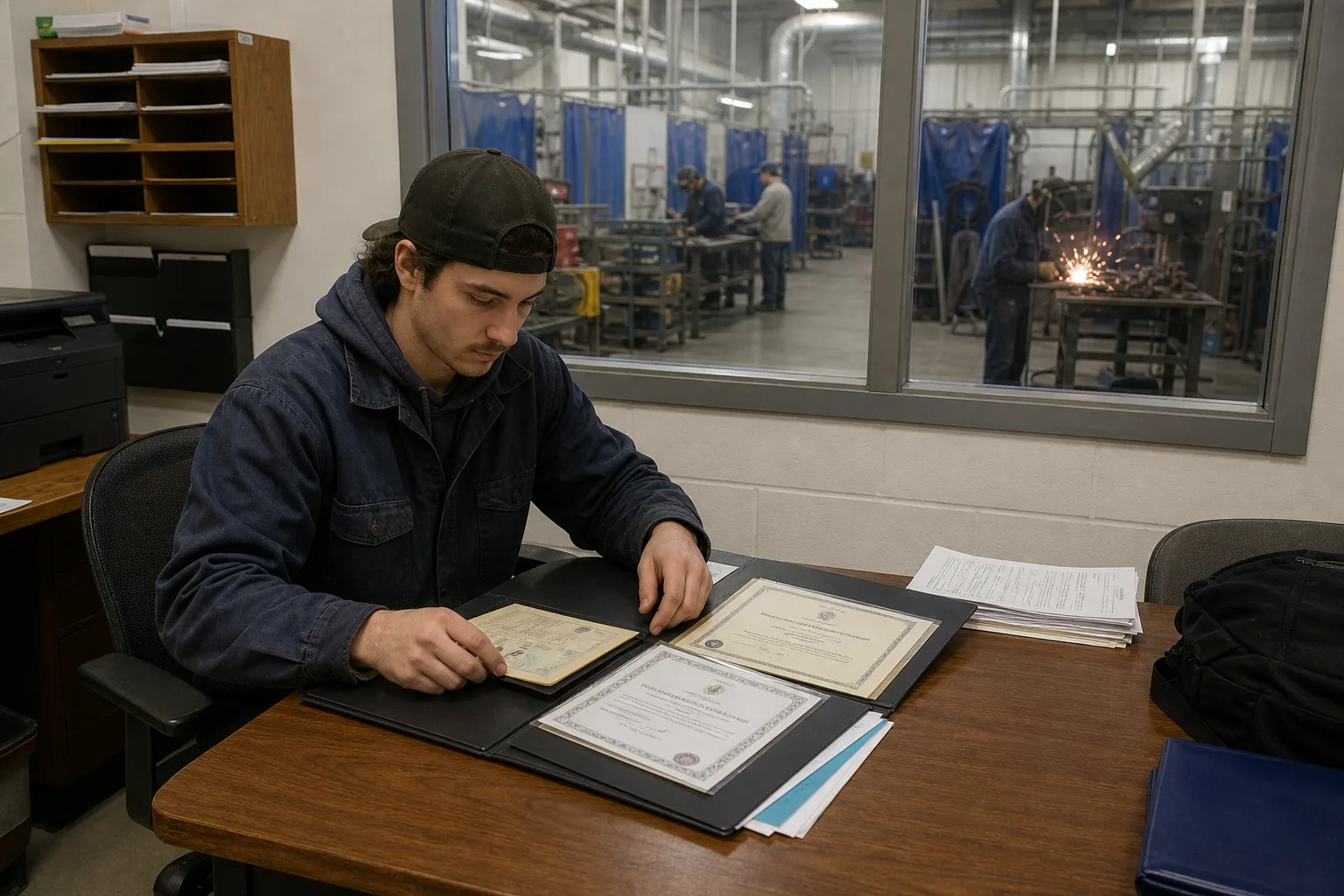
People who have shepherded hundreds of enrollments keep a standing list, because the same items are requested over and over in slightly different formats. Assemble these once, scan them, and store them somewhere you can reach from a phone.
- Proof of high school completion or equivalency. The actual transcript or certificate, not a photo of a diploma on a wall. Order a spare copy now; districts can be slow.
- Government photo identification and Social Security card. Needed for aid, for apprenticeship registration, and for most testing centers.
- Prior college transcripts, including the course you dropped in 2016. Partial records trip aid eligibility more often than low grades do.
- Tax return and income documentation for the relevant aid year. The federal aid form now pulls IRS data directly for most filers, but you still need to know which year applies and who counts as a contributor.
- Employment history with dates and supervisor contacts. This is what turns into the experience attestation for an industry exam.
- Existing licenses, cards and certifications with expiration dates. Safety cards, driver's license endorsements, anything with a renewal clock.
- Immunization or physical records if the program places you in a clinical or industrial setting.
The second half of the folder is financial: the enrollment agreement, the published cost sheet, every receipt, and any written statement about what the program price includes. If a tool kit, an exam voucher or a uniform is covered, get it in the agreement rather than in a conversation.
What has shifted in the last couple of enrollment cycles
Three practical changes are worth adjusting for.
The federal aid application was rebuilt and now imports tax data from the IRS automatically for most households. That removed a long-standing source of error, and it also moved the bottleneck. The common delay now is a contributor who has not created their own federal student aid account and consented to the data transfer. Sort that out before you sit down to fill anything in, not during.
Short-term workforce programs have moved steadily toward eligibility for federal aid, which previously reached mainly longer credit-hour programs. The consequence for a prospective student is that a program you were told was cash-only two years ago may now have an aid pathway, and the only way to know is to ask the financial aid office directly about that specific program code rather than the school in general.
Verification has gone digital. Many states and national credentialing bodies now publish a license or credential lookup that employers check themselves. That cuts the time between passing an exam and being hired, and it makes the spelling of your legal name across documents genuinely important. One mismatched middle initial between a transcript, an exam registration and a license application can cost a week of phone calls.
The route most people overlook: teaching the thing you already do
Programs across the country are staffed by people who spent fifteen or twenty years in the field and crossed over. The route in is not a four-year education degree. Most states run an alternative or industry-based certification for career and technical instructors, built around documented work experience and a verified credential in the occupation, with coursework in instruction completed alongside the first year or two of teaching.
The time and money profile is unusual: low tuition, substantial unpaid preparation in the first year, and an immediate paycheck from the district. The paperwork is heavier than any other route on this list, because it combines occupational verification, background clearance, and state certification filings that each run on their own timeline. Organizations that support mid-career entrants into cte training roles exist specifically to sequence those filings, and using one is the difference between starting in August and starting the following August.
For a tradesperson weighing it, the honest comparison is this: you trade peak field earnings for a stable calendar, benefits, and summers, and your existing license becomes the qualification rather than something you have to earn again.
Pick the route that matches the calendar you can actually hold to, then spend an evening building the folder before you contact anyone. Every coordinator you deal with afterward will move faster, because for once the documents will already be in order.
Grant Weatherby
Grant writes about what has changed lately and what it means.