Commerce
Packed the Boxes Yourself? Where a Damaged Goods Claim Actually Gets Decided
A household move, two broken items, and two completely different outcomes. The split came down to who packed the carton and which valuation box got checked at booking.
- Words
- 1,212
- Written by
- Tobias Renfrew
- Filed
A two-bedroom move from Ohio to North Carolina produced exactly two damage claims. A dining table with a cracked leg joint, and a carton of glassware that rattled when the driver set it down. Same truck, same crew, same day. One claim paid something close to what replacement cost. The other paid an amount the household described as insulting. The difference had nothing to do with how badly each item was broken. It was settled weeks earlier, by a checkbox on the estimate and by who taped the carton shut.
This is the part of a move that nobody reads until the truck is already unloaded. It is also the part that is entirely within a household's control, and the rules governing it are federal, published, and unusually specific.
The two items, and why they were treated differently
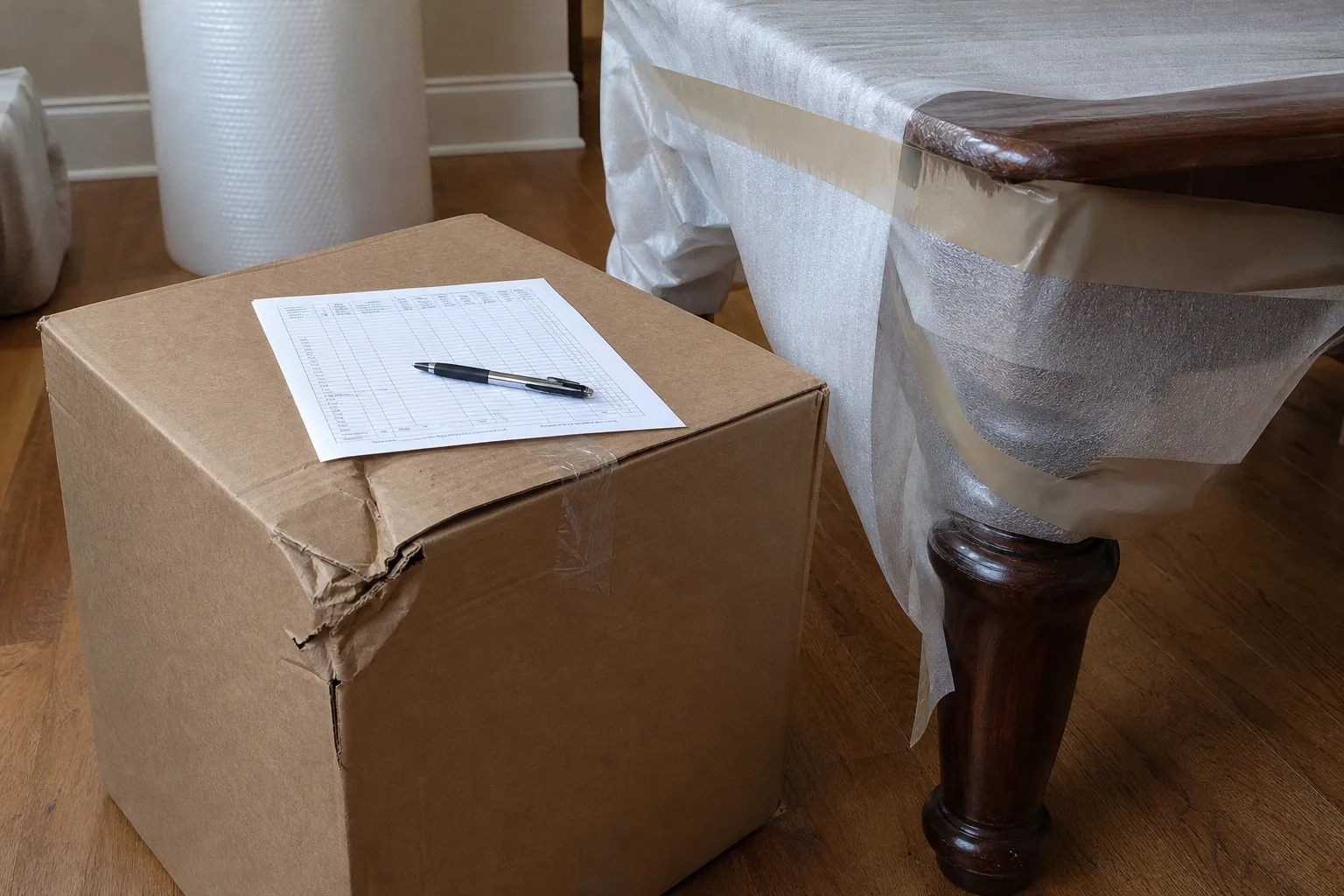
The glassware was packed by the household. Newspaper, a liquor store box, good intentions. On the mover's inventory it was marked PBO: packed by owner. The table was disassembled and wrapped by the crew on load day, and the inventory recorded it as the carrier's work.
Interstate household goods carriers are regulated by the Federal Motor Carrier Safety Administration, which is responsible for the rules that govern estimates, valuation, inventories and the claims process on moves that cross a state line. Under those rules a carrier is liable for loss or damage it causes. A carton the carrier never opened, inspected or packed is a different proposition. The standard position across the industry is that a PBO carton gets paid only where there is visible external damage to the box itself, because otherwise the carrier has no way to know whether the glasses were wrapped properly or wrapped at all.
The liquor store box arrived with no crush, no puncture, no water staining. Nothing on the outside suggested the truck had done anything to it. The claim on the glassware went nowhere, and the reason given was the one written into the paperwork the household had signed.
The table was different. The crew had wrapped it, loaded it, and recorded its condition on the inventory at origin. The damage was new. That claim was straightforward on liability. What it was not straightforward on was amount.
Released value and full value protection are not close to each other
Every interstate mover must offer two levels of liability, and the household picks one at booking. The default, if nothing is selected, is released value protection. It is free, and it pays by weight: 60 cents per pound per article. That is the federal minimum, and it is what you get if you let the form default.
Run the arithmetic on a solid wood dining table. If the table weighs 90 pounds, released value protection produces a settlement of $54. Not $54 toward a repair. $54, full stop, on a table that would cost well into four figures to replace. The number is not a mistake and it is not a lowball offer. It is the contract the household agreed to.
The alternative is full value protection, which costs extra and is priced against the declared value of the shipment. Under full value, the carrier may repair the item, replace it with something of like kind and quality, or pay the cash amount needed to do one of those things. The carrier usually gets to choose which. Deductible options are available and lower the premium.
The Ohio household had taken full value protection, almost by accident, because the salesperson walked through it on the phone. That single decision is why the table claim produced a repair paid by the carrier rather than a check for the price of a tank of gas.
One thing worth knowing about high-value items
Full value protection has a carve-out. Items of extraordinary value, typically defined as worth more than $100 per pound, generally need to be listed on a high-value inventory form before the truck leaves. Jewelry, a camera body, a signed print, a small rug worth more than it weighs. Unlisted, those items fall back to a much lower limit no matter what coverage was purchased. Listing them takes five minutes at origin and preserves the coverage already paid for.
The delivery paperwork is the evidence, and it is created in ten minutes
At delivery the driver hands over the inventory and asks for a signature next to each numbered item. This is not a formality. It is the document a claims examiner reads first, and in most disputes it is the only contemporaneous record of what condition the goods were in when they came off the truck.
The household's instinct is to sign everything and let the crew leave. Resist it. Note exceptions on the inventory itself, in the space provided, before signing. Write what you see: carton crushed on one side, table leg split at the joint, water staining on the bottom of box 41. Keep your copy. A signed clean inventory does not make a later claim impossible, but it hands the carrier an argument you then have to work around.
Photograph the damage where it sits, before anything is moved to another room. Photograph the carton exterior as well as the contents, because on a PBO box the exterior is the whole case. Keep the box. Claims examiners ask for it more often than people expect, and it is routinely thrown out on day one.
The clock the carrier runs on, and the one you run on
Federal rules on interstate moves give a household nine months from the delivery date to file a written claim. That is generous compared with most consumer deadlines, and it is also longer than it feels, because the items that turn up broken are often the ones unpacked in month three.
Once the claim is filed, the carrier must acknowledge receipt within 30 days and must, within 120 days, either pay it, deny it, or explain in writing why it needs more time. Those duties are not courtesies. They are obligations attached to the operating authority the carrier holds, and a written claim that cites the delivery date, the inventory item numbers and the valuation elected is noticeably harder to let sit.
File in writing even if a phone call seems to be going well. Include the inventory numbers, photographs, the repair estimate or replacement cost, and a clear statement of what you want. Keep it factual. Claims examiners handle volume, and a short, documented, well-numbered claim moves faster than a long one.
What the household would do differently
Everything that went wrong in that move went wrong at the start. The glassware got packed into a liquor store box to save money on cartons, and that decision quietly shifted the entire risk on that box onto the household. It is a legitimate trade. Self-packing genuinely does cut the bill. It just needs to be made knowingly, and applied to the pillows and the paperbacks rather than to the stemware.
The table, by contrast, came out well, because a valuation decision made in under a minute on a booking call held up months later against a real loss. The protections exist, they are written down, and the household that reads the estimate before signing it gets the benefit of them.
Tobias Renfrew
Tobias covers complaints, claims, and the paths open once something has gone wrong.