Health
Three Bills for One Visit? How to Read Each Line Before You Pay Any of Them
A hospital summary statement is not a bill you can check. Here is what a careful line-by-line review looks like, and the weekly rhythm that makes it work.
- Words
- 1,036
- Written by
- Tobias Renfrew
- Filed
The document that arrives first is almost never the one you can check. It says something like "Hospital Services" and gives a number. Maybe it breaks that number into four categories: room, pharmacy, supplies, other. That is a summary statement, and a summary statement is designed to be paid, not audited. A person who pays it has not done anything wrong. They have simply skipped the only step where money is ever recovered.
The gap between a barely adequate review and a good one is not intelligence or persistence in the abstract. It is whether you obtained the underlying detail, whether you laid it next to what your insurer said, and whether you handled the whole thing as a recurring half hour rather than a single frustrated evening.
Ask for the itemized statement, and know what you are asking for
Call the billing number and request an itemized statement with procedure codes, dates of service, and units. Those three words matter. An "itemized" bill that lists departments is not itemized. What you want shows each charge with a CPT or HCPCS code, a revenue code if it is a facility bill, the date the service was rendered, and how many times it was billed.
Expect to ask twice. The first request often produces the same summary in a different font. When you call back, use the specific language: line-level detail with codes and units. Get the name of the person you spoke with and a reference number for the call. Write both down. This is the moment most reviews quietly end, and it is the moment that decides everything after it.
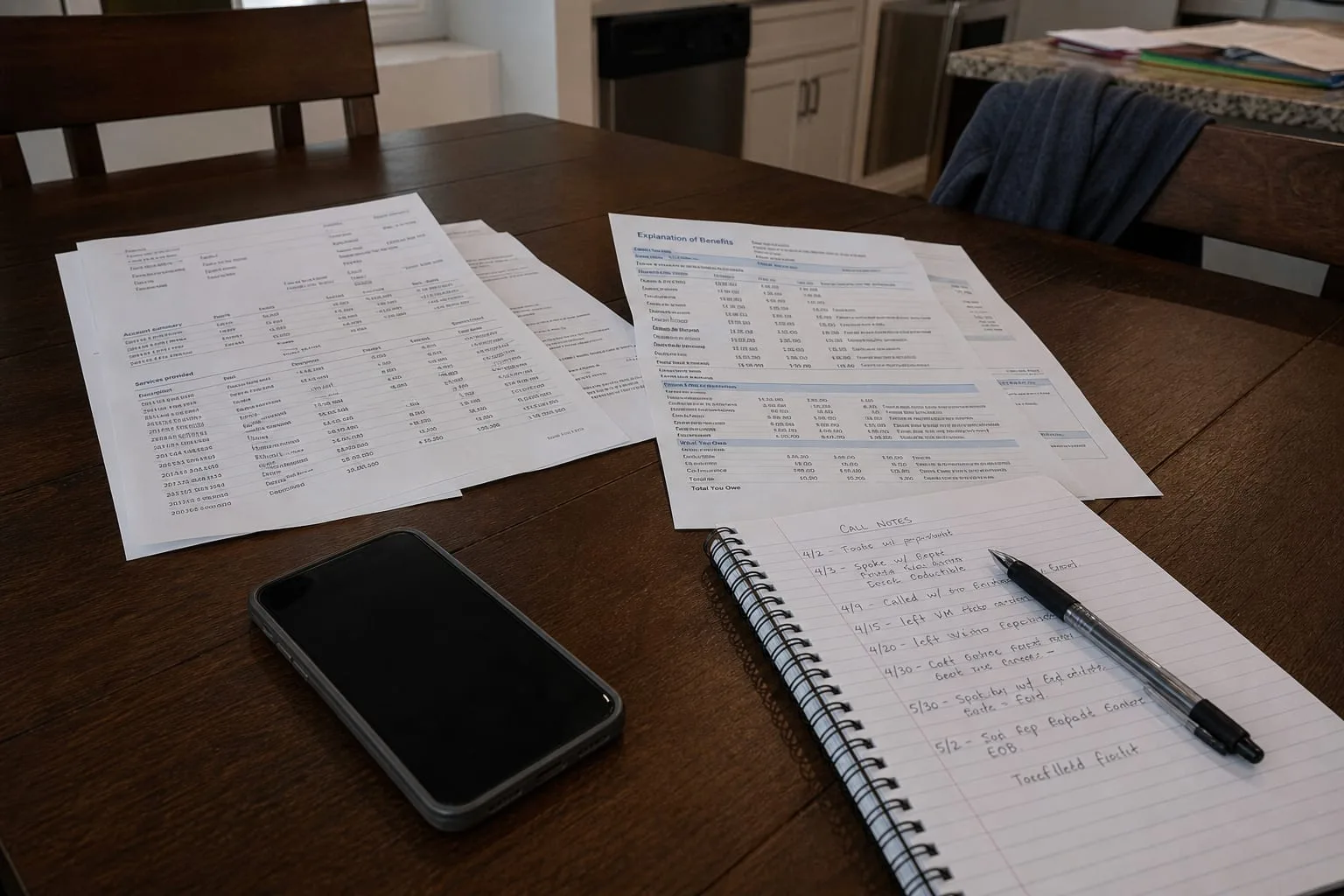
Then wait for the insurer's explanation of benefits. The EOB is not a bill. It is the insurer's account of the same event: what was charged, what the plan allowed, what it paid, what it assigned to you and why. A hospital bill read on its own tells you very little. Read against the EOB, it tells you almost everything.
What a line-by-line pass actually looks for
Sit with both documents and work down the itemized statement one line at a time. You are looking for a short list of specific things, not for a feeling that something is off.
- Dates that do not match the visit. A charge dated the day before you arrived, or two days after discharge, needs an explanation.
- Units and quantities. One dose billed as ten. Ninety minutes of a service in a visit that lasted forty. Quantity errors are the most common recoverable mistake and the easiest to see.
- Duplicates. The same code on the same date twice, with no modifier explaining why.
- Things that did not happen. A medication you declined. A test that was ordered and canceled. Equipment charged for a room you were never in.
- Charges the EOB does not show. If a line appears on the hospital bill but never reached your insurer, it was not adjudicated. You should not be paying plan-network rates on it, or possibly anything.
- Denials with a reason code. The EOB will say why a line was denied. "No prior authorization" and "not medically necessary" and "filed after the deadline" are three completely different problems, and two of them are usually not yours to pay.
You will also find that one visit generated several bills. The facility bills for the room, the equipment, the drugs. The physician bills separately for their professional time. Radiology, pathology, and anesthesia often bill from their own entities. That is normal. What is worth checking is whether each of those separate bills matches a corresponding line on your EOB, and whether any of them came from a provider outside your network when you had no practical ability to choose. Federal surprise billing protections cover a meaningful share of those situations, and the balance-billed amount is frequently the first thing to disappear once you name the problem.
The week-to-week reality
Disputes are not resolved in a phone call. They are resolved across billing cycles, and billing cycles are monthly. A corrected claim goes back to the insurer, the insurer reprocesses, a new EOB issues, the provider posts the adjustment, and a revised statement prints. Four steps, each on its own calendar. Six to ten weeks is ordinary.
What makes this survivable is treating it as a standing appointment. One folder, paper or digital. Every statement, EOB, and letter goes in it with the date received written on top. Once a week, twenty minutes: open the folder, look at what arrived, make the one call that is due, log it.
The log is the part people skip and later wish they had not. Date, number dialed, name, what was said, what they committed to, reference number. When a bill goes to collections eight months later because someone never applied an adjustment they promised, that log is the difference between an argument and a file.
Put everything material in writing too. Call to start, then follow with a short letter or portal message stating the specific lines you dispute and why. Ask them to hold collection activity while the account is under review, which most providers will do and many are required to do. The Consumer Financial Protection Bureau is responsible for how medical debt is collected and reported, and a documented, pending dispute changes what a collector can properly do with the account.
The two questions to ask before you pay the remainder
Once the errors are out, some real balance usually remains. Two more questions belong here.
First, ask for the financial assistance policy. Nonprofit hospitals maintain one, and the income thresholds are often higher than people assume. Ask specifically whether you qualify for a full or partial write-off, not whether they offer help.
Second, ask what payment plan is available at zero interest, and get the term in writing. Many providers offer one and mention it only when asked. Compare that against any card or medical credit product being suggested at the counter, where deferred interest can reprice the whole balance retroactively.
A careful review does not require expertise. It requires the itemized statement, the EOB beside it, a folder, and one standing twenty minutes a week until the numbers on the two documents agree.
Tobias Renfrew
Tobias covers complaints, claims, and the paths open once something has gone wrong.