Legal Affairs
Signing a Contingency Agreement? What the Percentage Is Actually Quoted Against
In a civil claim against an institution, the fee percentage matters less than the base it is applied to, and that base is negotiable at signing.
- Words
- 922
- Written by
- Alma Sandoval
- Filed
Two firms quote you the same number. Thirty-three and a third percent, no fee unless we win. One of those agreements will leave you with meaningfully more money than the other, and the difference has nothing to do with the percentage. It sits in a clause about what the percentage is multiplied by, and in a second clause about who carries the case expenses and when they come out.
Take a narrow case to make it concrete: a civil claim against an institution that had a duty to protect someone, a hotel, a treatment facility, a school district, a property manager. These cases run long, they involve expert witnesses and depositions, and the costs are real. That is exactly the situation where the base matters most, because the expense column is large enough to change your outcome by five figures.
Gross recovery and net recovery are not close to the same thing
A fee calculated on gross recovery takes the percentage off the top of the full settlement, and then case expenses are deducted from what remains, which is your share. A fee calculated on net recovery subtracts expenses first, then applies the percentage to the balance. Same percentage, different math, and the gap grows with every expert retained.
Run it with round numbers. On a $300,000 settlement with $40,000 in case expenses and a one-third fee: gross-basis, the firm takes $100,000 and you absorb the $40,000, leaving $160,000. Net-basis, expenses come off first, the fee is roughly $86,700, and you keep about $173,300. Thirteen thousand dollars turns on a phrase most people read once.
Neither structure is improper. Gross is common and many firms will not move off it. But you cannot evaluate a quote without knowing which one you are being handed, and the honest answer to "is thirty-three percent fair" is that the question is incomplete until the base is on the table.
The expense column is where the surprises live
Ask three questions about costs and you will learn more than a fee schedule tells you. Who advances them. Whether you owe them back if the case produces nothing. And whether the firm charges interest or an administrative markup on advanced funds.
Many firms advance all case expenses and absorb them on a loss. Some advance them and seek reimbursement regardless of outcome. Some bill copying, postage, and internal staff time as expenses rather than treating them as overhead already covered by the fee. In an institutional claim built on records, depositions, and expert testimony, those line items are not rounding errors.
Get a written estimate of the expense range for a case of this type, and ask for a threshold above which the firm will notify you before committing. A cap on expenses without your written consent is a reasonable ask and a common one. It costs the firm nothing to agree if their intentions match their pitch.
Where the rate steps up, and why that is the part to read slowly
Tiered agreements are standard. The rate might be lower if the matter resolves before a lawsuit is filed, higher once litigation begins, higher again if the case is tried, and higher still on appeal. That structure is defensible because the work genuinely escalates. The thing to check is what triggers each step and whether the trigger is something you control.
If the rate rises "upon filing," and filing is a strategic decision the firm makes, then the firm controls your fee. Ask for the trigger to be tied to an event with a date, and ask whether a settlement reached one week after filing is billed at the litigation rate. When you are interviewing a sexual assault attorney for a claim of this kind, that conversation also tells you how the firm thinks about pacing, because a lawyer who plans to file early will say so plainly rather than treat the question as an insult.
Two more deductions that arrive after the fee is calculated
Medical liens, health plan subrogation claims, and any litigation funding advance come out of your share, not the firm's. So the number in the fee agreement is the third-to-last step, not the last one. Ask whether lien negotiation is included in the fee or billed separately, because a firm that reduces a $60,000 hospital lien to $20,000 has done more for your bottom line than a one-point difference in the percentage.
Then there is tax. The Internal Revenue Service is responsible for how settlement proceeds are characterized, and the treatment differs by what the money is compensating. Ask your lawyer to tell you, in writing, how they expect the settlement to be reported, and take that answer to a tax professional before you sign anything final.
Your leverage is highest before you sign, and it is real
Once the agreement is executed and the firm has invested months of work, you have very little room. Before it is signed, you are a client the firm wants. That is the window to ask for a net-of-expenses base, a cost cap, defined tier triggers, lien negotiation inside the fee, and a monthly expense statement. Some of those will be granted. A firm's willingness to negotiate any of them is itself information.
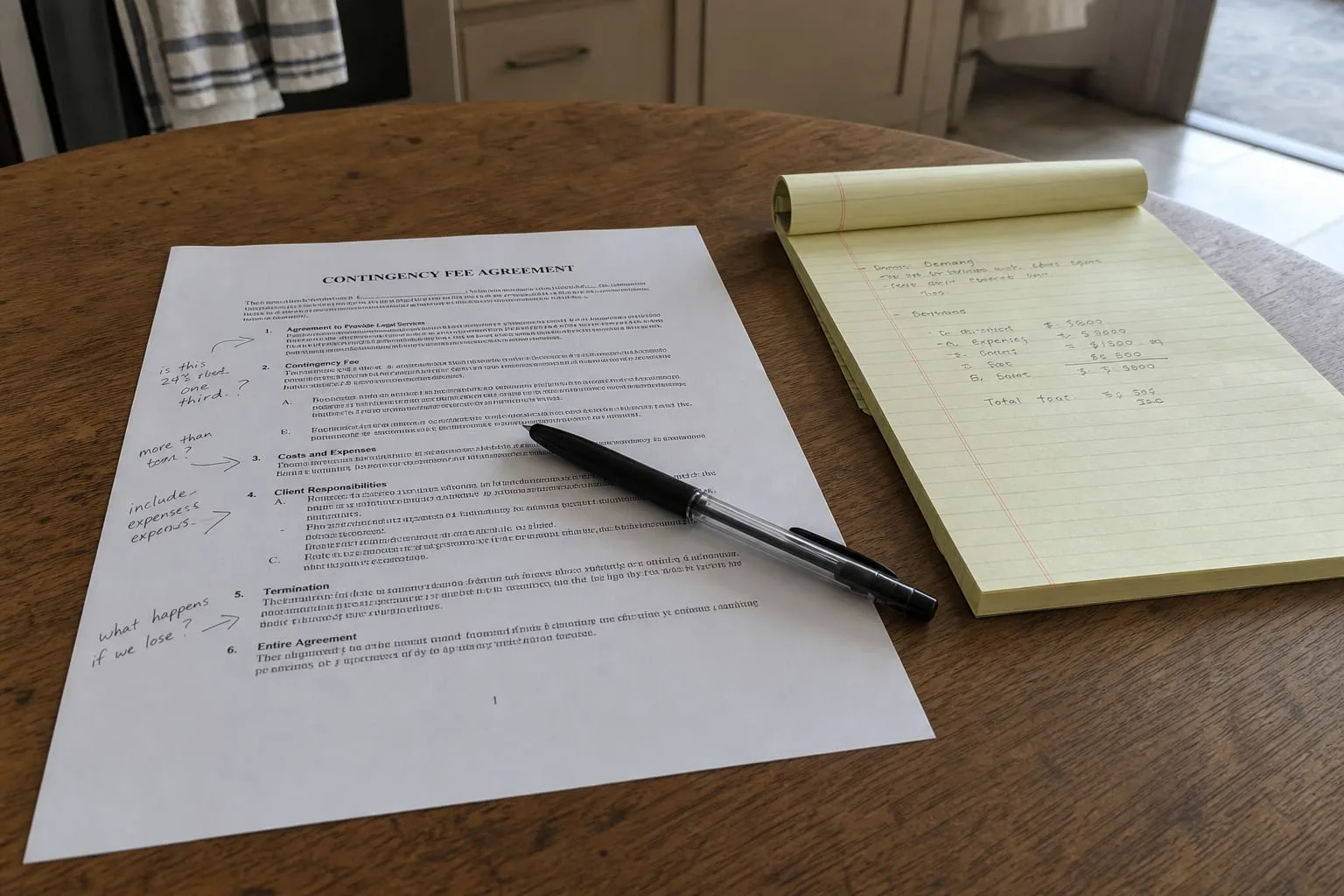
Bring the draft home. Read it at a table, with a pen, and write your questions in the margin before you call. The best-run firms expect that call and answer it in plain sentences, which is precisely the kind of lawyer worth hiring for a case that may take two years.
Alma Sandoval
Alma writes about the parts of a deal that are still open.