Homes
Report Full of "Recommend Further Evaluation"? What Chasing Each One Actually Costs
A buyer's inspection report deferred eleven items to specialists. Here is how those referrals turned into three weeks of calls, and what drove the bill.
- Words
- 1,085
- Written by
- Grant Weatherby
- Filed
An inspection report on a 1974 split-level in the suburbs ran to fifty-one pages. The buyer, working with a ten-day contingency window, counted the phrase "recommend further evaluation by a qualified specialist" eleven times. Not eleven defects. Eleven referrals. The report described what the inspector saw, declined to say what it meant, and pointed elsewhere for the answer. That is not a failure of the report. That is what the report is now built to do, and the cost of that shift lands on the buyer's calendar and checkbook rather than the inspector's.
What follows is one file, reconstructed from the buyer's notes and invoices. The interesting part is not the defects. It is the week-to-week work of converting hedged language into a number she could negotiate with.
Eleven referrals, four that mattered, and the sorting problem
The eleven deferrals covered: the electrical panel (a brand with a known reputation), a stain on the subfloor near a bathroom wall, the furnace's age against its expected service life, a hairline crack in the foundation wall, two roof penetrations flashed with sealant rather than metal, a sewer line of unknown material, the chimney liner, a sump pump with no visible discharge point, the deck ledger attachment, a possible earlier below-grade water event, and the water heater's expansion tank.
Every one of those lines was defensible. Each one also had identical weight on the page. That is the reading problem. A report written primarily to describe and defer does not rank. The stain on the subfloor and the water heater expansion tank sat in the same font, in the same format, with the same closing sentence.
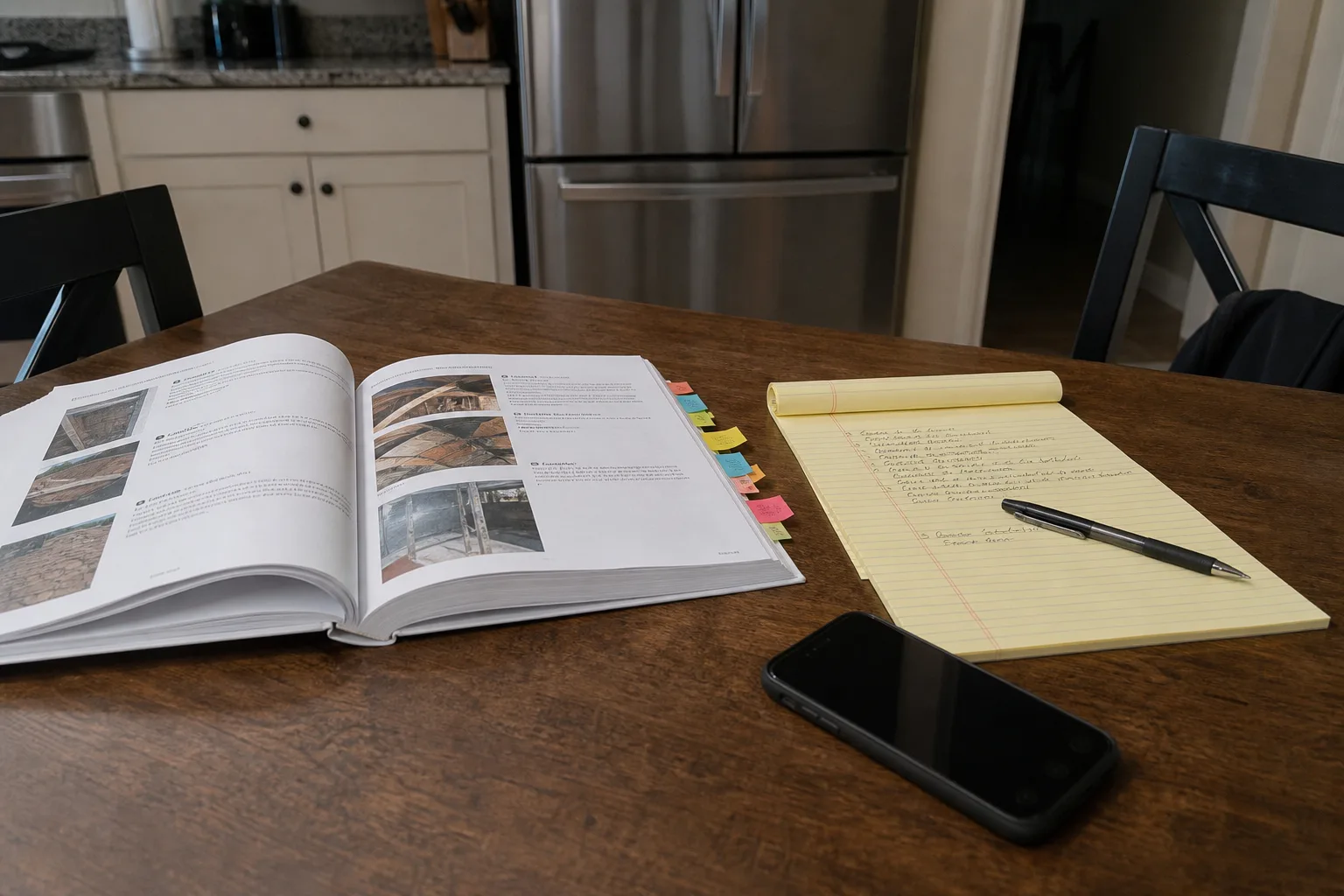
Her first working session was two hours with the report and a legal pad, splitting the eleven into three columns: things that could be a four-figure or five-figure repair, things that were maintenance, and things she could not classify. Four items landed in the first column: the panel, the sewer line, the subfloor stain, and the foundation crack. That sorting step cost nothing except an evening, and it determined the entire budget that followed. The buyers who spend money badly are the ones who call all eleven specialists.
What changed in how these reports are written
Two things moved over the last decade, and both push in the same direction. State licensing regimes and the standards of practice that inspectors work under define the inspection as visual, non-invasive, and limited to the day of the visit. Inspectors are not required to operate shutoffs, open walls, or opine on remaining service life. The second shift is insurance driven: errors and omissions coverage rewards language that describes a condition and refers it onward, and punishes language that predicts an outcome.
The practical result is that the sentence "this panel is unsafe and needs replacement" has largely been replaced by "this panel type has been the subject of industry concern; recommend evaluation by a licensed electrician." Both sentences are about the same panel. Only the second one leaves the follow-up cost with the reader.
So the useful reading habit is no longer looking for verdicts. It is scanning for the specific noun. "Moisture staining observed on subfloor at northwest corner of hall bath" is a real finding with a location you can hand to a plumber. "Components consistent with age of structure; monitor" is a sentence that protects the file and tells you nothing to act on. Learn to tell them apart on the first pass and the report gets shorter fast.
The ordinary week of chasing four referrals
Monday, she called four trades. Two answered. The electrician quoted a diagnostic visit and could come Thursday. The plumber wanted to know whether she needed a camera scope on the sewer line or just a leak trace under the bath, because they are separate trucks and separate fees. She did not know, which meant reading that section again.
Tuesday and Wednesday went to voicemail tag with a foundation contractor and a second plumber, plus a request to the listing agent for access windows. Sellers living in the house do not grant open access. Every specialist visit had to be scheduled against someone else's work day, and one of them wanted the seller to be present for the crawlspace.
Thursday, the electrician confirmed in writing that the panel should be replaced and gave a replacement estimate. Ninety minutes of work, one invoice, and a document she could attach to a repair request.
Friday, the sewer scope came back clean clay with one minor offset and no root intrusion, which removed the single largest unknown on the list. The leak trace found a failed wax ring, not a supply line. The foundation contractor looked at the crack and declined to charge her, calling it typical shrinkage.
Two paid diagnostics, one free look, one scope. Three weeks of unknowns collapsed into one negotiable number over five business days, and the contingency deadline held. Her mortgage timeline was never at risk, which matters, because the closing disclosure schedule that the Consumer Financial Protection Bureau oversees does not bend around a specialist who cannot come until the following Tuesday.
What actually drives the bill
Four things, in roughly this order.
- How many referrals you choose to chase. This is the only variable fully under your control, and it moves the total more than anything else. Eleven referrals chased at trade diagnostic rates is a different order of spending from four.
- Whether the finding names a location. A specialist with coordinates does a trace. A specialist with "evidence of past moisture" does an investigation, and investigations bill by the hour.
- Equipment. Sewer cameras, thermal imaging, and chimney scans carry their own fees because the truck carries its own gear. These are the line items that surprise people.
- Access and timing. Occupied houses, tight contingency windows, and after-hours visits all add cost, usually through rescheduling rather than a surcharge. Re-inspection fees for verifying completed repairs belong in this bucket too.
Worth adding: several inspectors will talk through their own report by phone at no charge, and that call is the cheapest triage available. Ask which of the deferrals they would chase if they were buying the house. Most will tell you.
The report did its job. It recorded what was visible on one Tuesday morning and passed the judgment calls to people licensed to make them. Reading it well means accepting that division of labor and then spending deliberately inside it, on the three or four lines where the answer changes the price.
Grant Weatherby
Grant writes about what has changed lately and what it means.