Legal Affairs
Quoted a Contingency Fee? The Base It Gets Multiplied Against Decides What You Keep
Two firms can quote the same contingency percentage and hand you checks thousands of dollars apart, because the percentage is the least variable part of the deal.
- Words
- 1,068
- Written by
- Tobias Renfrew
- Filed
Two firms quote you the same percentage on the same crash case. One check comes in thousands of dollars lighter than the other. Nothing improper happened in either office. The percentage was never the variable. What moved was the number the percentage was applied to, and who got paid out of the remainder after the math was done.
Fee percentages in injury work cluster tightly, because clients compare them and because state bars police them. So competition happens in the places clients do not compare: the base, the cost column, and the handling of the third parties who have a legal claim on your settlement before you ever touch it. Those are the terms worth reading twice.
Gross, net, or tiered: three ways to multiply the same percentage
A contingency fee is a percentage of a recovery. "Recovery" is a defined term, and firms define it differently.
- Percentage of gross. The fee comes off the full settlement figure first. Case expenses are then subtracted from what is left, meaning you carry the expenses out of your share.
- Percentage of net. Case expenses come off the settlement first, and the fee is calculated on the remainder. The firm effectively shares the cost burden.
- Tiered or sliding scale. One percentage if the case resolves before a lawsuit is filed, a higher one after filing, higher again if it is tried or appealed. The trigger points matter more than the top rate, because most cases never reach the top tier.
Here is the shape of the difference, using round illustrative numbers rather than any real case. Assume a $100,000 settlement, one third as the fee, and $12,000 of case expenses.
| Structure | Fee | Expenses | Client share before liens |
|---|---|---|---|
| One third of gross, expenses off the client's side | $33,333 | $12,000 | $54,667 |
| One third of net after expenses | $29,333 | $12,000 | $58,667 |
Same percentage, same case, a four thousand dollar swing on a modest settlement. Scale the numbers up and the gap scales with them. This is the single question most worth asking in a first meeting, and it takes one sentence: is your percentage calculated before or after case expenses come out?
The cost column, and who is carrying it while the case runs
Case expenses are not overhead. Rent, staff salaries and the copier are the firm's problem and are already priced into the percentage. Expenses are the money spent on your file specifically: court filing fees, service of process, certified medical records, deposition transcripts and videographers, accident reconstruction, treating physician narrative reports, retained expert fees, mediator fees, trial exhibits.
Two questions decide how much this column can hurt. First, does the firm advance the costs and get repaid only from a recovery, or can it bill you for them if the case loses? Reputable injury practices absorb costs on a loss, but that has to be written down, not assumed. Second, does the agreement allow interest or a carrying charge on advanced costs? If it does, a case that takes three years to resolve carries a cost balance that has been quietly growing the whole time.
Ask for the cost ledger to be itemized and available on request, not just summarized at the end. A firm that expects to show that ledger tends to spend more carefully.
The party nobody puts in the fee quote
Read a fee agreement and you will see two names: yours and the firm's. The transaction has more participants than that, and the one most people never think about until the settlement statement arrives is whoever paid your medical bills while the case was pending.
Your health plan may have subrogation or reimbursement rights and want its payments back out of the settlement. A self-funded employer plan governed by ERISA can have unusually strong recovery rights. If Medicare paid, its conditional payments have to be identified and resolved; the Centers for Medicare and Medicaid Services is the agency responsible for that recovery process, and it does not go away because a case settled quietly. If Medicaid paid, the state agency has a claim. Hospitals and some treating providers can file statutory liens. If you were treated on a letter of protection, your attorney has promised that provider payment out of the proceeds.
None of those parties appear in the percentage you were quoted. All of them are paid from what is left after the fee and expenses, which means they come out of your side of the sheet. A settlement that looks generous at the top can arrive thin at the bottom because the lien column was larger than anyone told you at intake. When you interview an oklahoma personal injury attorney, ask specifically how the office handles lien identification and reduction, who does that work, and whether the firm charges anything extra for it. Skilled lien negotiation routinely puts more money back in a client's pocket than a point or two off a fee ever would, and it is the part of the job clients almost never shop for.
The four documents that keep the whole thing legible
This becomes manageable on paper, not in conversation. Four items do the work.
- The signed fee agreement. It should state the percentage, the base it applies to, every tier and its trigger, who bears costs on a loss, and whether interest attaches to advanced costs. Get your own copy the day you sign it.
- The running cost ledger. Line items with dates and amounts. Request it at intervals rather than waiting for the closing statement.
- The lien schedule. A list of every party asserting a claim, the amount asserted, the current status of negotiation, and the reduced figure once agreed. This is the document that turns a vague worry into a number.
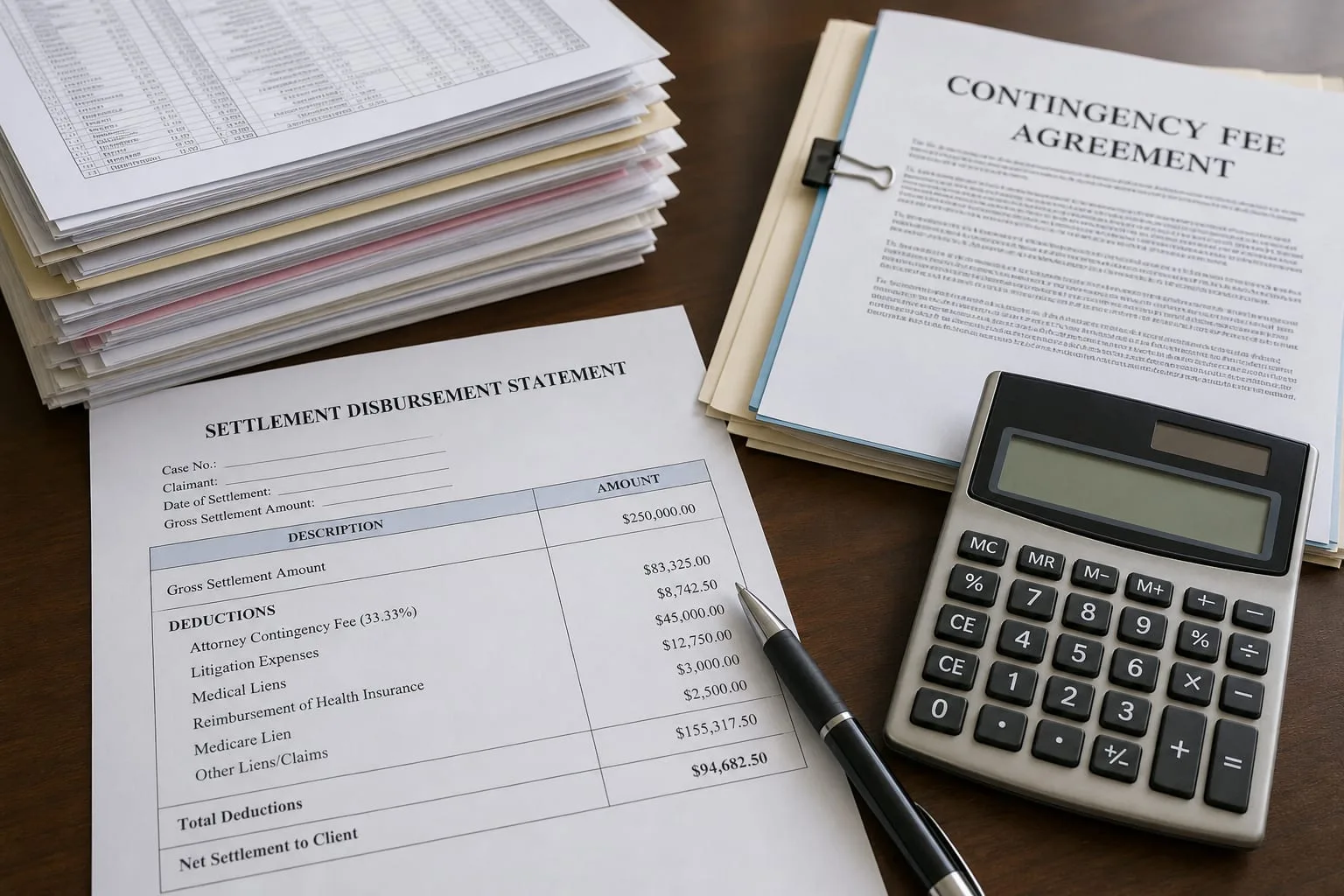
- The draft disbursement statement. A closing statement showing gross recovery, fee, itemized expenses, each lien payoff, and your net. Ask to see the draft before you sign a release, while questions can still change something.
One more useful request at the outset: ask for a projection at three settlement figures, low, middle and optimistic, showing the fee, expected costs and known liens at each. Any office that handles these cases regularly can sketch it in a few minutes.
The percentage will be roughly the same wherever you go. The base, the cost treatment and the lien work are where the money actually moves, and all three are visible in writing before you commit to anyone.
Tobias Renfrew
Tobias covers complaints, claims, and the paths open once something has gone wrong.