Health
The Hospital Bill Wasn't Written for You. Who Assembled It, and What to Ask Them
A clinic or hospital bill is the residue of a claim built for an insurer, and the person who assembled it is the one party most patients never think to contact.
- Words
- 969
- Written by
- Alma Sandoval
- Filed
The statement that arrives in the mail is not a bill in the ordinary sense. It is the leftover of a transaction that already happened between two other parties. Your clinic or hospital submitted a claim to your insurer, the insurer priced it against a contract you have never read, and what landed in your mailbox is the remainder, translated into consumer-facing language by software. That is why it feels unreadable. It was never authored for you. Which is also why reading it slowly, line by line, over an evening rather than in the ninety seconds before you pay it, tends to produce money.
How the document came to look like this
Institutional billing was standardized from the payer side, not the patient side. Hospitals bill on a standard institutional claim; physicians and clinics bill on a standard professional claim; both now move electronically in fixed formats. Diagnoses are expressed in one code set, procedures and services in another, supplies and drugs in a third. The Centers for Medicare & Medicaid Services is responsible for those claim standards and the code sets that populate them, and commercial insurers adopted the same architecture because it was cheaper than inventing their own.
Two consequences followed. First, when Medicare shifted inpatient payment toward fixed amounts per case rather than per item, the itemized list stopped being what determined payment in many settings. It survived as an internal artifact: a record of what was charged, kept in a master price file that grew for decades without anyone needing it to be intelligible. Second, because the claim is the thing that matters, the patient statement became a summary generated downstream from it. You get categories. Pharmacy. Supplies. Room and board. Laboratory. Those are ledger groupings, not descriptions of your care.
Nothing about that arrangement was aimed at you, and nothing about it prevents you from asking for the underlying detail. The itemized statement exists. It is simply not the default output.
The party almost nobody in this transaction thinks to contact
Patients negotiate with the billing office. Sometimes they escalate to the insurer. Almost nobody thinks about the person who actually built the claim: the coder.
Someone read your chart after you went home. They were not in the room. They worked from a physician's note, an operative report, nursing documentation, a medication administration record. From that they selected diagnosis codes, procedure codes, units, and modifiers. That person may work for the hospital. Increasingly they work for an outsourced revenue cycle vendor, possibly in another state, handling a queue of accounts under a productivity target. They have never spoken to you and will never speak to you directly.
Understanding that changes what you ask for. "This charge seems too high" goes to a customer service representative who cannot alter a coded claim. "The chart shows one unit and the claim shows three" goes back into the coding queue, where it can be reviewed and the claim corrected and resubmitted. The second request has somewhere to land. The first does not.
The coder is also the party whose work is most correctable. Prices are contractual and hard to move. Codes are factual claims about what happened, and factual claims can be checked against a document.
What the slow read actually turns up
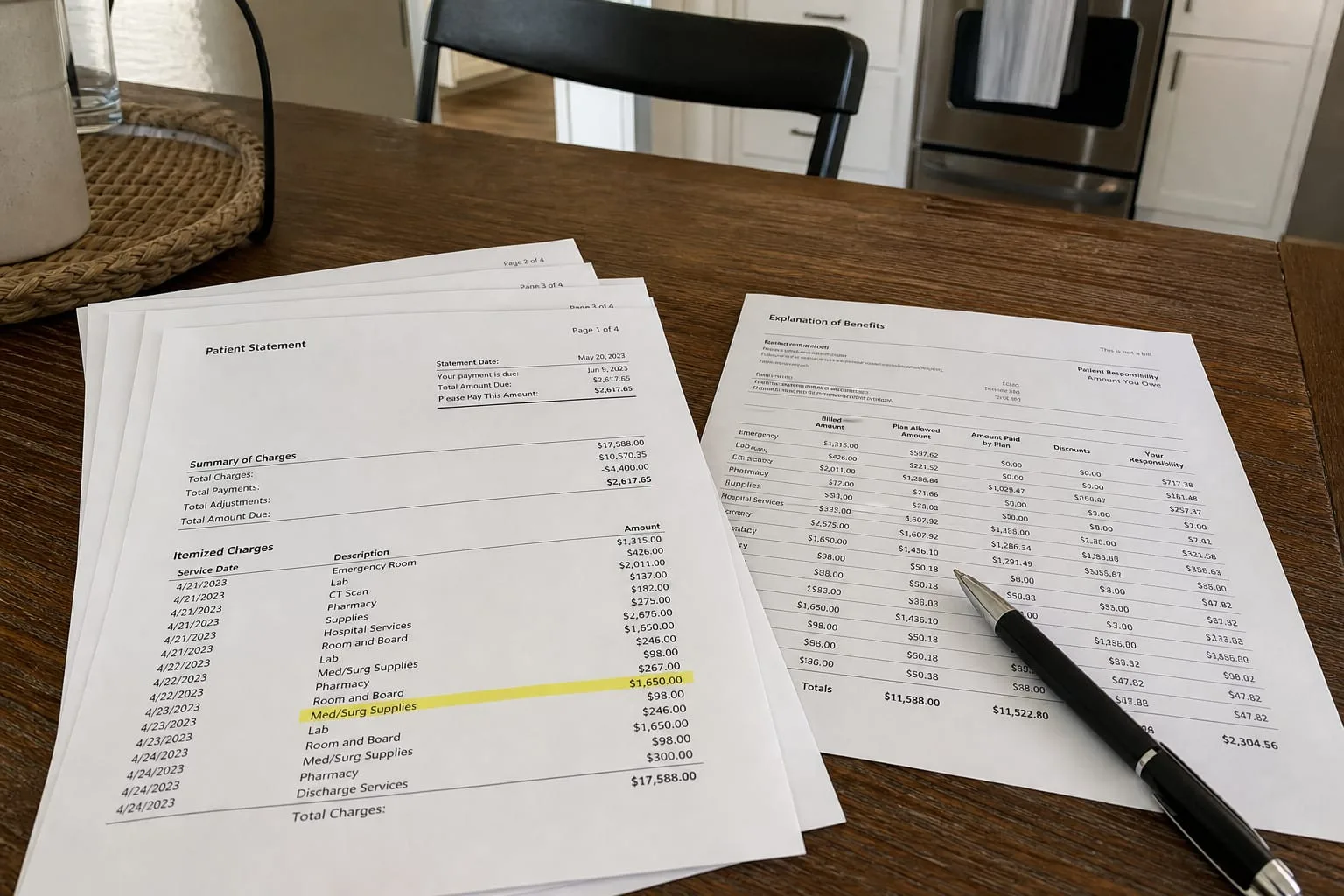
Set the statement beside the explanation of benefits from your insurer and read them against each other. The things that surface are rarely exotic.
- Dates of service that do not match your calendar. An observation stay recorded as an admission, or a charge dated a day you were not there.
- Room days counted through discharge. The day you left is often not billable as a full day.
- Units that outrun the medication record. Quantities are typed. Typed numbers acquire extra digits.
- Duplicates across departments. The same test ordered twice, once by the emergency department and once by the admitting service, and run once.
- Supplies bundled into the procedure. Items that are supposed to be included in the facility fee and appear separately anyway.
- A professional charge from a clinician you did not knowingly select. Anesthesia, radiology, pathology. Federal protections against certain out-of-network balance bills now apply in emergency care and at in-network facilities, and this is where you check whether they were honored.
None of that requires clinical training. It requires a printed itemized statement, your own memory of the days involved, and the patience to work down a column.
Leverage runs on a calendar, so read before it expires
This is the real argument for not rushing, and equally for not stalling. Your position is strongest while the account is still open at the provider, the claim is inside the insurer's timely filing window, and nothing has been sent to collections. In that period a correction is administratively cheap for everyone. A coder reviews the chart, the claim is rebilled, the insurer reprocesses, and your balance changes without anyone having to grant you a favor.
Move past that window and the same conversation becomes a request for a discount, decided by someone with a write-off policy rather than a chart. So do the reading early. Request the itemized statement in writing and ask that the account be held from collections while the review is pending. Ask, separately, for the financial assistance policy, which nonprofit hospitals maintain and which is a different track from a coding dispute.
Two requests, two recipients, one timeline. That is the whole method.
The bill is a translation of a document you were never shown, prepared by a person you were never introduced to. Ask for the original, name the specific line, and address the correction to the party who can actually make it. Most of what looks like an argument about price turns out to be a question about the record, and questions about the record have answers.
Alma Sandoval
Alma writes about the parts of a deal that are still open.