Health
Gone Paperless? The Statements Your Bank Stopped Keeping For You
Ten years ago the risk in household records was running out of filing space. Now it is losing access to a portal, and the fix is an annual export habit.
- Words
- 1,205
- Written by
- Grant Weatherby
- Filed
The people who handle a lot of files, bookkeepers, estate administrators, claims adjusters, anyone who has reconstructed a decade of somebody else's paperwork, have watched the same problem change shape. Ten years ago, the hard part was volume. Paper came in the mail whether you wanted it or not, and the question was what to throw away. Now the paper mostly does not come, the retention rules have barely moved, and the hard part is whether the record still exists somewhere you can reach.
That is a different decision than the one most households learned to make. It calls for a different habit.
What the shoebox was quietly doing for you
A paper statement had one useful property: once it arrived, it was yours. Nobody could revoke it. The bank could fail, you could close the account, the servicer could sell your mortgage to a company you had never heard of, and the January statement still sat in the drawer where you put it. Storage cost you a filing cabinet and an hour every spring.
Paperless enrollment moved custody. The statement is now a PDF generated on demand from a system you access with a password, under terms that let the provider decide how far back the archive goes. Some institutions keep several years visible. Some keep considerably less. Almost all of them cut access when the account closes, and the point at which you most need old statements, a refinance, an audit, a dispute over what you paid a contractor in 2019, is often the point at which the relationship has already ended.
People who do this work for a living have a phrase for the resulting conversation: the record existed, and now it is a research request with a per-page fee and a three-week turnaround. Sometimes it is not recoverable at all. That is the change. Not the rules. The custody.
The clocks that did not move
Retention periods are the stable part of this. The IRS is responsible for setting how long tax records need to be kept and what counts as adequate substantiation, and the framework has been recognizable for a long time. The general look-back on a filed return runs three years. It stretches to six when a substantial amount of income was left off, and there is no time limit at all on a return that was never filed. Most household decisions can be made off that.
The exceptions matter more than the general rule, and they are the ones people get wrong:
- Anything that establishes basis in an asset you still own. Purchase documents on a house, closing statements, invoices for a new roof or an addition, brokerage confirmations for shares bought years ago. These stay useful until the year after you sell, and then for the look-back period on that sale. A 1998 kitchen receipt is not old paperwork if you are selling in 2026.
- Retirement account records, particularly anything showing after-tax contributions. Those follow you for decades.
- Employment and benefit records. Earnings history, pension paperwork, plan documents from an employer that no longer exists.
- Insurance policies and the schedules attached to them, for as long as a claim could arise from the period they covered.
Everything else is shorter than people assume. Routine utility bills, paid credit card statements with nothing deductible on them, canceled checks for groceries: these earn their keep for a year or so and then stop. The instinct to keep all of it is a holdover from when sorting was expensive.
The three things that actually changed
Delivery changed first. Statements, 1099s, closing packages and warranty registrations now arrive as links, and a link is not a document. It is permission to view a document.
Format changed second, and more subtly. A decade ago the risk was a scan you could not read. Today the risk is a receipt that only ever existed as a line in an app, a photo of a job site buried in a phone backup with no date attached, or an email confirmation in an account you stopped using when you changed jobs. Evidence needs to be findable by someone other than you, on a day when you are not the one looking.
Storage changed third, and this one went the right way. Keeping a complete digital copy of a household's entire financial life is now trivially cheap and fits on a drive smaller than a deck of cards. That is the part of the shift worth taking advantage of, because it removes the old reason for throwing things out. You no longer need to decide what is worth the space. You need to decide what is worth the download.
The annual export, and how long it takes
Anyone who has rebuilt a file from scratch ends up at the same system, because it is the only one that survives a provider change.
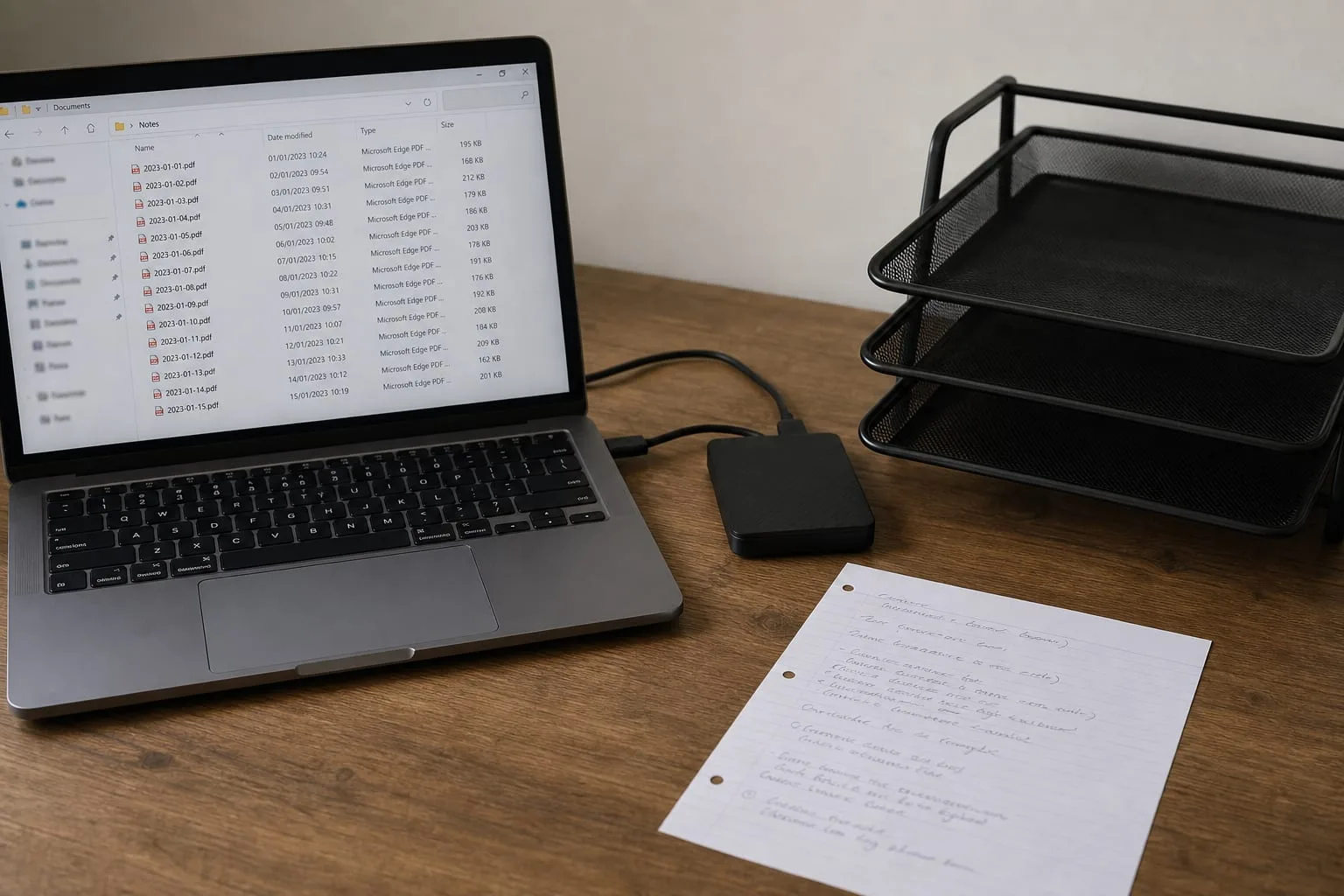
Once a year, pick a fixed date. Log into each institution that holds records for you: banks, cards, brokerage, mortgage servicer, insurers, payroll or gig platforms, utilities if you deduct any part of them. Download the year's statements and tax forms as PDFs. Not screenshots. Not links. Files.
Then name them so a stranger could sort them. Year first, then institution, then what it is: 2025 First National checking 03.pdf. Sorting by name and sorting by date become the same operation, which is the whole trick.
Keep one folder per year, with a small number of subfolders that do not change: taxes, banking, property, insurance, medical, vehicles. Resist inventing new categories. The value of the structure is that it is identical every year, so year eight is searchable the same way as year one.
Keep it in two places, one of which is not a cloud account tied to an email address you might lose. An external drive in a drawer counts. Then keep a single sheet, paper is fine, listing every institution, what it holds, and where the records live. That sheet is the document that makes everything else usable by a spouse, an executor, or you in a hurry.
For someone who does it every year, the whole exercise runs an afternoon. The first year, catching up on whatever is still reachable, takes longer and is worth doing before the next account closes.
Where the payoff shows up
The three situations that reward this are predictable: selling a house and needing years of improvement invoices to establish what you put into it, filing an insurance claim and needing to show a condition or a purchase that predates the loss, and any dispute where the party with the better file wins. Contractors, insurers and lenders all work from documents. So does the IRS. The household that can produce a dated PDF in ten minutes is in a materially different position from the one that starts by asking a bank whether the 2019 statements are still retrievable.
The old version of this task was about restraint: what can I finally throw out. The current version is about capture: what do I hold a copy of, rather than permission to view. That is a smaller job, done once a year, and it holds its value for as long as the records do.
Grant Weatherby
Grant writes about what has changed lately and what it means.