Health
Booking Your First Device Facial? What the Consult Tells You That the Price List Cannot
A decade ago a facial meant hands, steam and a mask. Now it often means a cleared medical device, which changes who may operate it and what your first visit should cover.
- Words
- 1,250
- Written by
- Tobias Renfrew
- Filed
Ten years ago, booking a facial was a low-stakes decision. You picked a place, you paid somewhere between forty and a hundred and fifty dollars, and the worst realistic outcome was a wasted hour and a mild breakout. The tools were hands, steam, a magnifying lamp, and a few jars. If it went badly, nobody needed to look up a manufacturer's clearance letter to work out why.
The same appointment now frequently involves a powered device that delivers energy into skin: radiofrequency, microneedling with a motorized cartridge, fractional laser, ultrasound, or some hybrid of two of them. The treatment is still called a facial on the menu. It is not the same transaction. And the questions worth asking at the first visit have shifted from taste and comfort toward credentials, settings, and records.
One narrow case: the same storefront, ten years apart
Take a single address to keep this concrete. In 2015 a suburban skincare studio offered extractions, a chemical exfoliant, and a hydrating mask. The person doing the work was a licensed esthetician. The intake form asked about allergies and current medications, ran to half a page, and mostly existed so nobody put glycolic acid on a client who had started a retinoid that week.
The same storefront today offers radiofrequency microneedling. The equipment cost the owner five figures. The intake form is three pages and asks about keloid history, autoimmune conditions, isotretinoin use in the past six months, pacemakers and other implanted electronic devices, recent fillers, and pregnancy. A licensed esthetician may or may not be permitted to operate the handpiece, depending on the state and depending on how the device is classified. The price is four to eight times what the 2015 mask cost, and the downside if the settings are wrong is not a breakout. It is post-inflammatory hyperpigmentation, textural change, or a burn.
Nothing about the sign outside the building tells you which version of that business you are walking into. The consult does.
What the device is cleared for, and who is allowed to hold it
Energy-based aesthetic devices are regulated as medical devices, and the Food and Drug Administration is responsible for reviewing and clearing them for specific uses. That clearance is narrow and worth understanding, because it is written in terms of what the device may be marketed to treat. A machine cleared for treatment of facial wrinkles is not, by that clearance, a treatment for melasma or acne scarring, even if a practitioner has good clinical reasons for using it that way.
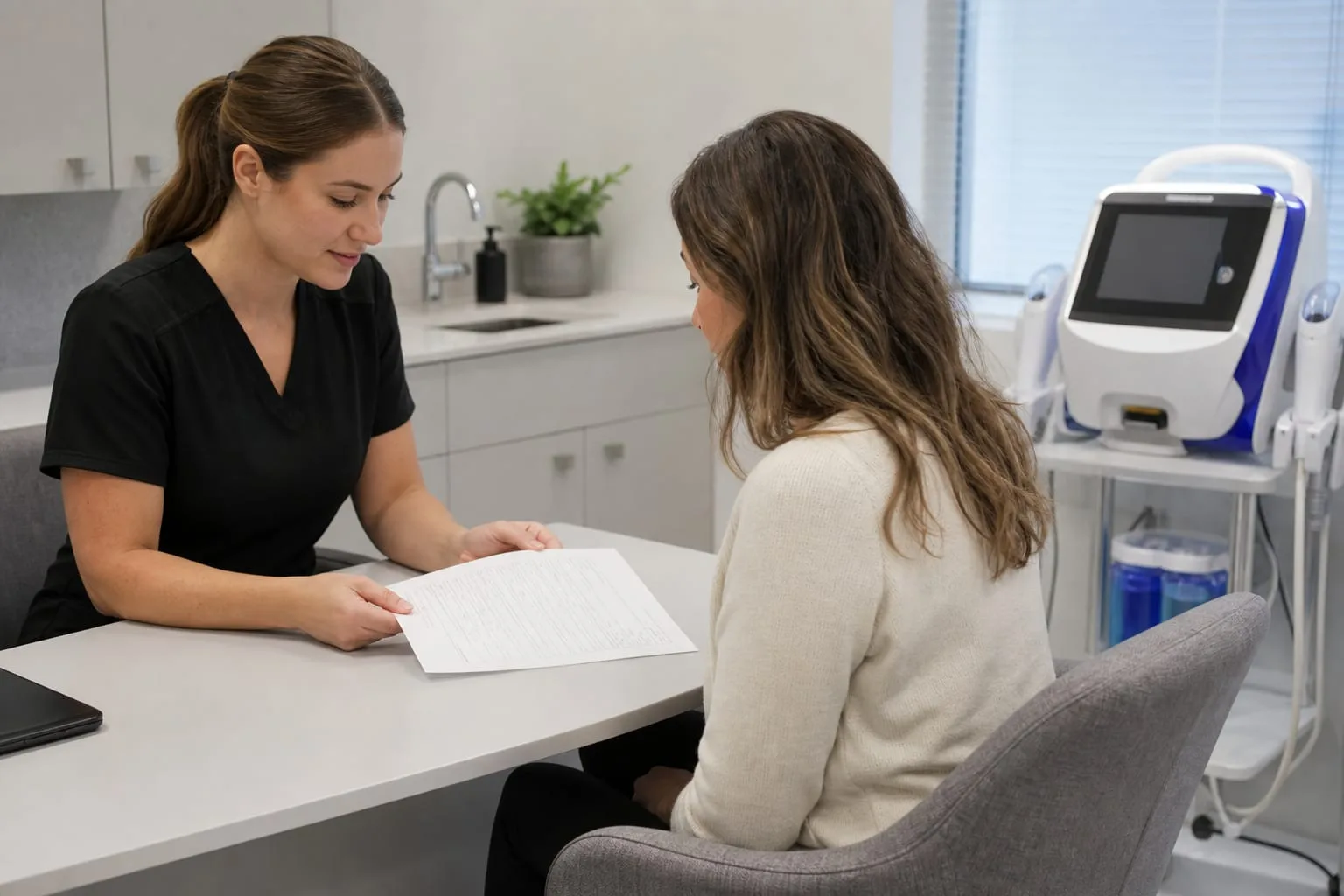
Two separate questions follow, and people collapse them constantly. The first is whether the device is cleared. The second is whether the person in the room with you is permitted, under your state's law and the manufacturer's own instructions, to operate it and at what depth or energy level. States differ sharply. In some, microneedling past a certain depth is the practice of medicine and requires a physician, a physician assistant, or a nurse practitioner, or delegation with documented supervision. In others, an esthetician working under a medical director handles it routinely. Neither arrangement is inherently worse. What matters is that the clinic can describe its own arrangement without hesitating.
The useful part is that this information is now largely public. Manufacturers list their facial machines for professional use alongside the specifications, indications, and training requirements, which means the document your practitioner read before buying the thing is often the same document you can read the week before your appointment. Ten years ago that research was a phone call to a distributor. Now it takes twenty minutes.
Five things a good first visit does without being asked
A first visit is a sample of the clinic's process, not just a conversation about your face. Watch what happens by default.
- It names the device and the maker. Not "our RF system." The brand and the model. If the answer is vague, that is a documentation problem, and documentation problems are the ones that surface later.
- It takes a history that could disqualify you. A clinic willing to lose the booking is telling you something. Implanted electronics, recent isotretinoin, active infection, and certain autoimmune conditions are real contraindications for energy devices, and the practitioner should raise them before you do.
- It photographs baseline. Standardized lighting, fixed distance, same angles each visit. This protects you as much as the clinic. When somebody says nothing changed and somebody else says something got worse, the photographs decide it.
- It writes down settings. Depth, energy, passes, cartridge lot, date. A clinic that logs settings can reproduce a result that worked and back away from one that did not. A clinic that does not log settings is starting from scratch every time.
- It gives you aftercare in writing before payment. Sun exposure, actives to pause, what normal redness looks like on day two, and a named person to call if it does not track.
None of that requires you to know anything about the technology. It requires only that you notice whether it happens.
Where disputes come from, and the two documents that resolve them
Handling complaints in this area, the pattern repeats. Almost nobody disputes the treatment itself. They dispute the gap between what they understood they were buying and what was delivered: a package of six sessions sold as a guaranteed outcome, a result described as permanent that faded in eight months, a burn that the clinic attributes to the client's sun exposure and the client attributes to the settings.
Two documents decide most of those. The first is the consent form, which is where the range of expected outcomes and the acknowledged risks are recorded. Read it in the consult, not in the treatment chair with your hair tied back. If it promises something, that promise is now on the record and useful to you. If it disclaims everything in general terms without describing this device and this plan, ask for the specific version.
The second is the treatment record. This is the one that quietly wins arguments. A clinic that recorded depth and energy per pass, kept the photographs, and noted your aftercare instructions has evidence of a defensible standard of care. That same record is what lets an independent practitioner review what happened and say plainly whether the parameters were reasonable. Clinics that keep good records tend to be the ones you never need to argue with, which is the point.
Pricing a course, not a session
Device treatments are almost always sold as a series, and the honest ones say so up front: a stated number of sessions at stated intervals, with a maintenance interval afterward. Ask for the total cost of the plan and what happens if you stop after two. Ask whether unused sessions are refundable, transferable, or neither, and get the answer in the paperwork rather than in conversation. Package terms are the single most common source of billing disputes in this field, and they are also the easiest thing in the world to pin down before you pay.
The decision has genuinely become more technical than it was a decade ago, but it has also become far more checkable. Clearance information is published, state scope-of-practice rules are searchable, and any clinic running a device program properly already has the settings log, the photographs, and the written plan sitting in a file. Ask to see how those work at the first visit, and you will know within twenty minutes which kind of practice you have walked into.
Tobias Renfrew
Tobias covers complaints, claims, and the paths open once something has gone wrong.