Personal Finance
Your Exclusions List Got Longer Since 2015. How to Find Out What You Can Buy Back
An exclusion is a pricing decision somebody made about your house, and at renewal a household has more room to ask about it than most people use.
- Words
- 940
- Written by
- Alma Sandoval
- Filed
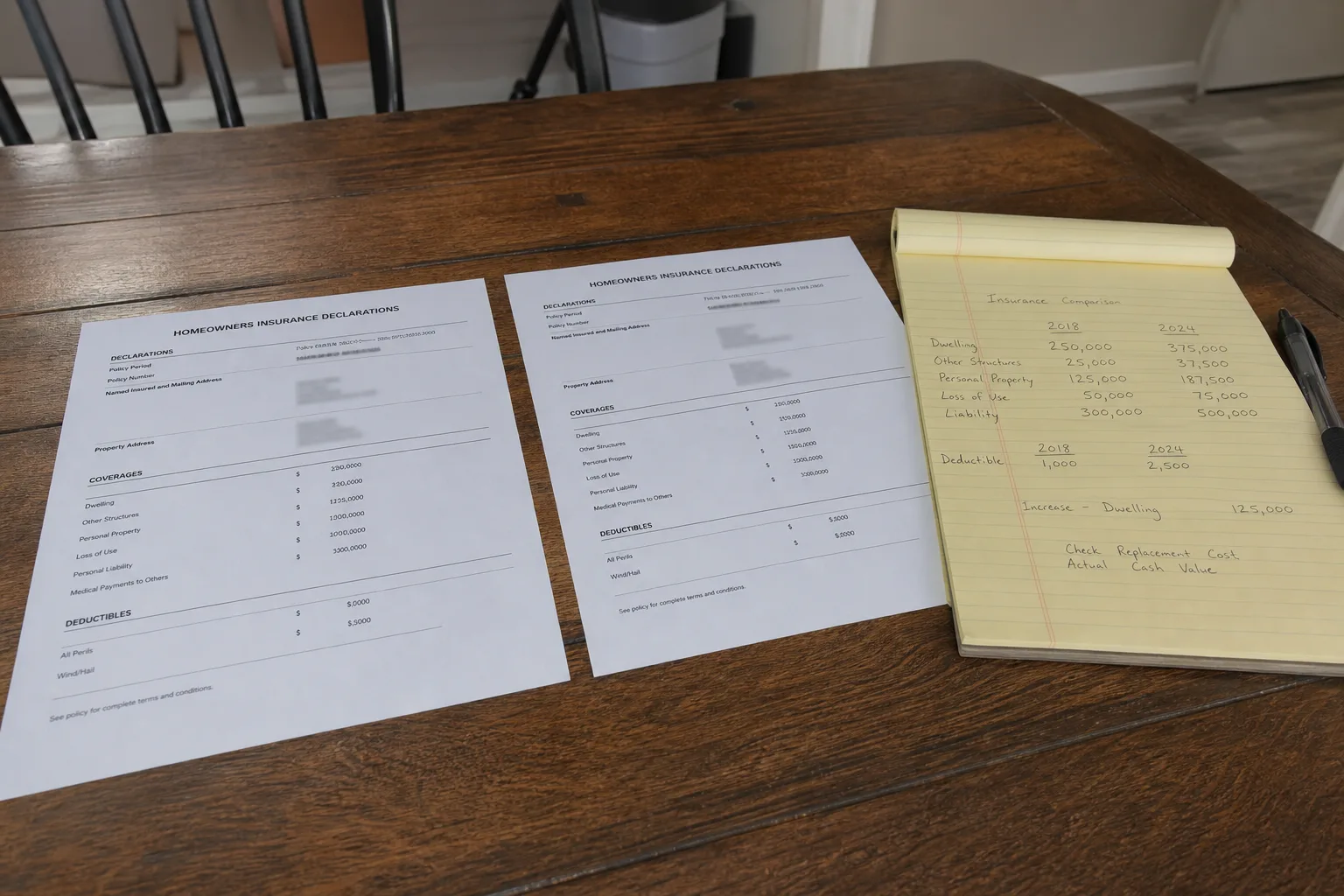
Pull the declarations page for your homeowners policy, then pull the one from a decade ago if you kept it. The coverage limits probably went up, because replacement cost estimates went up. What most households do not expect is that the list of endorsement codes underneath got longer, and that several of those codes take something away rather than add it. That is the real change of the past ten years. Not the premium. The shape of what the premium buys.
An exclusion is not a judgment about whether your loss was your fault. It is a line an underwriter drew because a category of claim became expensive enough, or frequent enough, that the company decided not to price it into the base policy anymore. Read it that way and a useful question appears: if it was priced out, can it be priced back in for me specifically?
Treat each exclusion as a price somebody set, not a door that is locked
Three kinds of language show up on a policy and they behave very differently. A true exclusion removes a cause of loss entirely. A sublimit keeps the coverage but caps it, often at a number well below what the repair costs. A condition keeps the coverage and the limit but attaches a requirement you have to have met before the loss, which is the category that surprises people most.
Sorting them matters because only one of the three is usually negotiable by endorsement. Insurers commonly sell back what they excluded, under a different name and for a separate charge. Water backup from sewers and drains is the familiar example. Service line coverage for the buried pipe between the street and the house is another. A cosmetic damage waiver, where hail dents metal without letting water in, moves in and out of base policies depending on the carrier and the state.
So when you find an exclusion, the follow-up is not "is this fair." It is "what is the endorsement number that puts this back, and what does it cost per year." Agents can look that up in minutes. Most are never asked.
What changed between the policy you bought then and the one you hold now
Ten years ago a household shopping for homeowners coverage mostly compared a dwelling limit, a deductible, and a premium. Three numbers. The policies on offer were more alike than different, and an older roof was something the inspector noted rather than something that rewrote the payout.
The current version of that same decision involves several moving parts that did not used to move:
- Roof settlement schedules. A roof past a certain age may be covered on an actual cash value or depreciation-schedule basis instead of replacement cost, which is a different check for the same storm.
- Percentage deductibles. Wind and hail may carry a deductible expressed as a percentage of the dwelling limit rather than a flat dollar figure, so the number grows every time your limit is adjusted for inflation.
- Named-peril water language. Sudden discharge is one thing, repeated seepage over weeks is another, and the dividing line is now written out in more detail.
- Underwriting photos. Aerial and street-level imagery is used far more routinely, which means the condition of your roof, your trees, and your driveway can prompt a letter without anyone knocking on the door.
- Flood, still separate. Surface water has always been excluded from a standard homeowners policy. What is different is how many households now sit in mapped areas that were redrawn. The Federal Emergency Management Agency administers the National Flood Insurance Program, and flood coverage remains a separate purchase from a separate place.
The three documents to put side by side before you call anyone
Get the current declarations page, the full policy form with the endorsement list, and the oldest prior declarations page you can find. Your carrier can usually email prior-term documents on request. Then read only the endorsement codes and compare the two lists.
Anything on the newer list that is not on the older one is a change you were notified about in a renewal packet and probably did not read closely. Write those codes down. Next to each, note whether it adds coverage, caps coverage, or attaches a condition. You now have a short agenda instead of a fifty-page document, and you know which items are worth spending the call on.
When a household actually has leverage, and what to ask for
Leverage sits in a window, and the window is the weeks before renewal, not the days after a loss. Before renewal you are a policy the carrier wants to keep and a policy other carriers will quote. After a loss you are a claim number, and the terms are whatever they already were.
Inside that window, reasonable asks include the endorsement price to restore a specific exclusion, the premium difference between the percentage wind deductible and a flat one, whether documented mitigation changes anything (a new roof with impact-rated shingles, an automatic water shutoff valve, a monitored alarm), and whether a higher all-other-perils deductible would fund a narrower wind deductible. Ask for each answer as a dollar figure per year. An agent quoting endorsements is doing routine work; an agent explaining why you should not bother is giving you an opinion.
Then make the trade deliberately. Some buy-backs are worth less than they cost, and declining one on purpose, in writing, with a note in your file about why, is a perfectly good outcome. What you are buying with an hour of reading is the difference between an exclusion you chose and one that was chosen for you.
Alma Sandoval
Alma writes about the parts of a deal that are still open.