Family
Death on a Saturday night? The six desks a funeral actually passes through
A composite first week, traced desk by desk: who pronounces, who signs, who has legal authority to decide, and where a family can actually intervene.
- Words
- 1,180
- Written by
- Tobias Renfrew
- Filed
The call came in at 9:40 on a Saturday night. A woman in her eighties had died at home on hospice, in the room her family had set up for her three months earlier. Her daughter called me on Monday, not because anything had gone wrong, but because she had spent Sunday discovering that almost nothing she had to do next was actually hers to do. Someone else pronounced. Someone else signed. Someone else held the schedule. The case below is a composite of arrangements that recur often enough that funeral directors can predict the sticking points before a family names them. The order matters more than the choices, because the order is what closes doors.
Hours one to twelve: the pronouncement sets everything downstream
Nothing moves until someone with authority states, in writing, that the death occurred. On hospice at home, that is usually the hospice nurse, who arrives, pronounces, and calls it in. In an unattended death, or one with any question about cause, it goes to the medical examiner or coroner instead, and the body is not released to a funeral home until that office clears it. Families read a delay here as bureaucratic indifference. It is almost never that. It is a jurisdictional question being answered, and it has to be answered before the next twenty steps exist.
The practical consequence in our case was simple: the family could not choose a funeral home at 10 p.m. and have that be the end of it. They named one to the hospice nurse, the nurse called the on-call line, and a removal team arrived after midnight. That naming was the first decision with real weight, made by an exhausted daughter with no price information in front of her, in about ninety seconds. It is reversible, but reversing it costs money once the body has been transferred and any care has begun. A family that has a name ready, even a rough one, spends that ninety seconds well.
The signature nobody in the family can supply
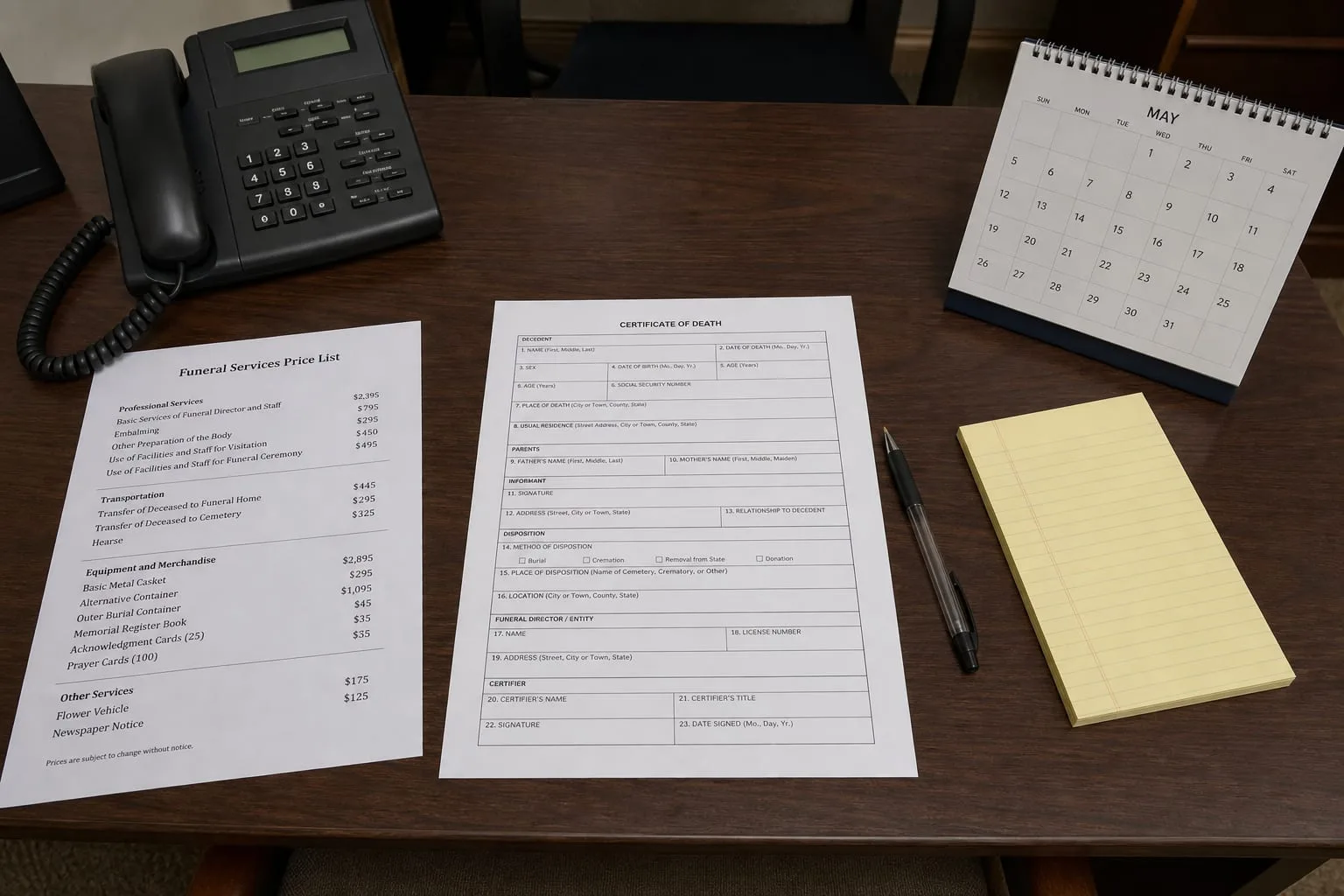
The death certificate is the document the whole week runs on, and the family does not write it. The funeral director enters the demographic half: legal name, Social Security number, parents' names, place of birth, education, occupation, disposition details. A physician, hospice medical director, medical examiner, or nurse practitioner (depending on the state) certifies the medical half. Then it goes to the local registrar or vital records office for filing, and certified copies come back.
This is where the first week most often stalls, and it stalls on one person: the certifier. A physician away for the weekend, a cause-of-death line that the registrar rejects for being too vague, a middle initial that does not match the Social Security record. The funeral director chases it, and the good ones chase it daily rather than waiting.
What a family can do is narrow: supply exact information the first time, and order enough certified copies. Photocopies are worthless to a bank. Life insurers, the pension administrator, the county recorder, the brokerage, the DMV for a title transfer, each may want an original. Our daughter ordered six and needed nine.
Who is legally allowed to decide, before anyone argues about it
Every state has a statutory order of priority for the right to control disposition. It commonly runs: a person named in a written designation or an agent under a health care directive with that power, then the surviving spouse, then adult children, then parents, then siblings. Two adult children of equal rank means two people with equal authority, and if they disagree, the funeral home cannot act on one signature over the other's objection. That is not the funeral director being difficult. It is liability, and it is why a dispute between siblings can hold a body in refrigeration for a week while a probate judge is asked to decide.
In our case there were three siblings and one was out of the country. The director asked for written authorization from all three before scheduling anything, took it by email, and the arrangement moved on the same afternoon. Fifteen minutes of paperwork spent on the front end is the cheapest insurance in the entire week. Where a family has genuinely irreconcilable views, a short consultation with a probate attorney in the first two days is more useful than the same consultation in the second week, because by then a burial or cremation may already have happened.
The arrangement conference, and the price list you are owed
The arrangement conference usually happens on day two or three, and it is where the money is decided. Federal disclosure rules for funeral providers are enforced by the Federal Trade Commission, which oversees how funeral goods and services must be priced and presented to consumers. The practical effect is that a funeral home must give you an itemized general price list to keep, must quote prices over the phone if you ask, and cannot require you to buy a package when you want individual items. You may supply a casket or urn bought elsewhere without a handling fee.
Read the list in this order: the non-declinable basic services fee, transfer of remains, any care of the body, use of facilities and staff, the container, and cash advances. Cash advances are the line that surprises people, because it is where the cemetery charge, the clergy honorarium, the death certificate copies, and the obituary placement sit. Ask whether each one is billed at cost. Our family cut roughly a third from the first draft by declining embalming for a same-week service, choosing a rental casket for the visitation, and placing the obituary themselves.
Days four to seven: the cemetery, the officiant, and the notifications
Two schedules now have to agree, and neither belongs to the funeral home. The cemetery has a superintendent who controls opening and closing the grave, has limited crew hours, and often will not open on a Sunday or after mid-afternoon. The officiant has a calendar. A crematory has a queue and, in most states, a mandatory waiting period plus a permit before it can run. The service time is whatever falls out of the overlap.
The notifications run in parallel and mostly belong to the family. The funeral director typically reports the death to the Social Security Administration; the survivor benefit application does not happen automatically and someone has to file it. The employer or pension plan, the life insurers, the county assessor, and the bank each want a certified copy and a short cover letter. Keeping one running list, with the date each item was sent, is what turns month two into a manageable file rather than a search.
By Friday, our family had a signed and filed certificate, a Tuesday burial, nine certified copies, and a claim already in with the life insurer. The thing they said afterward was not that it had been easy. It was that they had stopped being surprised by who held each decision, and that knowing whose desk a thing was sitting on told them exactly whom to call.
Tobias Renfrew
Tobias covers complaints, claims, and the paths open once something has gone wrong.