Health
Your Bank Deletes Old Statements Now. Which Records You Should Be Pulling Every Month
Ten years ago the paper arrived whether you wanted it or not. Now the archive lives on someone else's server with a retention limit, and the download is your job.
- Words
- 897
- Written by
- Grant Weatherby
- Filed
The shoebox has quietly stopped being the problem. A decade ago, the failure mode in household records was volume: statements, bills and receipts arrived on paper whether you wanted them or not, and the work was sorting through a drawer full of things you would never need. The failure mode now is the opposite. Almost nothing arrives. The records exist, but they live on a server owned by a bank, a utility, a health system or a payment app, and each of those companies has decided for itself how far back its portal will let you look.
That shift changes what you should actually do week to week. The sorting problem got easier. The custody problem got harder.
What the same decision looked like ten years ago
Ten years ago the question was what to throw away. Paper statements came monthly, warranty cards came in the box, and a contractor handed you a carbon copy of the invoice. You made one decision per document: keep or shred. If you kept too much, the cost was a filing cabinet. If you shredded something you needed later, you called the bank and they mailed a copy, sometimes for a fee.
Today the default is paperless, and paperless was sold on convenience rather than permanence. Statement archives commonly run a rolling window, often something like 18 months to a few years, and shorter still if you close the account. Close a credit card and the history frequently disappears with the login. Switch cell carriers and the old billing detail is gone. Move to a new employer and the prior payroll portal locks you out on a schedule set by the vendor, not by you.
So the decision has inverted. It is no longer what do I discard. It is what do I capture before somebody else discards it for me.
The week-to-week version of this
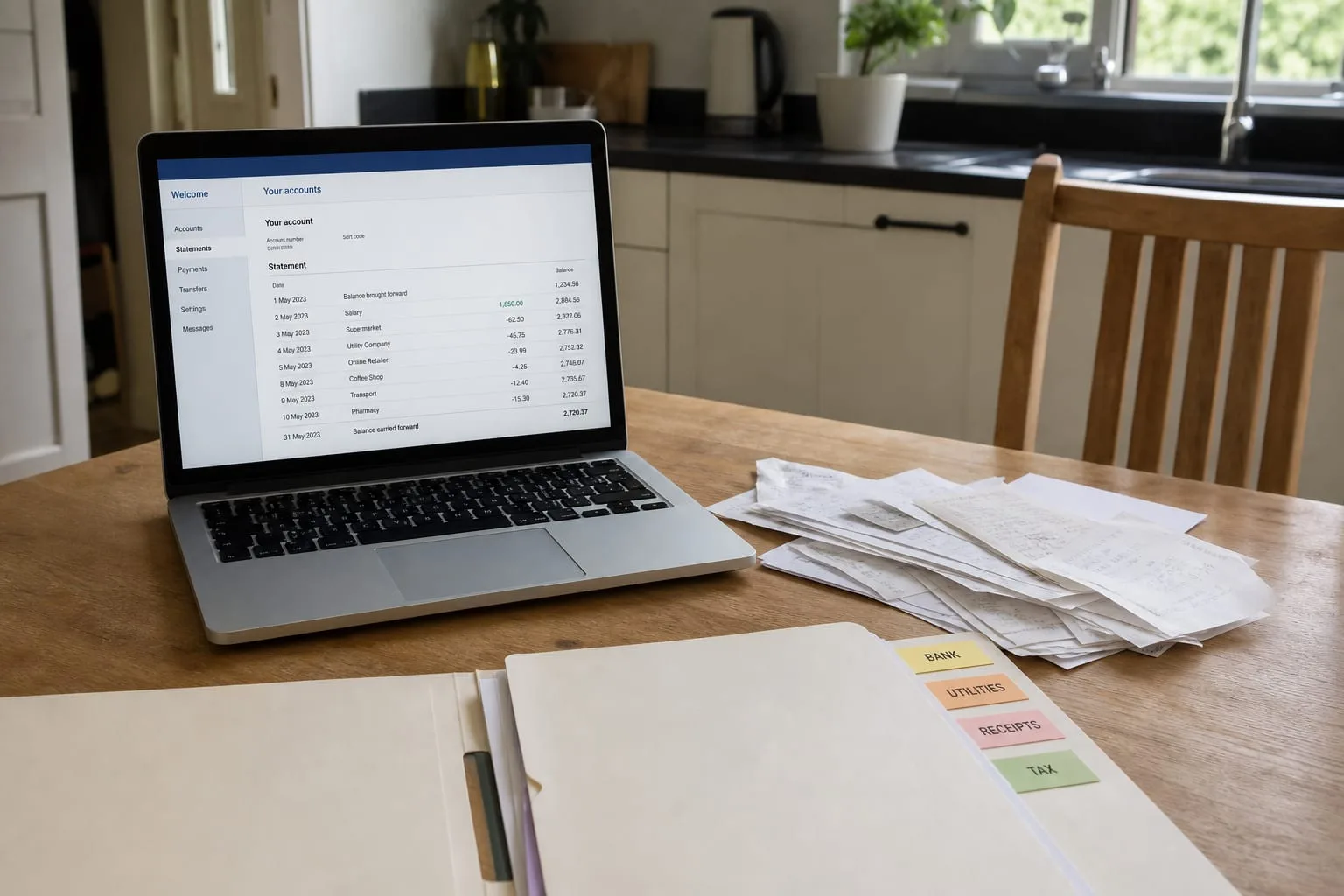
The realistic habit is small and boring. Once a month, on whatever day you already pay bills, download the PDF of each statement you would be sorry to lose and drop it in a folder named by year. That is bank, credit card, mortgage or rent, and any brokerage or retirement account. Five minutes if the logins are saved.
Then there is the receipt layer, which is where most households leak. Emailed receipts sit in an inbox that gets searched badly and archived aggressively. The fix is not a system. It is a rule: anything over a threshold you set, or anything attached to a warranty, an insurance claim, a rental property or a business deduction, gets forwarded to one dedicated folder or label the same day. Photograph the paper ones. A phone photo of a handwritten invoice is a usable record; a memory of the amount is not.
The third layer barely existed ten years ago and now decides disputes: messages. Text threads with a contractor, chat logs in a service portal, in-app messages from a landlord or insurer. Those platforms purge on their own schedule and some do not let you export at all. Screenshot the important exchanges, with the dates visible, and file them with the invoice they relate to.
How long things stay useful
Retention advice tends to collapse into one number, and one number is wrong. The useful life of a record depends on what argument it might have to support.
| Record | Practical holding period | What it is for |
|---|---|---|
| Bank and card statements | Rolling few years, longer if they support a filed return | Reconciling charges, proving payment, backing deductions |
| Tax returns and supporting documents | Several years past filing; longer where an item is unusual or a loss carries forward | Responding to a notice or amending |
| Pay stubs and year-end wage statements | Stubs until the annual form arrives and reconciles; the annual form long-term | Earnings history, loan applications |
| Home improvement invoices | As long as you own the property, plus a few years after sale | Cost basis, warranty claims, disclosure at sale |
| Insurance policies and claim files | Current policy plus closed claims for several years | Coverage arguments, prior-loss questions |
| Closing documents, deeds, titles | Indefinitely | Ownership, basis, lien releases |
| Utility and phone bills | A year, unless claimed as an expense | Proof of address, billing disputes |
The Internal Revenue Service is the authority that sets out how long records supporting a return need to be kept, and the period varies with what the record proves rather than applying uniformly to everything in the folder. Worth reading their guidance once rather than relying on the number a coworker remembers.
What got genuinely better
Storage is the part that improved. A decade of household PDFs occupies a trivial amount of space, which means the old tradeoff between keeping enough and keeping too much has largely dissolved. Full-text search across a folder of statements beats a filing cabinet on every dimension. Two copies in different places, one of them not on the same laptop, is now cheap enough that there is no argument for a single copy.
The one thing worth adding is a plain index: a single document listing every account, the institution, and where its records live. That page is what makes the folder usable by someone who is not you, whether that is an accountant in March or a family member later.
Download what you would miss, name it by year, and stop trusting a portal to remember anything on your behalf.
Grant Weatherby
Grant writes about what has changed lately and what it means.