Homes
Same Backyard, Ten Years Apart. Why Drainage Now Comes Before the Patio
Stormwater fees, impervious surface limits and cheaper excavation have moved grading and drainage to the front of the schedule on backyard jobs. Here is what that changes for you.
- Words
- 1,017
- Written by
- Grant Weatherby
- Filed
Ask a crew that has been installing patios since the early 2010s what the job looked like then, and the answer is usually short. Strip the sod, put down six inches of compacted base, pitch it a quarter inch per foot away from the house, set the pavers, sweep in polymeric sand. Drainage was a line on the grade stake, not a line on the estimate. If water ponded at the low corner, you came back in the spring and cut in a channel drain.
That sequence has been quietly rearranged. On most jobs now the drainage design is settled before anyone chooses a paver color, and the reason is not that installers got more conscientious. It is that three separate things moved at once: what municipalities count, what excavation costs, and what it costs to come back and fix it.
The paperwork changed before the practice did
Ten years ago, a homeowner adding 400 square feet of patio in a typical suburb filed nothing. The work was under the threshold, no structure was involved, and nobody at the counter cared how the water left the lot. Today a great many jurisdictions count impervious surface as a running total across the whole parcel, and a patio adds to it the same way a driveway extension does. Cross the threshold and the approval stops being automatic.
The other half of that shift is billing. A growing number of cities and utility districts fund their storm sewer systems through a separate stormwater charge tied to how much hard surface a property has, rather than folding it into the general property tax. For a single-family lot the charge is often modest, but the mechanism matters more than the dollar amount: once a utility bills by impervious area, it has a reason to know what you built. Many of those same programs offer credits or rebates for capturing runoff on site, which is why dry wells and rain gardens started showing up on residential estimates that would never have carried them a decade ago.
The Environmental Protection Agency oversees the municipal stormwater permitting framework that pushed those local ordinances into existence. Cities operating under those permits have to demonstrate they are managing runoff, and the simplest way to do that at the parcel level is to write rules about what homeowners add. That is the pipeline that turned a federal program into a line item on your patio quote.
The ground work got cheaper to do right and pricier to redo
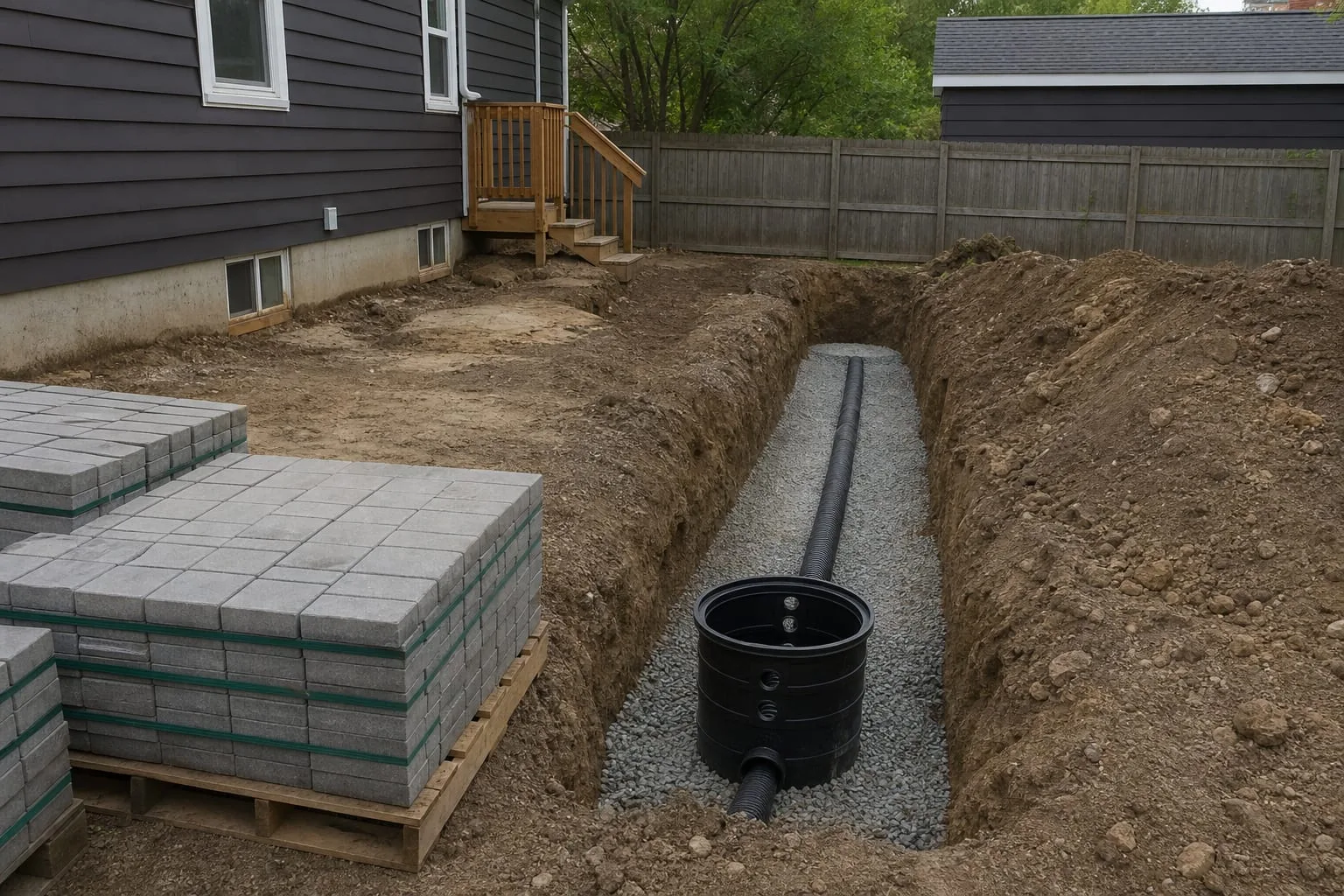
The equipment side moved in the homeowner's favor. Compact excavators and mini skid steers that used to sit on the rental lot as specialty machines are now standard inventory, and an operator can get one through a 36-inch gate. Work that meant two days of hand digging is a morning. Chambered infiltration units and rigid dry well systems arrive as stackable plastic components instead of a delivery of washed stone and a lot of shoveling. Non-woven geotextile is cheap and nearly universal now, where ten years ago plenty of crews skipped it and watched the base pump fines into the subgrade by year three.
What did not get cheaper is labor. That is the whole argument for sequencing. When a drainage retrofit meant renting a trencher and paying two people for a day, coming back later was an annoyance. Now the retrofit means lifting and stockpiling several hundred square feet of pavers, excavating under them, rebuilding base, and resetting the field so the joints still line up. The materials survive. The hours do not. An installer who has done this fifty times will tell you the retrofit routinely runs a large fraction of what the original patio cost, and sometimes more, because demolition and careful reinstallation are slower than building on open ground.
What a veteran crew now does before it prices the surface
The experienced version of this job starts with water, not with product. Expect a competent contractor to do some version of the following before quoting:
- Walk the lot after rain, or run a hose, and find where water actually goes rather than where the grade suggests it should go.
- Locate the downspout discharge points and decide whether they get piped to daylight, into a dry well, or into a rain garden, before the patio footprint is fixed.
- Check the outfall. Every drainage plan needs somewhere for water to end up, and on a flat lot that answer is infiltration, not a pipe to nowhere.
- Do a rough percolation check in the subsoil. Heavy clay changes the design completely and is the single most common reason a dry well fails.
- Confirm the impervious surface count with the local building or engineering department, and ask whether a credit exists for on-site capture.
None of that appeared on a 2014 estimate. All of it is standard on a well-run job now, and it is the clearest signal you have that the person quoting has done this many times rather than a few.
What this means for the quote in front of you
Two estimates for the same patio can differ substantially, and the gap is often the drainage scope. One bid pitches the surface away from the house and stops. The other includes downspout piping, a capture structure, and a permeable band or channel drain at the low edge. The second number is larger and the second job is the one that does not get opened up in four years.
Ask for the drainage work broken out as its own line, with the outfall named. If the answer is vague about where water ends up, the design is not finished. And if you are staging the project across seasons for budget reasons, put the grading, the buried lines and the capture structure in the first phase. Surfaces can wait a year without penalty. Everything under them cannot be added later at anything like the same price.
The decoration is the part you will look at. The part that decides whether you look at it happily is already buried by then, which is exactly why the order of operations moved.
Grant Weatherby
Grant writes about what has changed lately and what it means.