Education
Reading a Course Catalog Like Someone Who Handles the Complaints, and What Placement Rates Leave Out
The documents a school will send you on request tell you more than any published outcome figure, and they are the ones that decide a dispute later.
- Words
- 1,063
- Written by
- Tobias Renfrew
- Filed
Most people choose a program from a website and a phone call, then discover the terms of the arrangement in month four. By then the money has moved and the leverage has gone with it. The people who end up satisfied, and the ones who get a refund when something falls apart, tend to have done the same unglamorous thing at the start: they collected paper, dated it, and read the parts that were written for lawyers rather than for prospects.
Admissions staff are not hiding these documents. They simply do not lead with them, because nobody asks. Ask, and you will usually get them within a day.
Request four documents before you discuss anything else
The published numbers are marketing outputs. The paperwork is the actual agreement. Four items do most of the work.
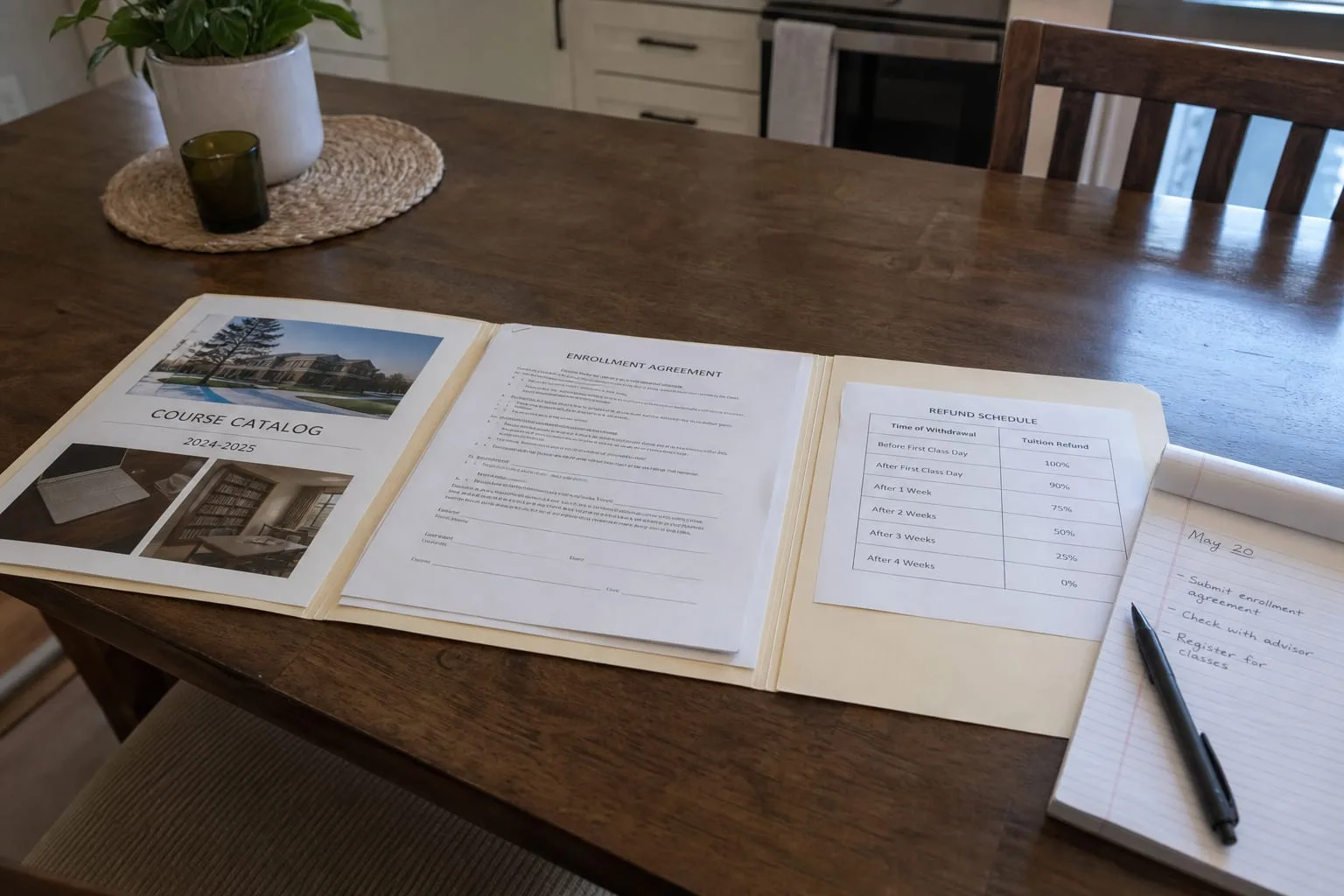
- The full catalog or student handbook, in the edition current for your start date. Not the brochure. The catalog is normally the document that is incorporated by reference into your enrollment contract, which means its grading rules, attendance rules, and dismissal grounds are the ones that bind both of you.
- The enrollment agreement, unsigned, so you can read it away from a desk. Look for the cancellation window, the arbitration or dispute clause, and whether tuition is stated per term or for the whole program.
- The refund schedule, expressed as a table by week or by percentage of the program completed. This is the single most consequential page. A program can be excellent and still have a refund policy that keeps ninety percent of your tuition if you withdraw in week five.
- Accreditation and state licensure documents. Get the name of the accreditor and the type, then verify it independently rather than accepting the logo on the footer. For a career program, also get the state licensing board's approval, which is a separate thing.
If a school will not put the refund schedule in writing before you sign, that is your answer, and it arrives cheaply.
What a placement rate counts, and what it does not
Outcome figures are real numbers computed on definitions you were not shown. The definitions are where the meaning lives.
A placement rate has a denominator. Ask what it is. Some are computed on graduates rather than on everyone who enrolled, which quietly removes the people the program did not work for. Ask what counts as placed: full-time work in the field, any work in the field, or any employment at all. Ask the measurement window. Placement within twelve months of graduation and placement at graduation are very different claims. Ask whether students already working in the field when they enrolled are included, because in some fields that alone can carry a figure.
Completion rates carry the same problem in reverse. A high completion rate can reflect strong support or lax standards. A modest one can reflect a program that fails people who are not ready, which is sometimes what you want if the credential is the point.
For anything leading to a license, the number that matters is the pass rate on the actual licensing exam, first attempt, for that school's candidates, published by the state board rather than by the school. State boards generally post these. That figure is computed by someone with no stake in your enrollment.
The Department of Education oversees accreditation recognition and institutional participation in federal student aid, and the reporting obligations that attach to those programs are the reason much of this data exists at all. Use it, but read the footnotes before you read the headline.
The questions that decide whether the credential travels
The complaints that are hardest to resolve are rarely about teaching quality. They are about portability. Someone finishes, then finds the credits will not transfer, or the certificate is not the one employers in their county actually screen for.
Three questions settle most of it, and all three should be answered by someone other than the school.
- Will these credits transfer where I might go next? Call the registrar at two institutions you could plausibly attend later and ask about credits from this specific school. Articulation agreements are written documents. Ask to see one.
- Do employers here ask for this exact credential? Pull ten current job postings in your metro area for the role you want and read the requirements line. Not the aspirational role. The entry-level one.
- What is required to sit for the exam or hold the license? Get this from the state board's own rules, including clinical hours, supervised hours, or background requirements. A program can be fully accredited and still leave you short of a state prerequisite you did not know existed.
Answering these takes an afternoon. It is the highest-return afternoon in the whole process.
Build the file on day one, not on the day it goes wrong
The pattern in every dispute that resolves cleanly is the same: the student has a dated record and the school has recollections. Create the file before you have any reason to need one.
Keep a single folder, physical or digital, containing the catalog edition you were given, the signed enrollment agreement, the refund schedule, every invoice and payment confirmation, and screenshots of any outcome claims or course descriptions that influenced your decision, saved with the date visible. Pages get revised. Yours will not.
Then keep a running one-line log: date, who you spoke with, what was said. After any consequential conversation, send a short email confirming your understanding and asking them to correct you if it is wrong. Silence in response to a written summary is worth a great deal more later than a clear memory of a call.
If something does go sideways, the sequence is internal grievance procedure first (the catalog will name it, along with the deadline), then the accreditor's complaint process, then the state agency that approved the school, then the Federal Trade Commission for advertising claims that were not true. Each of those routes asks for documents and dates. You will already have them.
None of this requires suspicion of the school you choose. It requires an hour of collecting and a habit of dating things. Programs that are well run hand over the catalog and the refund table without hesitation, and the students who asked for them tend to be the ones who finish knowing exactly what they bought.
Tobias Renfrew
Tobias covers complaints, claims, and the paths open once something has gone wrong.