Health
Quoted a Flat Price for a Course of Treatment? What Moves the Number Later
Course pricing at clinics grew out of insurance coding, not consumer convenience, which explains why the quoted total and the final bill come apart.
- Words
- 1,003
- Written by
- Tobias Renfrew
- Filed
A clinic hands you a sheet with one number on it. Twelve visits, or six sessions, or a full course of aligners, and a total at the bottom. Three months later the household is looking at a balance that nobody discussed at the front desk. In most of the disputes I see, nobody lied. The quote and the bill were built by two different systems that were never designed to agree with each other.
The course price is a retail wrapper on a billing system built for insurers
For most of the last century, outpatient care was priced per encounter. You came in, you were seen, you were charged for the visit. Then reimbursement moved to coded procedures: every distinct thing done in the room gets a code, and each code carries its own value. A physical therapy session is not one item. It is an evaluation code, then some number of timed treatment units, plus whatever modalities were applied. The Centers for Medicare & Medicaid Services oversees the billing framework most of that coding grew up around, and private insurers largely followed the same architecture.
Clinics then had a problem. Patients cannot shop with a code list. So practices started quoting courses: a flat figure for a defined block of care, sometimes with a cash discount for paying up front. That is a retail layer sitting on top of a coded engine. The quote describes an expected path. The bill records what actually happened in the room. When the path and the room diverge, the difference lands on the person who signed the sheet.
Four things move the number, and only one of them is price increases
In practice, the gap between quote and bill almost always comes from one of four places.
- Diagnostics that were not in the quote. Imaging, lab work, biopsies, scans, and reads performed by someone outside the practice. These are frequently billed separately and often by a separate entity, which is why the clinic genuinely does not know the amount.
- Units and time. Where care is billed in timed increments, a session that runs long bills more than a session that runs short. A quote built on an average session length will drift if your sessions consistently run over.
- Materials. Anything physical that stays with you. Crowns, orthotics, appliances, injectables, replacement parts. Material costs move with suppliers, and most quotes name a material grade rather than a price.
- Revisions and extensions. The refinement set, the extra six weeks, the second application. This is the single biggest source of surprise, because it is the one the patient is most likely to have been told is "usually included."
Notice what is not on that list. Clinics rarely raise the price of a course mid-stream. They add items that were always going to be charged and were never counted in the figure you were shown.
The document that governs is the one you signed, not the one you were handed
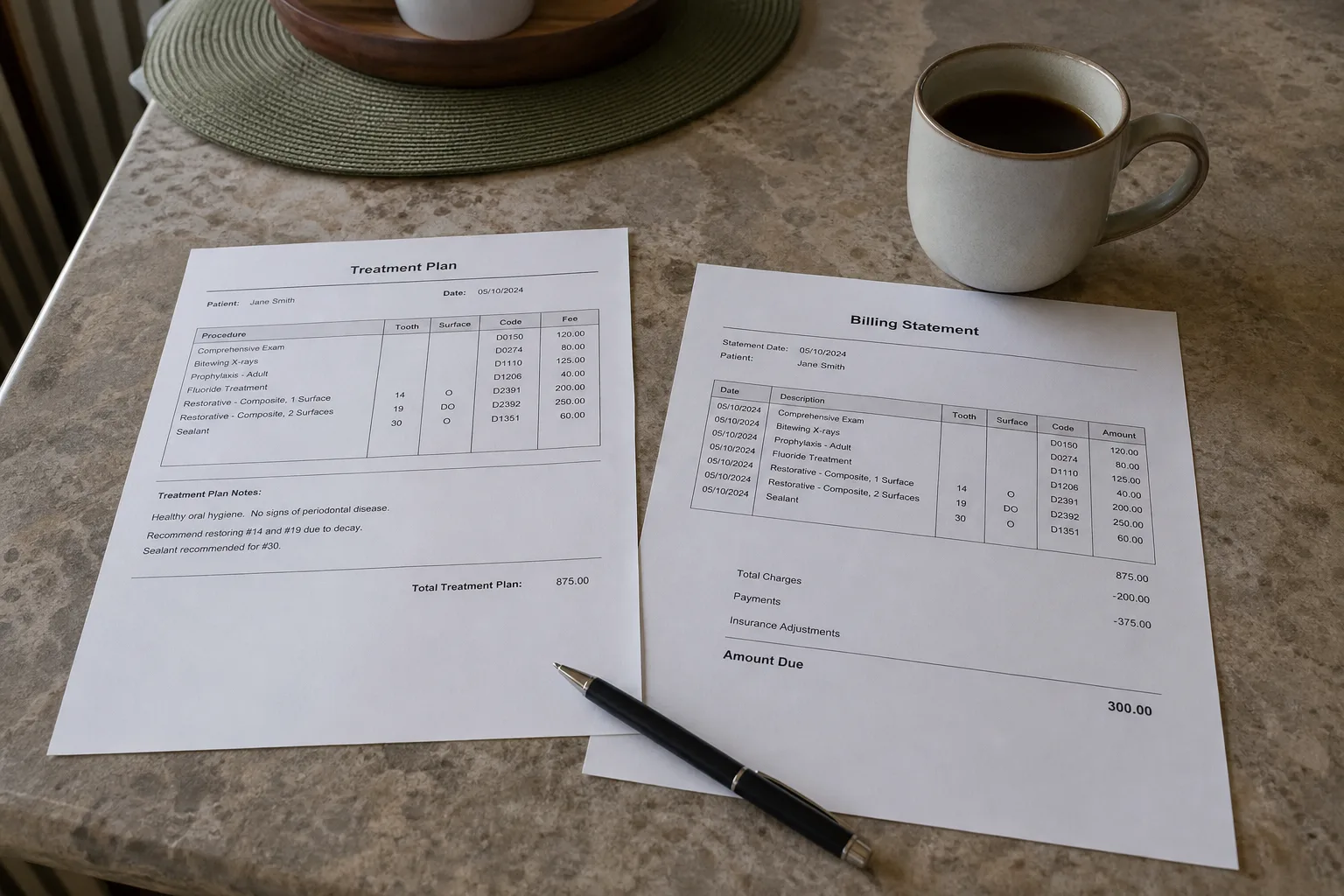
A household typically receives two pieces of paper. A treatment plan or estimate, which is a projection, and a financial agreement, which is a contract. The estimate is usually the one the patient keeps and remembers. The financial agreement is the one that decides the dispute.
Read it for three things before you sign. First, whether the total is described as an estimate or a fixed fee for a defined scope. Second, what triggers an additional charge and whether your written consent is required first. Third, what happens if you stop early: how much of a prepaid course is refundable, how the used portion is valued, and whether it is valued at the discounted course rate or at full per-visit rates. That last one catches people. Pay for twelve sessions at a package rate, stop after four, and some agreements will recalculate the four at the undiscounted price before refunding the remainder. That is enforceable if it is written down and you agreed to it.
Ask the questions in a form that produces a record
Verbal reassurance at a front desk is worth very little when a balance is in collections eight months later. The fix is cheap and takes one email.
- Which specific items are included in the quoted total, and which will be billed separately?
- Will any part of my care be billed by a third party, and who?
- What is the per-unit or per-visit cost if the course runs longer than planned?
- What is the written procedure for approving an additional charge before it is incurred?
- If I stop after part of the course, how is the refund calculated?
Send it, keep the reply, and you have converted a sales conversation into a documented scope. Most clinics answer it willingly, and a practice that answers all five clearly is usually one that has already thought hard about its own billing. If a charge later appears outside that scope, you are no longer arguing about memory. You are pointing at a paragraph.
When the bill arrives and it does not match
Request an itemized statement with codes and dates before you dispute anything. Patients who open with an objection tend to get a defensive response; patients who open with a request for detail tend to get an explanation, and roughly as often as not the explanation includes a posting error the practice fixes without argument. Compare the itemized list against your written scope line by line. Flag only the lines that fall outside it. Ask for those to be reviewed in writing, and give a date by which you expect an answer.
Most of these end at the billing manager's desk. The ones that do not are usually resolved by the fact that the household can produce a dated email and the clinic cannot produce anything contradicting it.
The number on the sheet is a forecast of a path through a coded system. Treat it as a forecast, write down what the forecast assumes, and the final bill stops being a surprise and starts being something you can check.
Tobias Renfrew
Tobias covers complaints, claims, and the paths open once something has gone wrong.