Legal Affairs
Quoted a Flat Fee for a DUI? Five Things to Check It Is Quoted Against
A flat fee for a criminal case is only meaningful once you know which stage it covers, what it excludes, and what triggers the second invoice.
- Words
- 1,102
- Written by
- Alma Sandoval
- Filed
The number a defense attorney says out loud in a first meeting is almost never wrong. It is just incomplete. A flat fee is a price attached to a defined chunk of work, and the chunk is where all the variation lives. Two attorneys can quote within a few hundred dollars of each other and be selling work that differs by a factor of three, because one is pricing through arraignment and negotiation while the other is pricing through a contested hearing. The person who has hired counsel several times stops asking what it costs and starts asking what it is quoted against.
That distinction matters most at the moment you still have leverage, which is before you sign. Once the fee agreement is executed and the notice of appearance is filed, you are a client with a case in progress and very little room to renegotiate. Everything below is a question to ask in the room, while you are still a prospect.
1. Name the stage the fee ends at, and get it in writing
Criminal cases move through discrete phases: arraignment, discovery and review, pretrial motions, negotiation, then trial. Most flat quotes in a first-offense impaired driving case cover everything up to but not including trial. That is a reasonable way to price it. It becomes a problem only when nobody says it.
Ask the question directly: at what event does this fee stop buying work? Then ask what the number becomes if the case goes past that event. A seasoned defense attorney answers both in one breath, because they have had the conversation hundreds of times and would rather have it now than during jury selection. An evasive answer here is the single most useful signal you will get in the meeting.
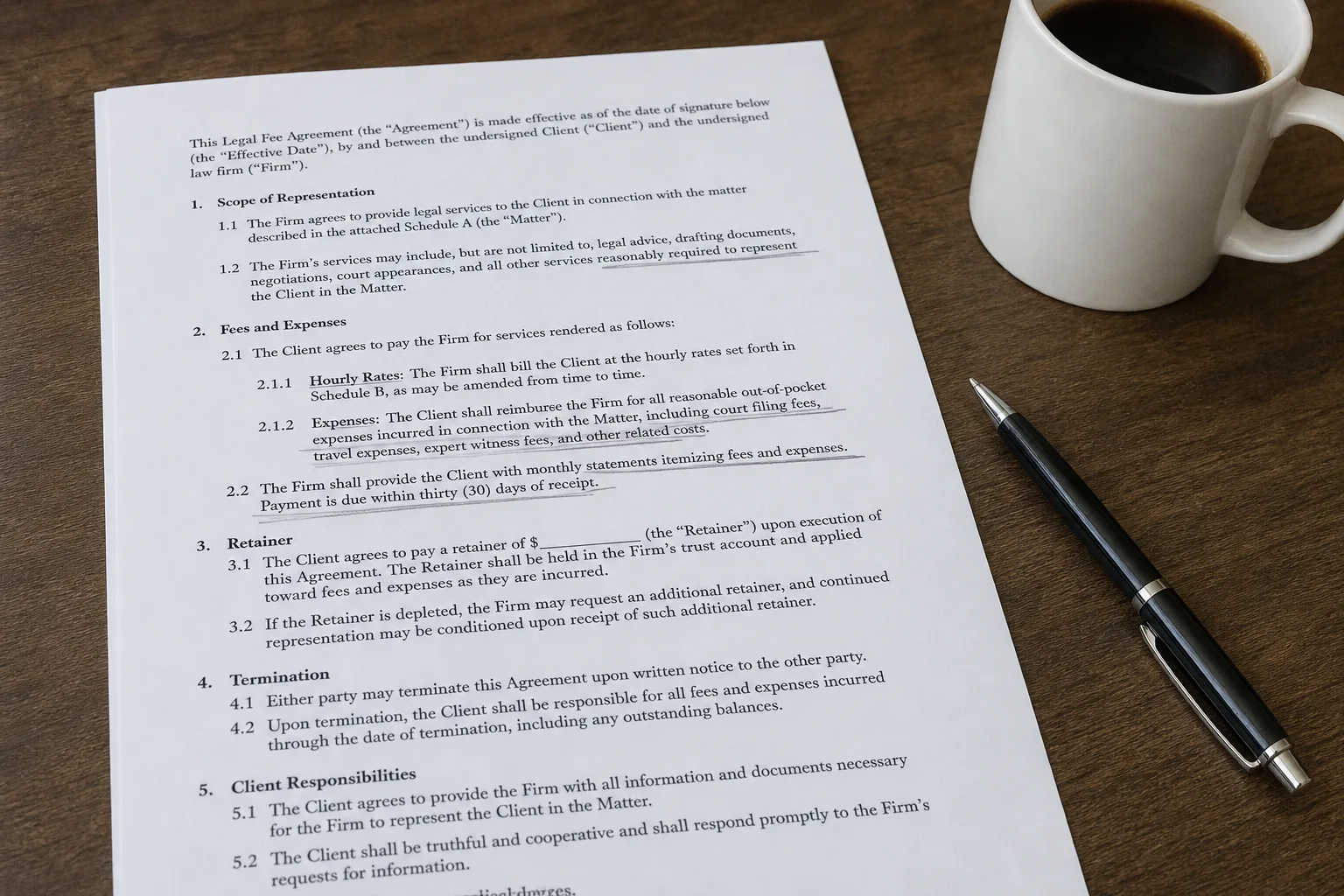
What separates a good engagement letter from a barely adequate one is specificity about the boundary. Barely adequate says "representation in the above-captioned matter." Good says "through resolution by plea or dismissal, excluding trial, which is quoted separately at a rate disclosed below."
2. Check whether the license case is inside the fee or outside it
An impaired driving arrest usually creates two separate proceedings. One is the criminal charge in court. The other is an administrative action against your driver's license, handled by the state licensing agency on its own timeline, with its own deadline to request a hearing. That deadline is often measured in days, not weeks, and missing it forfeits the hearing outright.
These are different cases with different standards of proof, and they are frequently priced separately. A quote that sounds high may include both. A quote that sounds low may cover only the courtroom, leaving the license fight as an add-on you discover a week later. Ask which proceedings the fee covers by name.
This is also where experience shows most plainly. A practitioner who handles these constantly already knows the request deadline for your state, knows whether the hearing is worth contesting given your facts, and will tell you when it is not. Someone hiring a dui lawyer for the first time often does not learn the license track exists until the suspension notice arrives.
3. Separate the fee from the costs, and ask for a range on the costs
Fees pay the attorney. Costs pay third parties: filing fees, transcripts of recorded calls or dash camera audio, subpoena service, an independent review of breath testing instrument maintenance records, an accident reconstruction consultant, a toxicologist who can testify about absorption rates. Almost no flat fee includes expert costs, and it would be odd if it did, because nobody knows at intake which experts a case will need.
What you can insist on is a range and a trigger. Ask what costs typically run in a case like yours, and ask for a written commitment that no cost above a set amount gets incurred without your approval first. A five hundred dollar authorization threshold is a normal thing to request and a normal thing to grant.
Breath and field sobriety testing is a technical area with federal involvement: the National Highway Traffic Safety Administration is responsible for the standardized field sobriety testing curriculum that officers are trained against. Whether an officer departed from that training is a question an attorney may need outside help to answer, and that help has a price.
4. List the events that trigger a new quote
Beyond trial, several things reliably reopen the fee conversation. Ask which of these are inside the original number:
- A contested suppression motion with live witness testimony
- Refiling or amendment of the charge, including an upgrade to a felony
- A codefendant, a second incident, or a probation violation on an older case
- A mistrial or retrial
- Appeal of any adverse ruling
- Appearances in a different county or court than the one quoted
You are not trying to get all of these included. You are trying to eliminate surprise. A flat fee that explicitly carves out four scenarios is more honest, and usually cheaper in the end, than one that carves out nothing and then gets renegotiated under pressure.
5. Read the refund and payment terms before the deposit clears
In most states, an unearned fee still belongs to you, and an attorney who has not yet done the work cannot simply keep the money because the agreement called it nonrefundable. The practical question is how the agreement describes earning. Some flat fees are earned in stages tied to milestones. Some are deposited into a trust account and drawn against as work is performed. Both approaches are legitimate. What you want is for the agreement to say which one applies and how a refund would be calculated if you changed counsel in month two.
Payment timing is negotiable more often than people assume, particularly where the quote is sizable and the case will run months. Asking to pay in installments tied to the stages in the agreement is a reasonable request, and it has the useful side effect of forcing both parties to define the stages.
A good fee agreement reads like a scope of work. A barely adequate one reads like a receipt. The difference costs nothing to ask for at the table and is close to impossible to add later.
Bring the quote home before you sign it. Mark the stage it ends at, the proceedings it names, the costs it excludes, and the events that reopen it. If the attorney answers those four questions the same way twice, in writing, you are dealing with someone who has priced this work many times and expects to be held to the number.
Alma Sandoval
Alma writes about the parts of a deal that are still open.