Commerce
Profitable Month, Emptier Bank Account? Where the Money Went and Who Is Holding It
A month can close in profit and still drain the account. Here is the same March seen two ways, and the people on the other end who decide when you get paid.
- Words
- 974
- Written by
- Tobias Renfrew
- Filed
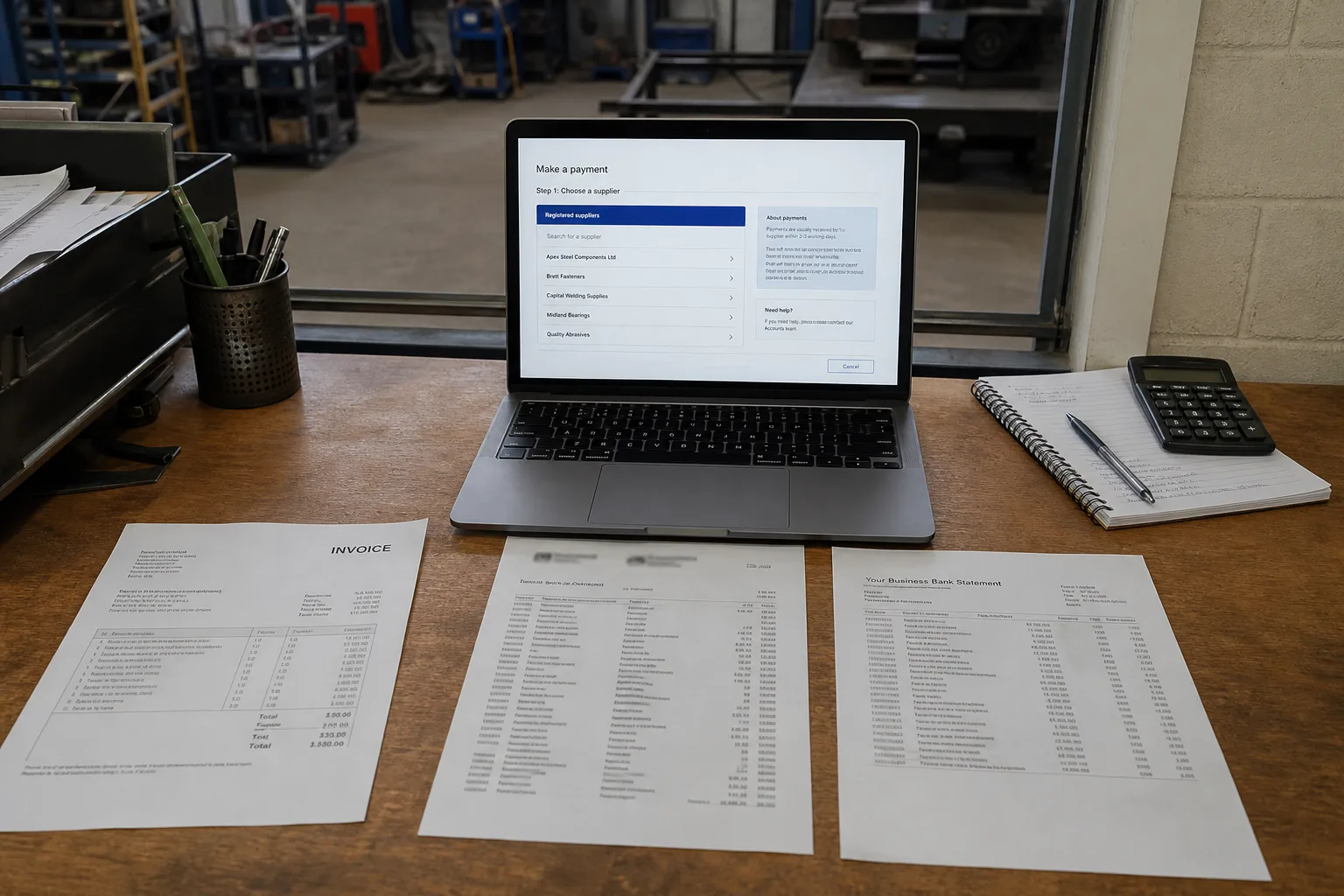
March closed at a profit of about eleven thousand dollars. The checking account ended the month roughly nine thousand lower than it started. Both numbers are correct. They are measuring different things, and the second one is the one that decides whether payroll clears on the fifteenth.
This is the month most small suppliers hit the first time they land a customer much larger than themselves. The work goes well. The invoice is approved. And the money sits somewhere between an accounts payable queue and a payment run calendar you were never shown.
The same March, written two ways
Take a fabrication shop with one big account and a handful of small ones. The figures below are an illustration, not survey data, but the shape is the point.
| Line | Profit view (accrual) | Cash view |
|---|---|---|
| Large customer, invoiced March 6, net 60 | +$64,000 revenue | $0 received |
| Small customers, paid on delivery | +$19,000 revenue | +$19,000 received |
| Materials for the large job, bought in February | $0 (expensed in February) | -$8,500 (card paid in March) |
| Materials bought in March | -$41,000 cost of goods | -$41,000 |
| Payroll, rent, insurance, fuel | -$31,000 | -$31,000 |
| Equipment loan payment | -$900 interest only | -$4,100 principal and interest |
| Owner draw | $0 | -$3,000 |
| Month total | +$11,000 | -$68,600 |
Nothing here is a trick. The profit view credits the $64,000 on the day the work was earned. The cash view credits it on the day the funds land, which under net 60 terms is early May, and in practice often later. The loan principal never appears on the income statement at all, because repaying borrowed money is not an expense. The owner draw does not either.
So a profitable March is funded by February's bank balance, and April is funded by March's small customers. The large invoice is a future month's oxygen.
The people who actually decide your payment date
The person who hired you almost never controls when you get paid. At a company with a real finance function, the sequence runs through at least four desks, and each one can stop the clock.
- The buyer or project manager. Signs off that the work happened. Usually responsive, usually powerless over timing.
- The supplier portal. Not a person, but it behaves like one. If the purchase order number, the line item description, or the tax treatment on your invoice does not match what the portal expects, the invoice is rejected or parked. Nobody necessarily calls you.
- Accounts payable. Matches invoice to purchase order to receiving record. A three-way match failure is the single most common reason a correct invoice ages past terms.
- The payment run. Many larger organizations pay on fixed cycles, often twice a month. Clearing approval on the sixteenth when the run closed on the fifteenth costs you two weeks and no one has done anything wrong.
Which means the useful question at contract signature is not "what are your terms." It is: who approves, what is the portal, what breaks a match, and when do payment runs close. A procurement contact will answer all four if asked plainly, and will rarely volunteer any of them.
Three ways to cover the gap, compared
Assume the gap is real and recurring. You have roughly three instruments, and they are not interchangeable.
A bank line of credit
Cheapest of the three if you qualify. You draw when the gap opens and repay when the large invoice lands. The constraint is timing: underwriting takes weeks, and banks are more willing to lend against two years of statements than against one good contract. The Small Business Administration oversees the federal loan guarantee programs that sit behind many of these lines, and a lender participating in those programs can often approve a borrower it would decline on its own balance sheet. Set the line up before you need it.
Invoice financing or factoring
A provider advances a share of the invoice face value, commonly most of it, and collects the balance less a fee when the customer pays. Faster to arrange, more expensive, and the real variable is whether it is recourse or non-recourse. Under recourse, if your customer never pays, you repay the advance. Read who is permitted to contact your customer, and in what tone. A factoring provider chasing your best account on day 35 can cost you more than the fee.
The customer's own early payment program
Large buyers increasingly run supply chain finance or dynamic discounting through their portal: take payment on day ten, accept a discount. The effective annualized cost can be higher than a bank line, but there is no application, no personal guarantee, and no third party touching the relationship. If you are going to use it routinely, price the discount into your quote rather than absorbing it.
What to change before the next large contract
Billing structure moves more cash than financing does. Milestone billing on a long job, a deposit against materials, or splitting one $64,000 invoice into three staged ones all pull money forward without costing a fee. Large organizations accept these far more often than suppliers expect, because their own procurement teams write such terms regularly.
Then build the dispute path in advance. Get the name and email of the AP supervisor, not just the clerk. Record the portal submission reference for every invoice. When something ages past terms, a dated email citing the purchase order number, the submission date, and the contract payment clause moves an invoice faster than six phone calls, and it creates the record you would need if the matter ever went further.
Run both statements every month, side by side, and the surprise disappears. Profit tells you whether the business model works. Cash tells you what you can safely spend on Tuesday. A thirteen-week forward cash projection, updated weekly, turns the large customer's payment calendar from a threat into a known date you can plan around.
Tobias Renfrew
Tobias covers complaints, claims, and the paths open once something has gone wrong.