Homes
Planning a Patio Under a Big Conifer? The Four People Who Decide the Order of Work
Before the pavers arrive, an arborist, a drainage contractor, a permit reviewer and your downhill neighbor have already shaped what your yard can be.
- Words
- 1,213
- Written by
- Tobias Renfrew
- Filed
Most yard projects that end up in a dispute did not start with bad workmanship. They started with a sequence that suited the calendar of whoever was available first. The paver crew had an opening in April. The arborist had a three-week wait. The drainage work was quoted as an add-on and got deferred to "phase two," which is the phrase homeowners use when they mean never. Two winters later there is standing water at the low corner of a new patio, a fifteen-inch root plate lifting the edge course, and four different companies each explaining why the problem belongs to one of the other three.
The order matters more than the budget. A household with modest money and the right sequence usually ends up better off than one that spends heavily in the wrong order. That is not a design principle. It is a practical observation about who has authority over what, and about how hard each decision is to reverse once the next trade shows up.
Four people already have a say, and only one of them works for you
Think about a typical project in a wet climate: a sloped lot, a mature conifer near the property line, a plan for a level patio and some raised beds. Before anything decorative happens, four parties have influence over the outcome.
The first is a certified arborist, who assesses whether the tree is a hazard, whether it can be retained, and what the root protection zone looks like. The second is whoever handles grading and drainage, because the water leaving your lot has to go somewhere specific and legal. The third is a municipal permit or code reviewer, who in many jurisdictions has authority over both significant-tree removal and stormwater discharge. The fourth is the neighbor downhill, who has no formal role until the day they decide they do.
Only the contractors are working for you, and even then their scope is defined by the contract you signed, not by your general hope that the yard will work. The reviewer is applying a code. The neighbor is protecting their own basement. None of them is obliged to warn you that your sequence is wrong.
The arborist's report is a document, not a second opinion
Homeowners tend to treat an arborist the way they treat a landscaper: someone who gives an opinion, which you can weigh against another opinion. In practice, in cities with tree ordinances, the arborist's written report is closer to an engineering document. It gets submitted. It gets reviewed. It gets relied on by the permit office, and later by an insurer or an attorney if something falls.
That has two consequences. First, the report has to be written before you decide where the patio goes, because the root protection zone will determine how close you can excavate and whether you can compact soil in that area at all. A design drawn first and an arborist consulted second produces a design that has to change. Second, the report is evidence. If a tree is later removed without one, or removed contrary to one, the household is exposed in a way a verbal conversation would never have created.
This is also where local rules bite hardest. In the Pacific Northwest, a large Douglas fir or western red cedar is often a regulated tree, and a household looking into seattle tree removal will find that the question is not whether a crew can take it down but whether the city agrees it should come down, and what has to be planted in its place. The answer arrives as a permit condition, not as a quote.
Get that settled early and the rest of the project gets simpler. You know what stays, you know where you cannot dig, and you know your replanting obligation before you have spent money on a layout that ignores it.
Water has to leave your lot at a place someone has agreed to
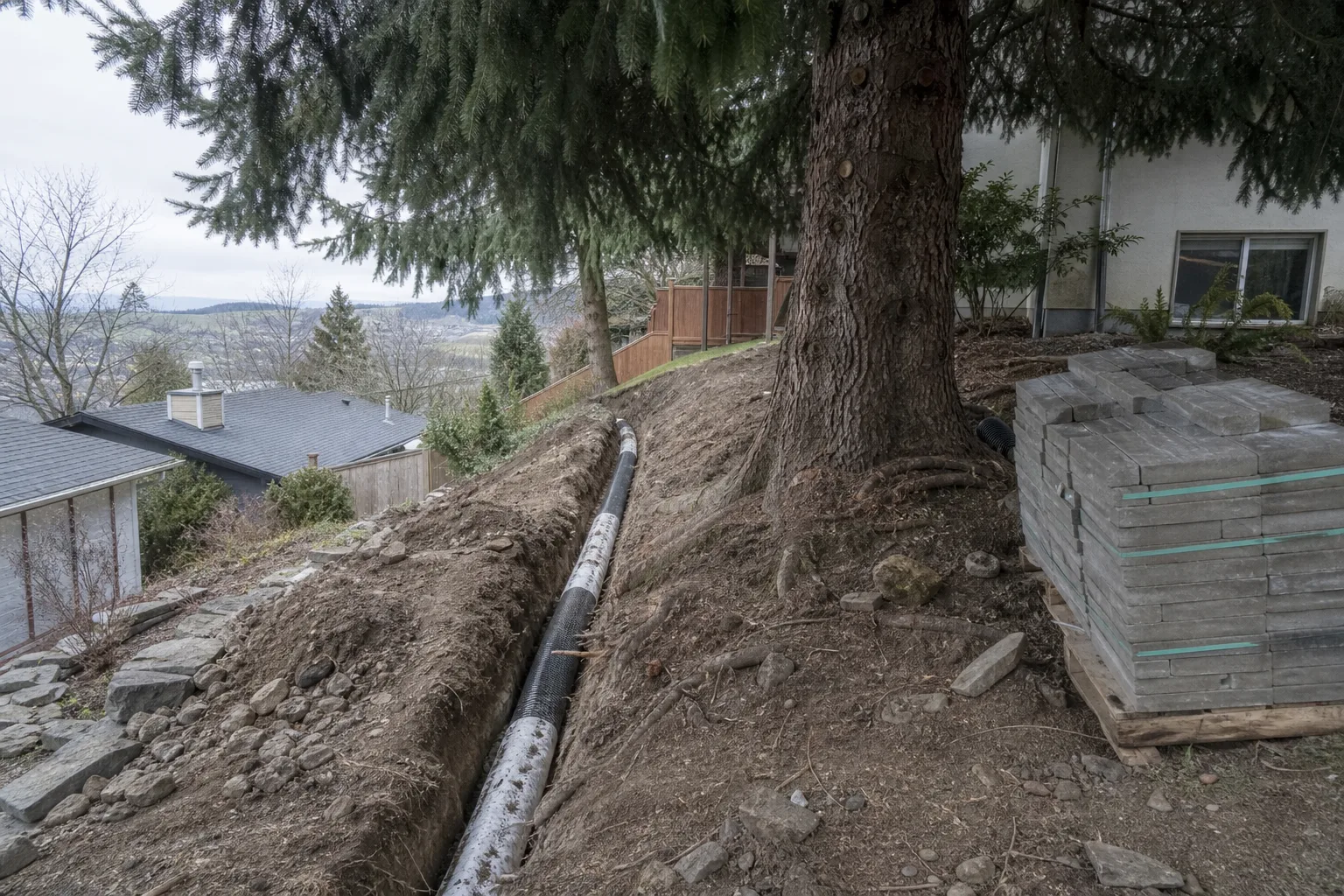
The part homeowners consistently underestimate is the discharge point. A drainage plan is not a trench. It is a route with a legal endpoint: a storm connection, a dispersion trench, an infiltration system sized for your soil, or a daylight outlet that does not dump onto someone else's ground.
Stormwater runoff from developed property is regulated at the federal level, with the Environmental Protection Agency responsible for the national framework that state and city programs implement. What that means for a household is that the local requirements you run into are not arbitrary municipal fussiness. They connect to something larger, and the reviewer applying them has limited discretion to waive them because your patio is small.
This is where the downhill neighbor becomes relevant. Redirecting water onto an adjoining property is the most common origin of a landscaping dispute I see, and it rarely surfaces in the first dry summer. It surfaces in the first heavy fall. By then you have a finished patio sitting on top of the pipe that needs to be changed.
The practical fix is unglamorous. Have the drainage route drawn on a plan, with the discharge point named, before any hardscape is ordered. Ask the contractor directly where the water goes and what happens to it when it gets there. If the answer is a gesture toward the back fence, you do not yet have a drainage plan.
Why the decorative trades are the ones who suffer from a bad sequence
There is an unfairness in how this plays out. The paver installer, the irrigation tech, the mason building the raised beds: these are the trades whose work is visible and whose reputation absorbs the damage. When a patio heaves because the subgrade stayed saturated, nobody blames the subgrade. They blame the person who set the pavers.
Good installers know this, which is why the better ones ask uncomfortable questions before they bid. If a hardscape contractor asks about your downspouts, your soil percolation, and whether an arborist has been out, that is a favorable sign about how they work. If they quote a square-foot price over the phone without seeing the slope, the number is not really a price. It is a placeholder.
You can use this. Put the sequence in the contract itself: tree work and its permit conditions completed first, grading and drainage installed and inspected second, hardscape third, planting and irrigation last. Tie a portion of payment to the drainage being observed working, not merely installed. Ask for photographs of the base and the pipe before backfill, and keep them. If there is ever an argument about whose work failed, the household with dated photos of an open trench is the one who can actually prove something. The household without them is relying on memory against three companies who remember it differently.
Keep the invoices, the arborist report, the permit and the approved plan in one folder. That folder is what turns a frustrating winter into a solvable claim.
None of this makes the project longer in any meaningful sense. It moves the slow, permitted, unphotogenic work to the front, where it costs a season of patience, instead of to the back, where it costs a rebuild. The patio still gets built. It just gets built on ground that has already been argued about and settled.
Tobias Renfrew
Tobias covers complaints, claims, and the paths open once something has gone wrong.