Commerce
Packing Your First Shipments? What Changed in Damage Claims and Who Carries the Loss
Carrier liability, box economics and marketplace rules all moved in the last decade. Here is what a first-time shipper should do differently at the packing bench.
- Words
- 1,175
- Written by
- Grant Weatherby
- Filed
The first box you ship out the door carries more than the product. It carries a set of assumptions about who pays if the thing arrives broken, and most of those assumptions were written for a market that no longer exists. A decade ago, a small seller could overpack with cheap void fill, write Fragile on the side, and treat the occasional claim as a nuisance. The economics of the box have changed since then, and so has the way carriers and marketplaces decide whose problem a damaged item is.
None of this is hard once you see where the decision points sit. But they are not where a first-timer expects them to be. The decisive moment is usually at the packing bench, several days before anything goes wrong.
The box stopped being free space and started being billed space
Ten years ago the standard advice for protecting a fragile item was simple: go up a box size and fill the gap. Shipping was priced largely on weight, so air inside the carton was close to free. That advice is now expensive. Dimensional weight pricing, where the carrier bills on whichever is greater, actual weight or cubic volume divided by a published divisor, has pushed the cost of empty space into every label you buy. The oversized carton that once cost nothing now shows up on your invoice on every single unit.
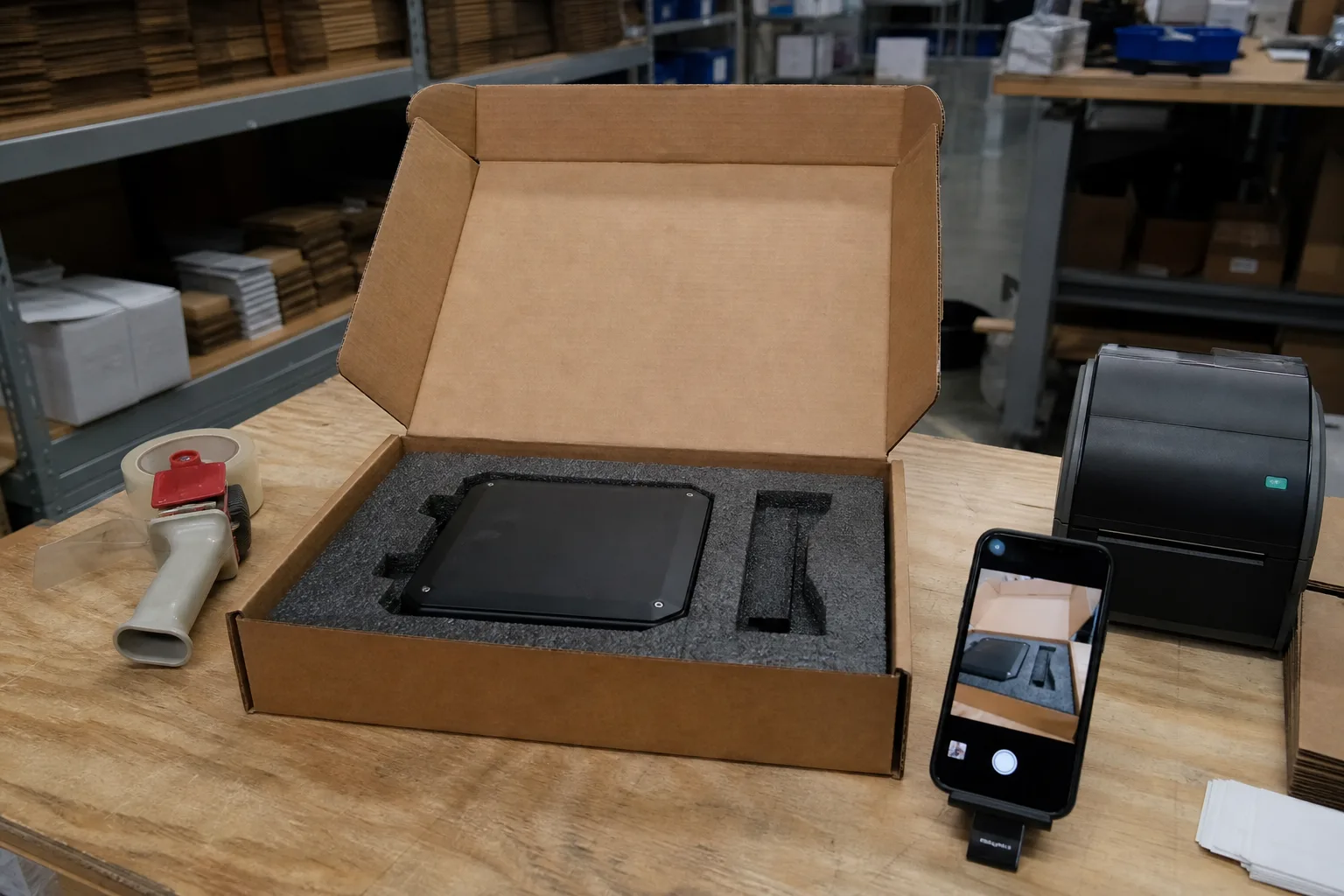
The response is not thinner packing. It is better packing in a smaller footprint. Suspension and retention packaging, molded pulp, custom-cut foam inserts and corrugated that is rated for the load all do more protective work per inch than a drift of loose fill. A first-time shipper who has only ever seen packing peanuts tends to assume cushioning volume equals protection. What actually matters is whether the product is immobilized, kept off the walls of the box, and cushioned against the specific drop orientations it will see.
There is a second shift tied to this. Large marketplaces now push sellers toward ship-in-own-container formats, where the retail package itself survives transit without an outer box. That is a real cost saving when it works, and a reliable source of damage when it is adopted without testing. If you are going that route, the package needs to have been through a transit test protocol, not just a thumb-press and a hope.
Carrier liability was never insurance, and the claim window got shorter
Here is the piece that catches nearly every new shipper. The amount a carrier will pay for a lost or damaged parcel is set by its tariff or service guide, not by what the item is worth. There is a default liability figure that applies automatically, and above that you have to declare a higher value and pay for it. Declared value is a contractual liability limit. It is not a policy of insurance, and the distinction matters when you read the exclusions.
What changed is how the claim gets adjudicated. A decade ago a damage claim was often a phone call and a mailed form, with a human inspecting the carton. Today it is a web portal, and the portal asks for things you can only supply if you planned ahead: photographs of the item before packing, photographs of the interior packaging, the carton and label photographed from multiple angles after damage, the commercial invoice, and the original packaging retained for possible inspection. Carriers also apply firm filing deadlines measured in days for visible damage and a slightly longer but still tight window for concealed damage. Miss it and the merits of the claim stop mattering.
The most common denial reason remains insufficient packaging. Carrier service guides describe expected packaging practice in detail, and a claim adjuster compares your photos against it. A seller who can produce a photo of the item seated in a cut insert with adequate clearance on all sides is in a very different position from one who can only describe what was in the box.
Who carries the loss depends on which sale you are making
Three different frameworks can apply to the same parcel, and a first-timer needs to know which one is live.
If you are selling to a consumer, the practical answer in the United States is that the risk sits with you until the buyer has the goods. The Federal Trade Commission is responsible for the rule governing merchandise ordered by mail, internet or telephone, which sets expectations around shipment timing and the seller's obligations when delivery does not happen as promised. A customer whose box arrives crushed is your problem first. You make them whole, then you pursue the carrier. Reversing that order, telling a retail buyer to file their own claim, is both a service failure and usually a losing position in a payment dispute.
If you are selling business to business, the terms of sale govern. Whether title and risk pass at your dock or at the buyer's receiving door is a question your purchase order or sales terms should answer explicitly. On freight shipments, the delivery receipt is the critical document: damage noted at the time of delivery is a materially stronger claim than damage discovered after a clean signature.
If you are selling through a marketplace, the platform's seller protection policy is a third layer sitting on top of both. These policies have become more prescriptive over the past decade. They typically require tracking, delivery confirmation, and in some cases signature confirmation above a value threshold, and they decide item-not-received and item-damaged disputes against their own published standard rather than the carrier's. Meeting those requirements is cheap. Discovering them during a dispute is not.
What a first-time shipper should actually do differently
Build the documentation habit before you have volume, because it is nearly impossible to retrofit.
- Photograph every outbound order at two stages: the item in the open carton with cushioning visible, and the sealed, labeled box. Store the images against the order number. This single habit resolves most disputes in your favor.
- Decide your declared value policy by math, not by instinct. Compare the per-parcel cost of declaring value against your historical damage rate and average order value. For low-value items, the premium often exceeds the expected loss. For high-value items it rarely does.
- Look at third-party parcel insurance, which has grown substantially as an alternative to carrier declared value and frequently prices below it with a broader coverage definition. Read what it excludes before you switch.
- Write your claim deadlines on the wall. Separate figures for visible and concealed damage, separate again for lost parcels, and calendar them so a claim never ages out while you wait on a customer reply.
- Test one package design properly. Drop it, at weight, on corners and edges, on a hard floor. One afternoon of this tells you more than any supplier catalog.
The shipper who gets this right is not the one with the thickest packaging. It is the one who knows, before the first order ships, exactly which document decides the argument and has already filed it.
Grant Weatherby
Grant writes about what has changed lately and what it means.