Family
Ordering a Memorial This Year? The Four Documents That Decide What You Cannot Change
Cemetery rulebooks and monument lead times have both moved. Here is the paperwork that keeps an irreversible decision from being made in a bad week.
- Words
- 1,155
- Written by
- Grant Weatherby
- Filed
The part of this that surprises people is how slow it is. A monument dealer takes an order in March and sets the stone in September. The cemetery pours foundations only in certain months. The engraving proof arrives as a PDF attachment on an ordinary Tuesday afternoon, seven weeks after anyone last thought about it, and it needs a signature back by Friday. That gap between the decision and the object is the whole problem, and it is also the opportunity: almost nothing about a memorial has to be settled in the first two weeks.
What has changed recently is the paperwork on both ends. Cemeteries have been rewriting their rules and regulations, and monument suppliers have been reworking lead times and price sheets. Neither change is dramatic on its own. Together they mean the document a family was handed three years ago is not the document they will be handed now, and the assumptions built on the old one quietly stop working.
What moved, and why the old advice reads differently now
Cemetery rulebooks are being updated more often than they used to be, mostly for maintenance reasons. Grounds crews mow with wider equipment than they did a generation ago, so flush markers and upright markers get segregated into different sections with different specifications. Rules on what sits beside a stone have tightened in a lot of places: glass vases, solar lights, shepherd's hooks, fenced borders. Rules on what sits on a stone have loosened in others, with more cemeteries now permitting ceramic photo inserts or a small etched code linking to an online tribute page, subject to approval.
On the supply side, granite quarrying, shipping and skilled hand-engraving have all been repriced, and the calendar has stretched. It is normal now to be quoted a delivery window measured in months rather than weeks, particularly for anything hand-carved, anything in an unusual color, or anything that has to clear a committee at the cemetery before fabrication starts.
Pricing disclosure is the other piece. The Federal Trade Commission is responsible for the Funeral Rule, which governs how funeral providers present prices to consumers, and the agency has been reviewing how that rule applies to the way people shop now, which is largely online before anyone walks into a building. The practical effect for a family is that an itemized written price list is something you are entitled to ask for and read line by line, and that a memorial is a separately priced item you can source separately from the funeral itself.
The decisions with no revision cycle
Most of the choices around a service can be adjusted, redone or simply let go. Three cannot.
The interment right. Buying a plot or a niche is buying a right of burial in a specific location, not the land. It comes with a certificate and a rule set attached to that particular section, and the section determines what kind of marker is permitted. Families sometimes pick a location for the view and then discover the section only allows flush bronze. Read the section rules before the location is chosen, not after.
The stone itself. Granite is cut, polished and sandblasted once. A misspelled name can sometimes be patched with a filled and recut letter, and the patch is usually visible in raking light forever. Material, finish, shape and size are permanent in the plainest sense.
The layout, including the space you leave empty. A companion marker with one name cut and one side blank is a common and sensible choice, but the blank side commits you to a design language decades in advance: the same font, the same depth, the same margins, cut by whoever is in business at the time. Decide deliberately whether you are leaving room, and write down what was left.
Four documents that carry the whole project
Everything manageable about this sits in four pieces of paper. Get all four into one folder, physical or shared, and the project stops depending on anyone's memory during a hard month.
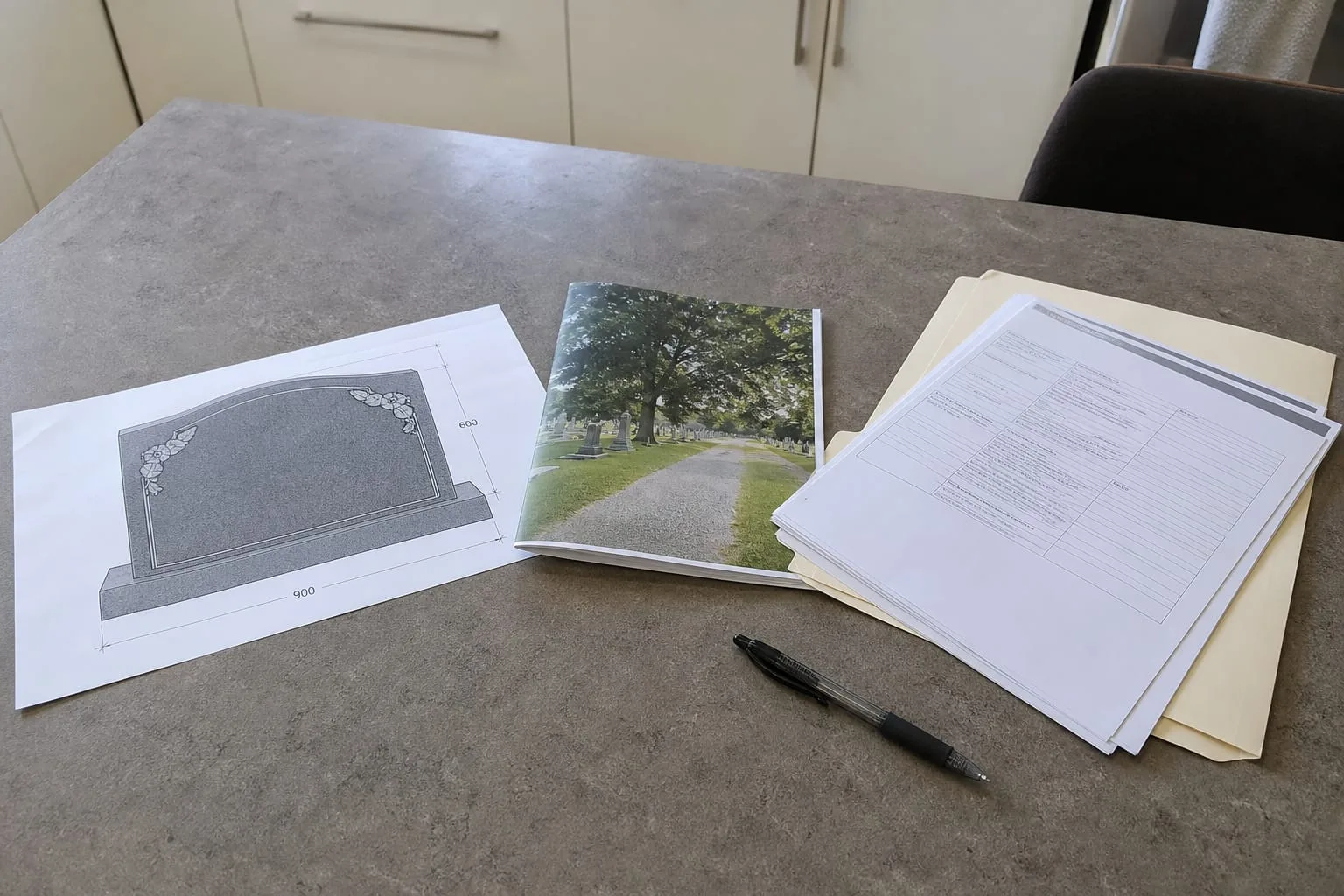
- The cemetery's rules and regulations for your specific section. Ask for the current version in writing, with a date on it. Confirm permitted marker types and maximum dimensions, whether a foundation is required and who pours it, the fee for setting, and the seasonal window when installation happens.
- The interment rights certificate and the record of who holds it. This is the document that establishes who is authorized to approve a marker at all. If it is held by someone who has since died, find out now what the cemetery requires to transfer it, because a monument application will stall on exactly this point.
- The monument application or permit. Most cemeteries require the design to be approved before fabrication. The dealer usually files it, but you should hold a copy showing what was submitted and what was approved, including dimensions and any inserts.
- The signed proof, plus the itemized order. The proof is a scale drawing of the finished stone. The order should name the material and color, the finish, the exact dimensions, the base, the lettering style, delivery and setting charges, and what the warranty actually covers.
How to read a proof without trusting yourself
The proof is the last reversible moment. Treat it as a checking task rather than an aesthetic one. Read the name and both dates aloud, character by character, against an original document: a death certificate, a birth certificate, a discharge record. Do not check against your own memory or against an obituary, which may itself contain the error. Have a second person do the same pass independently, on a different day. Check the punctuation in the epitaph and the spelling of any place name or foreign-language phrase.
Then look at what the proof does not show: how the stone sits on the base, how wide the margins are, and whether a second inscription would fit in the space that remains. Ask the dealer to confirm those in writing. Sign and date the proof, keep the copy, and note the promised delivery window in a calendar with a reminder set two weeks before it.
The version of this that fits a normal week
A temporary marker holds the location while you take your time. Cemeteries provide them routinely, and a great many families set the permanent stone somewhere between six months and a year later. That interval is not a delay, it is the working period: it is when the rule sheet gets read, the certificate gets located, three dealers get asked for itemized quotes on the same specification, and the wording gets argued about over a couple of dinners instead of in a single afternoon.
Handled that way, the whole thing becomes a series of small, bounded tasks, none of which needs to happen on the worst day. The folder does the remembering. The proof catches the errors. What ends up cut in stone is what everyone actually meant.
Grant Weatherby
Grant writes about what has changed lately and what it means.