Family
Ordering a Casket for a 1970s Family Plot? The Dimensions Decide More Than the Finish Does
An oversize casket in an older cemetery plot sets off a chain of costs and constraints that nobody traces back to the twenty minutes spent in the selection room.
- Words
- 1,148
- Written by
- Grant Weatherby
- Filed
The casket is usually picked in under half an hour, in a room where every lid is open and the price cards are small. It is also the one purchase in a funeral that sets physical limits on everything that follows: what the cemetery can put in the ground, what the opening and closing fee will be, whether a crypt front will close, and what a family can and cannot do if the grave is ever relocated. Almost none of that is discussed while the lids are open.
What has moved in the last few years is where the decision gets made. Third-party sellers now ship nationally on short notice, price lists sit online, and federal rules governing funeral price disclosure mean a funeral home cannot refuse a casket you bought elsewhere or add a fee for handling it. The Federal Trade Commission is responsible for those disclosure rules. The practical effect is that families are choosing earlier, sometimes from a kitchen table at midnight, and often before anyone has called the cemetery. That is the sequence worth reversing.
One narrow case: an oversize casket in a plot bought in 1974
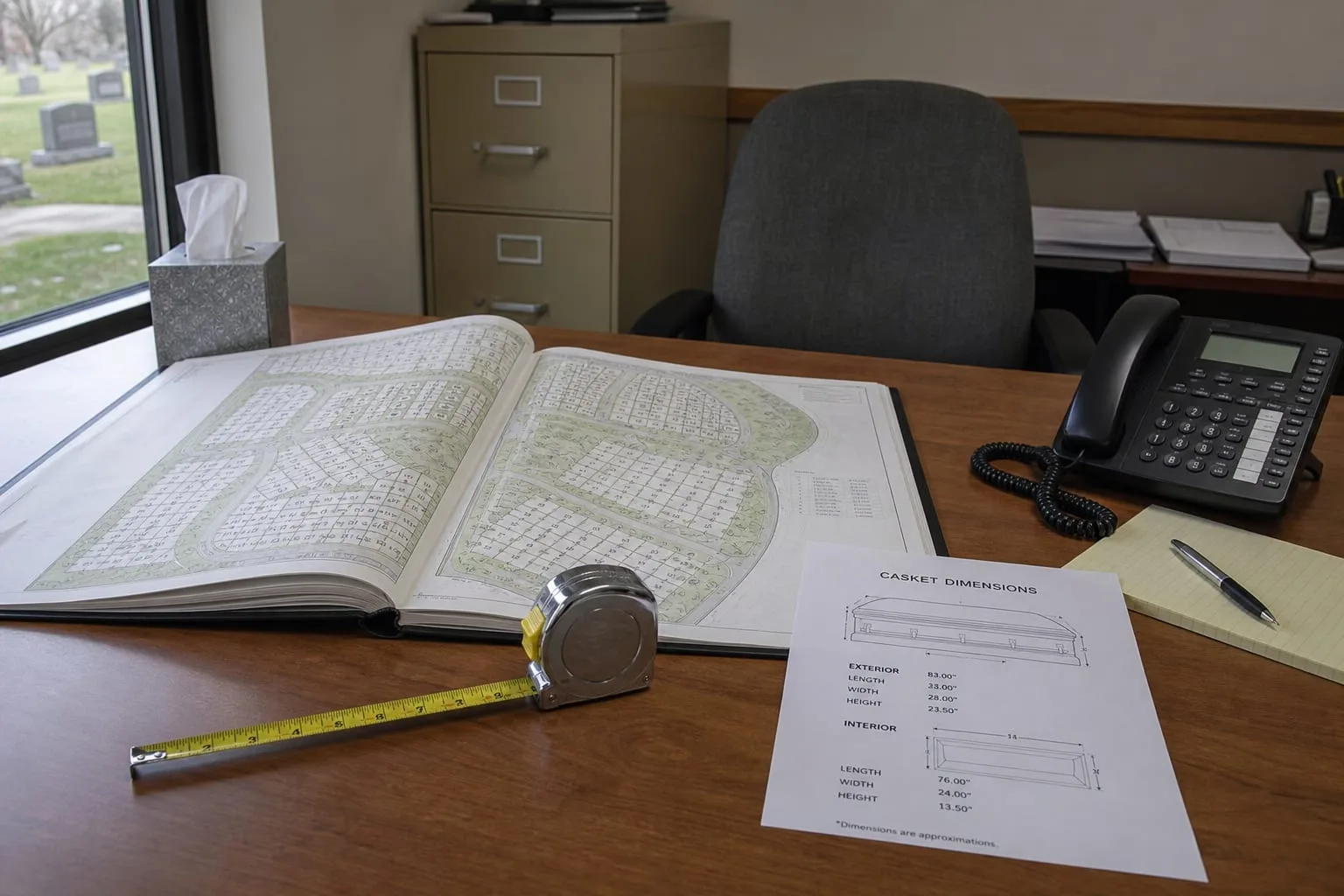
Take a family with two graves purchased in the mid-1970s in a lawn section, sold as standard single spaces. The person who died was a large man. The selection room has an oversize casket, wider inside and wider outside, and it is the obvious humane choice. Nobody in the room knows the plot dimensions, because the deed does not state them in inches.
Here is the chain that follows. The cemetery requires an outer burial container, either a concrete grave liner or a sealed vault, and its inventory of containers is sized for standard exterior widths. An oversize casket may need an oversize vault, which is a separate order with its own lead time. The excavation is wider, which can mean a higher opening and closing fee, sometimes a shoring charge, and in tight older sections it can encroach on the adjoining space. If that space is the family's second grave, the family has just used both. If it belongs to someone else, the cemetery will say no and the casket has to be exchanged in the twenty-four hours before the service.
None of that is a catastrophe if the order runs the other way. One call to the cemetery office produces the maximum exterior length and width their sections and outer containers accommodate, whether oversize vaults are stocked or ordered, and what the fee difference is. Ask for exterior dimensions in inches, not interior, because that is the number the ground cares about. Then choose.
Comparing the options by what they change downstream
Material and finish are the categories the catalog is organized around. They are not the categories that generate consequences. The useful comparison is between what each choice commits you to.
| Choice | Where it shows up later | Can it be changed? |
|---|---|---|
| Standard versus oversize exterior width | Vault availability, excavation cost, crypt and lawn crypt fit, whether an adjoining space is consumed | Only before the casket is in use, and only if the cemetery is asked first |
| Gasketed ("sealed") versus unsealed | Price, and the assumptions the family carries about preservation | The purchase is final once the casket is used |
| Metal gauge or hardwood species | Weight, number of bearers, appearance at the service | Reversible up to delivery, not after |
| Cloth-covered softwood or a rental casket with an insert | Cost, whether a viewing is possible, what is buried or cremated | Reversible until the service is arranged around it |
| Combustible construction for cremation | Whether the crematory will accept it, and what the container fee is | Reversible before the cremation is scheduled |
Weight deserves more attention than it gets. A heavy hardwood or thick-gauge metal casket with an occupant is a real load on a set of pallbearers, on cemetery equipment in a soft section after rain, and on a church stair. Funeral directors will handle it, but they will handle it with more staff, and staffing shows up on the statement.
The gasket question, and the one thing it does not do
A gasketed casket has a rubber seal and a locking mechanism. It is sold as protective, and the protection it offers is against water and soil entering for some period. It does not preserve a body, and sealing can accelerate anaerobic decomposition, which is why sealed units are sometimes fitted with a vent and why cemeteries and vault companies deal with pressure buildup as a routine matter.
The reason to raise this is not to argue against sealing. It is that families who chose a sealed casket for preservation reasons carry an expectation, and that expectation resurfaces at disinterment. Graves get moved: a family relocates across the country, a plot turns out to be in a section slated for a road widening, or a spouse dies in another state and the family consolidates. When a casket is raised years later, the condition of the casket and its contents is unpredictable regardless of what was paid, and the cemetery will require a new outer container and often a sealed transfer case for transport. Deciding with clear eyes now prevents a second grief later.
Buying it yourself, and the timing that makes it work
Buying outside the funeral home is legal, common, and priced differently, sometimes by a wide margin for a comparable unit. Independent sellers list funeral caskets with exterior dimensions, gauge, interior fabric and shipping windows published on the page, which is exactly the information a selection room tends to leave verbal.
Three logistics points decide whether it goes smoothly. First, delivery has to be arranged to the funeral home, with the funeral home's written agreement on a delivery window and someone authorized to receive it. Second, somebody has to inspect it on arrival for freight damage before the driver leaves, and the seller's replacement terms and turnaround matter more than the price difference if a corner is crushed. Third, the funeral home cannot charge you a handling fee, but it also cannot compress its own preparation schedule to absorb a late delivery. Order early in the arrangement process, not after the obituary has run with a time in it.
The order to ask questions
Cemetery first: maximum exterior dimensions, outer container requirement and stock, opening and closing fees for standard versus oversize, and whether the section allows double depth. Funeral home second: the itemized price list, the delivery window it will accept, and what the service looks like with the casket closed or open. Seller third, once you know the number of inches you are allowed to work with.
Run in that order, the choice narrows to appearance and price, which are the two things a family is actually equipped to decide in a hard week. Run backwards, and a set of inches nobody measured turns into a decision that the ground makes for you.
Grant Weatherby
Grant writes about what has changed lately and what it means.