Legal Affairs
One Ticket, One Flat Fee. What That Number Covers and What Sits Outside It
A single speeding citation is usually quoted as a flat fee, but the fee is quoted against a defined unit of work. Here is how to find the edges of that unit before you pay.
- Words
- 1,109
- Written by
- Tobias Renfrew
- Filed
A speeding citation is one of the few legal matters where a lawyer will give you a price over the phone in under a minute. That speed is possible because the work is standardized and the fee is quoted against a single, well-defined unit: one citation, one court, through to disposition. Understand what that unit includes and the quote becomes readable. Miss it, and you end up surprised by a second invoice for something you assumed was part of the first.
Take a narrow case and follow it all the way through. One driver, one ticket, 14 miles per hour over on a posted arterial, no accident, no prior moving violation in the past three years, and a court date roughly six weeks out in the municipal court where the stop occurred. That is the most common matter in traffic defense, and it is the one where fee structures are easiest to compare because the work is close to identical from firm to firm.
The fee is quoted against the citation, not the hour
Hourly billing is rare here, and for good reason. Nobody wants to pay for time on a matter whose entire downside is a fine and an insurance consequence. So the standard is a flat fee covering: review of the citation and the officer's narrative, entry of appearance, the filing that preserves your right to contest, communication with the prosecutor or the court's traffic unit, and attendance at the hearings the case actually requires.
That bundle is the unit. What differs between firms is where they draw the line around it. Some quotes cover every appearance until the case is resolved, including a contested hearing with the officer present. Others cover the negotiated path only, and treat a contested hearing as a separate engagement at a separate price. Both are legitimate. They are not the same purchase, and comparing the two numbers side by side without asking tells you nothing.
Ask the question plainly: if the prosecutor will not reduce this, and we go to a contested hearing, is that inside the fee I am paying today? Get the answer in the engagement letter, not in a phone call.
What moves the number on a single-ticket quote
Four things drive price on a matter this small.
- The court. Some courts allow counsel to appear without the client and resolve the matter in a single calendar call. Others require multiple settings, or the driver's presence, or run a docket that eats half a day. A firm that appears in that court weekly prices the travel and the waiting into the fee.
- The speed alleged and the zone. A reading in a school or construction zone, or one high enough to trigger a reckless or excessive-speed charge, changes the exposure and therefore the work. At that point the matter stops being administrative.
- Your record and your license type. A clean record is leverage with a prosecutor. A second violation inside a short window is not, and the negotiation takes longer. A commercial license changes the analysis entirely, because the Federal Motor Carrier Safety Administration is responsible for the national standards governing commercial driver disqualification, and the reductions available to an ordinary driver may not be available to a CDL holder at all.
- Whether evidence is in play. Radar or lidar calibration records, officer certification, dashcam footage. Requesting and reviewing discovery is real work, and a firm that does it as a matter of course prices for it.
When you call a speeding ticket attorney about a matter like the one above, those four facts are what they are listening for, and the quote lands within a narrow band once they have them.
The items that commonly sit outside the quote
Flat fees for traffic work are usually honest about their boundaries, but the boundaries exist. Expect these to be billed separately or not covered:
- Court costs, filing fees, and the fine itself if the case resolves with a payment. The lawyer's fee is never the total.
- A deferral or diversion program fee, where the court offers one.
- Reopening a case after a failure to appear, which is a different procedural posture and a different price.
- An appeal, or a trial de novo in a higher court where the structure allows one.
- Collateral work: a hearing before the state licensing agency over suspension, which is a separate proceeding from the criminal or infraction case even though the same ticket caused both.
That last one catches people. The court case and the license action run on separate tracks with separate deadlines, and a fee quoted for the first does not buy you the second. If your record is close to a suspension threshold, say so at the first call and ask for both quoted together.
Measure the fee against the right baseline
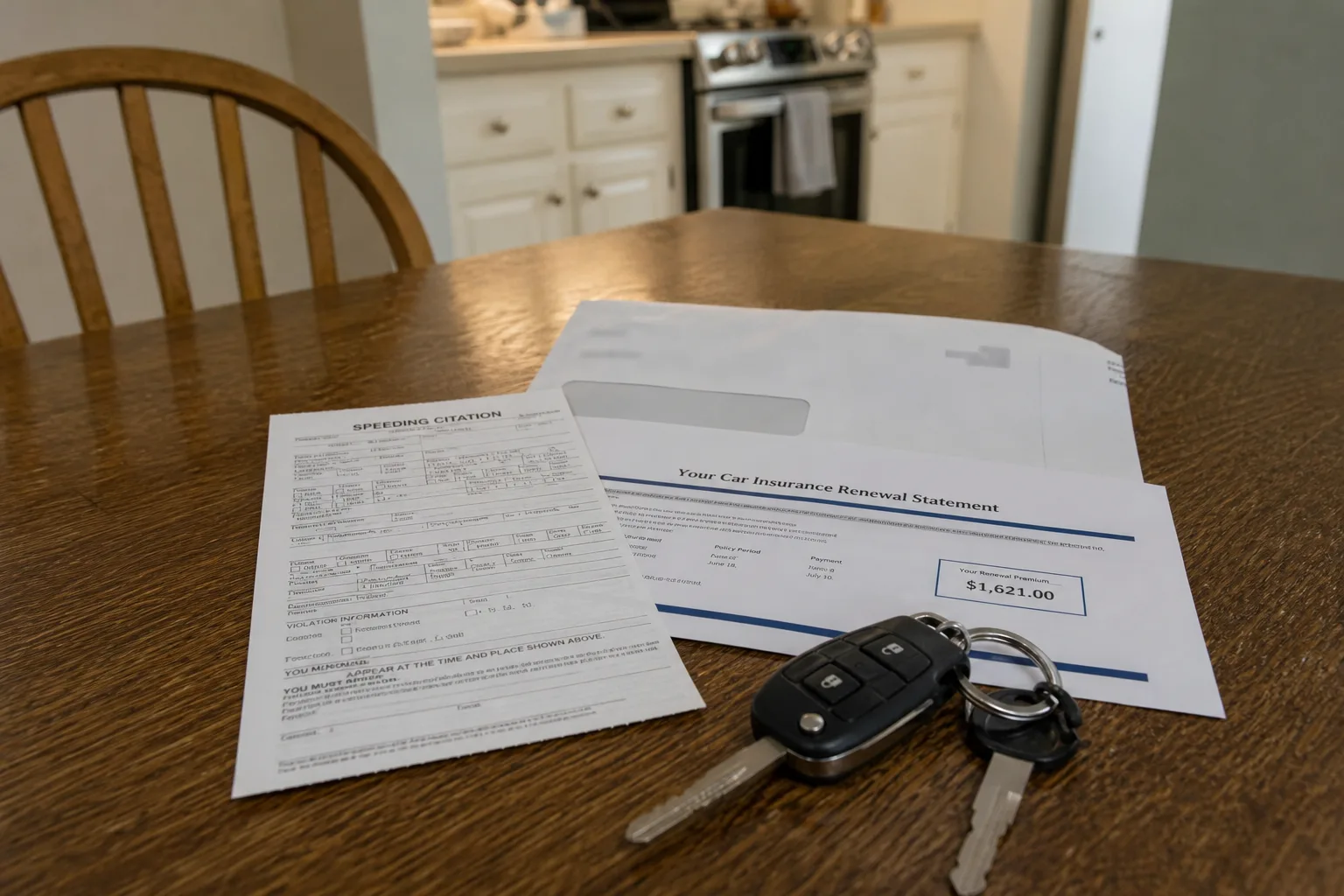
Drivers instinctively compare the attorney's fee to the fine printed on the ticket. That is the wrong comparison. The fine is a one-time number. The consequence that persists is the moving violation on your record and what your insurer does with it at renewal, typically for three to five years depending on the carrier and the state.
So the arithmetic that matters is the fee set against the multi-year premium difference, plus whatever a point total would do to your license standing. Your insurer can tell you, in general terms, how a single moving violation is treated at renewal. Ask before you decide. In some cases the honest answer is that the ticket is cheaper to pay, and a competent lawyer will tell you that rather than take the engagement.
Get the scope on paper before you pay
A written engagement letter for a matter this small should be short and should answer five things: what the fee covers, what it excludes, whether a contested hearing is included, who appears in court and whether you must attend, and what happens to the fee if the case resolves at the first setting. If a firm will not put those in writing, the quote is not a quote.
Also ask what outcome they are actually aiming for: dismissal, reduction to a non-moving violation, deferral, or a negotiated fine with no record impact. Those outcomes have very different value to you, and the one worth paying for is the one that keeps the violation off the record your insurer reads.
The quote arrives fast because the work is routine. The part that is not routine is your record, your license type, and what your carrier does with a single violation. Bring those three facts to the first call and the number you are given will be one you can actually evaluate.
Tobias Renfrew
Tobias covers complaints, claims, and the paths open once something has gone wrong.