Commerce
Moving Stock Into a 3PL? The Cost Hides in Assembly, Not Square Footage
A housewares brand priced outsourced fulfillment by the pallet and discovered the real variable was the labor spent building each order before it shipped.
- Words
- 893
- Written by
- Grant Weatherby
- Filed
A Midwest housewares brand spent two years running fulfillment out of a leased industrial bay with four part-time packers and a shelving system that had grown by accretion. When a national retailer picked up three of its SKUs, the brand did what most companies do: it called third-party logistics providers and asked what pallet storage cost per month. That was the wrong opening question, and the provider it eventually signed with said so during the site visit.
The assumption baked into almost every outsourcing conversation is that a warehouse sells space, and that space plus postage is the bill. Storage is the most legible line item, so it becomes the comparison point. What actually moved this brand's economics was none of that. It was the number of human touches between a shelf and a sealed carton, and the fact that a larger provider had already engineered most of those touches out.
What the pallet quote left out
The brand's products shipped three ways. Direct-to-consumer singles. Wholesale cases to independent stores. And now retail-ready display units, which arrive at the retailer's distribution center pre-built, pre-labeled, and loaded with a specific mix of units in a specific orientation.
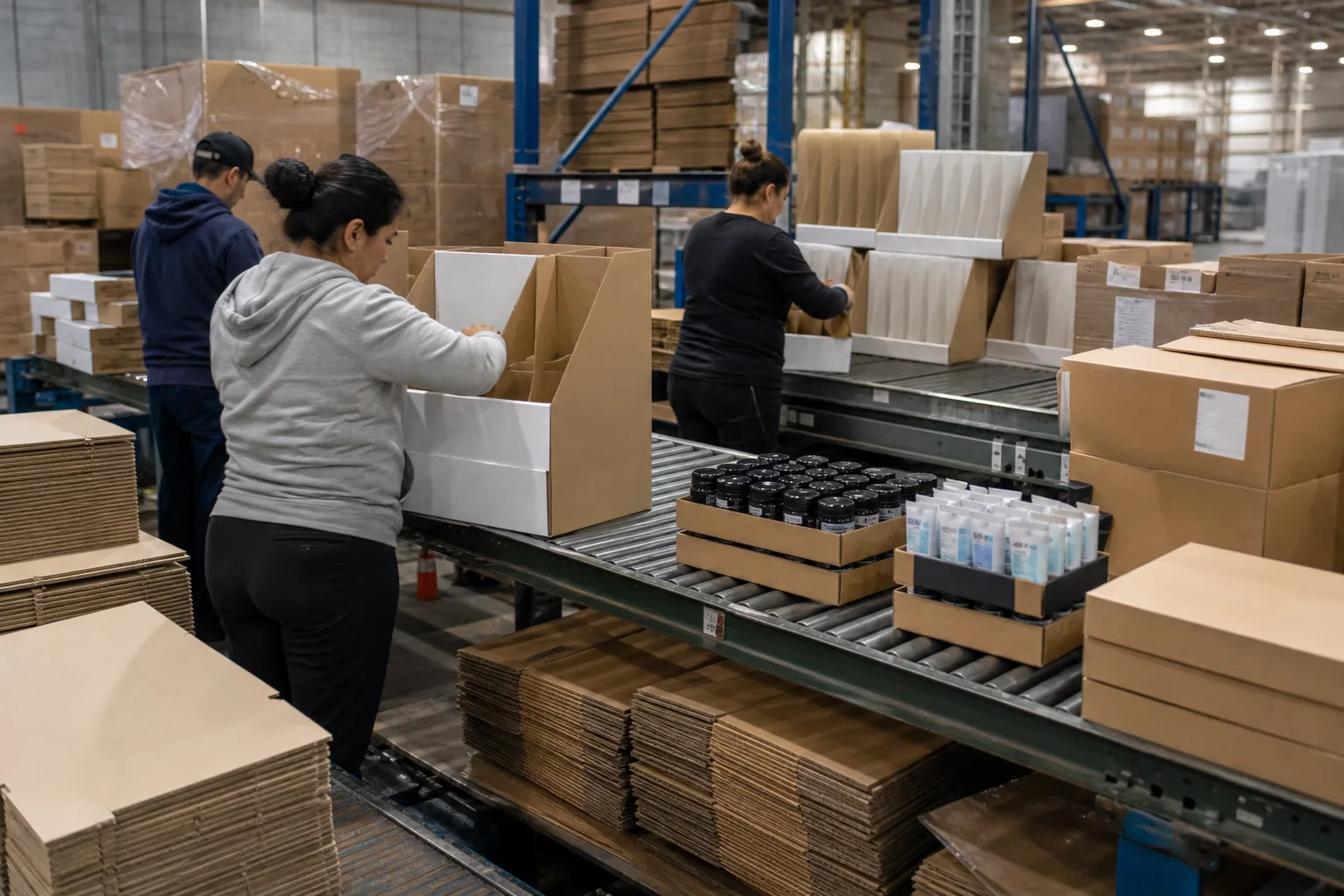
Only the first of those is a simple pick and pack. The second involves case count verification and a pallet build to the buyer's routing guide. The third is light manufacturing wearing a logistics costume: fold a display, seat the tray, load the facings, apply the retailer's carton label, shrink wrap, stage. The brand had been doing that work on folding tables with seasonal temps, and it had never been costed separately from anything else. It was simply what Thursdays looked like.
Storage, in the end, was a small fraction of the monthly invoice at any provider the brand looked at. Labor was the number that varied by multiples between bids, and labor was the number nobody put on the first page.
Why the larger provider priced it differently
Two of the three bidders quoted a flat per-unit assembly rate and moved on. The provider the brand chose asked for a sample display, built twenty of them on its own line, and timed the build. Then it came back with a rate tied to a documented work instruction: specified station layout, specified sequence, a photographed first article, and a quality check interval.
That is the practical difference a bigger operation brings to kitting and fulfillment: it treats assembly as a repeatable process with a measured cycle time rather than as overflow work absorbed by whoever is free. A provider running multiple buildings and multiple clients has already solved the problems a single-brand operation meets for the first time every season, including what to do when a retailer changes a label spec in week three.
It also had something the brand's bay did not: the ability to flex headcount into the build without stopping outbound parcel flow. During the rollout, consumer orders kept shipping on the same day cutoff while the display program ran on a separate line. That separation is why retail compliance chargebacks, the fines a retailer levies for late or incorrectly labeled freight, did not materialize.
The timing rule that sits underneath all of this
Shipping promises are not purely an operational matter. The Federal Trade Commission oversees how merchants represent delivery timing to consumers, and the obligation attaches to the brand whose name is on the order confirmation, not to the warehouse doing the work. A fulfillment partner can be late. The seller is the one answering for it.
This is the practical reason the brand pushed for same-day cutoff language in the contract with a defined measurement window and a monthly report, rather than accepting a general service commitment. If you cannot see the on-time percentage, you cannot tell a customer anything true about it.
What changed in the last two years
Two things have shifted enough to change the arithmetic for anyone still holding their own inventory.
- Parcel pricing now rewards box discipline. Dimensional weight and oversize thresholds mean the carton you choose is a pricing decision, not a packing decision. A provider with a cartonization system and a broad box library will routinely ship the same item in a smaller box than a four-person operation picking from eight sizes.
- Retailers tightened routing compliance. Label placement, ASN accuracy, and appointment windows are enforced more consistently than they were. The cost of getting it wrong is deducted from the invoice, which makes it easy to miss until the remittance arrives.
Both favor scale. Neither shows up in a storage rate.
What to ask before you sign
The questions that separated the bids were narrow and answerable. How long does one unit of my assembly take on your line, and did you time it or estimate it? Who writes the work instruction, and do I get a copy? What happens to my parcel cutoff during a kitting surge? Show me a chargeback from last quarter and what you changed afterward. Which carton would you put my best seller in, and why that one?
The brand kept its leased bay for six months as a hedge and then let it go. The decision that made that possible was not finding cheaper square footage. It was getting the assembly work measured, written down, and priced by someone who had done it a thousand times before.
Grant Weatherby
Grant writes about what has changed lately and what it means.