Education
Enrolling in a Training Program? Map the Week Before You Sign the Tuition Agreement
Tuition is the number everyone quotes, but the week-to-week demands of a training route decide whether you finish. Here is how to price both before you commit.
- Words
- 1,014
- Written by
- Alma Sandoval
- Filed
The tuition figure is the easiest number to get and the least useful one. Admissions offices publish it, competitors match it, and it tells you almost nothing about whether you will still be enrolled in month seven. What decides that is the week: how many hours the program takes out of your Tuesday, whether the lab section moves, what the commute does to your childcare arrangement, and how much cash leaves your account between the day you enroll and the day you finish.
Price the week first. Then price the program.
Build the calendar before you build the budget
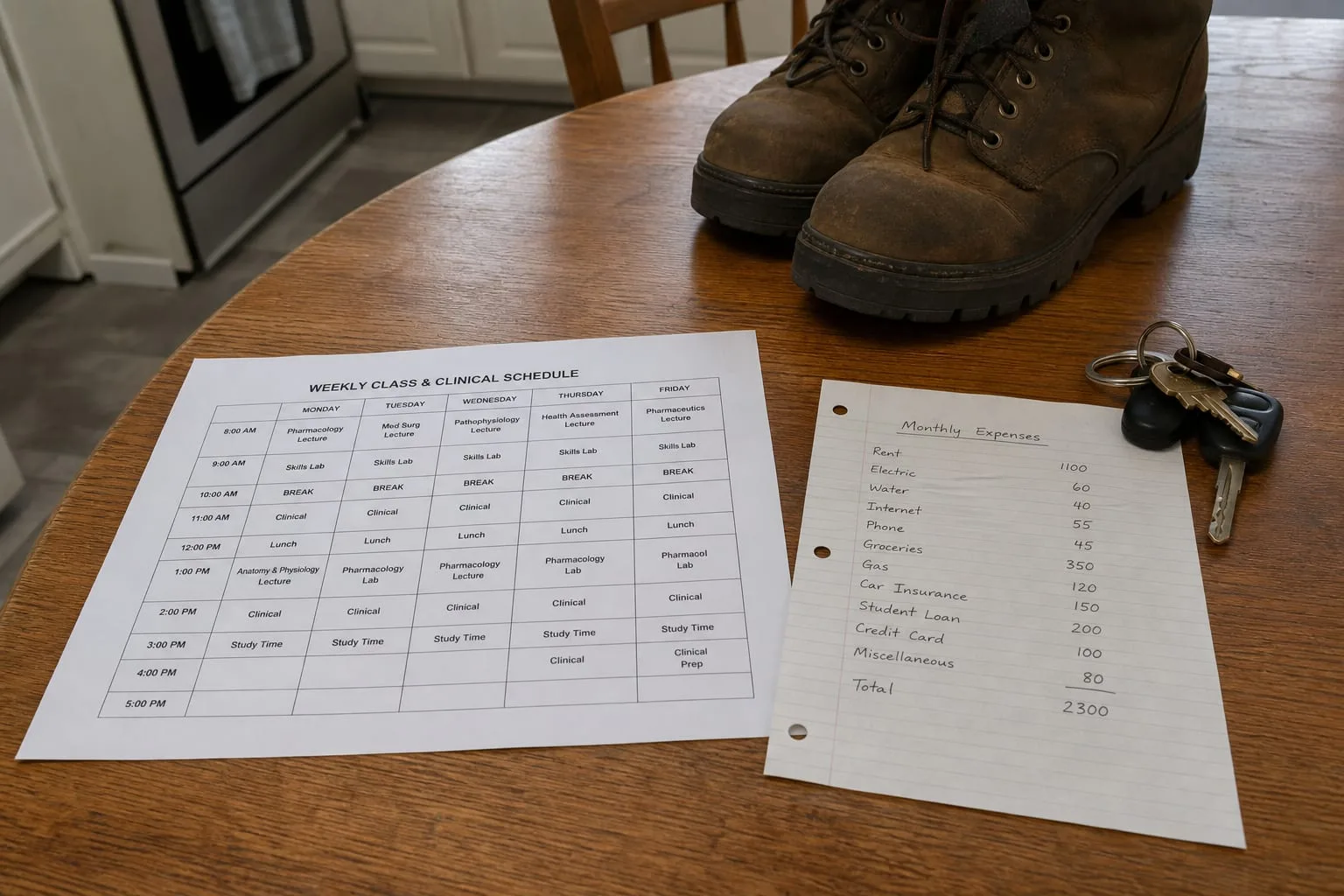
Ask the program for the actual schedule of a cohort currently enrolled, not the catalog description. You want start and end times, days of the week, and the required hours outside scheduled class. Trade and health programs are usually measured in clock hours rather than credits, which means the seat time is fixed and non-negotiable. A 900-clock-hour certificate delivered over nine months is roughly 25 hours a week of attendance before you open a book.
Then add the parts nobody lists. Commute both ways. Clinical or externship placements, which are often assigned rather than chosen and may sit forty minutes in the wrong direction. Study time, which for anything with a licensing exam at the end runs closer to one hour per class hour than the half hour people assume. Lab sections that meet only once a week, so missing one costs a week rather than a session.
Write it on a real calendar with your current obligations already on it. If the answer is that you have four hours of slack in a seven-day week, that is not a plan. It is a countdown.
The costs that arrive weekly, not at enrollment
Tuition is billed in one or two large pieces, which makes it feel like the whole cost. The spending that actually ends training routes is small and constant.
- Tools, uniforms, scrubs, steel-toe boots, a required tablet, a stethoscope. Ask whether the list is a recommendation or a condition of attendance.
- Background checks, drug screens, immunization records, and fingerprinting, often required by the clinical site rather than the school, and often repeated if the placement changes.
- Exam fees. There is usually a program fee, a separate testing-body fee, and a retake fee. Get all three numbers.
- Parking or transit. A permit at a hospital placement is a real line item.
- Childcare during hours you previously worked, plus the gap hours that no provider wants to cover.
- Food bought out because you are now away from home for eleven hours instead of nine.
Total these by the month and put the figure next to your current monthly surplus. Most people discover the constraint is cash flow rather than total cost, and cash flow problems have different solutions: payment plans, employer help, a different cohort start date.
The income question has three answers, not one
Forgone earnings usually dwarf tuition, so it deserves more than a shrug. There are three versions of the calculation and you should run all of them.
First, full-time study with no income. Fastest to finish, hardest to survive, and the one where a single unexpected repair bill becomes a withdrawal.
Second, keep the job and take the part-time or evening cohort. Cheaper in cash terms, longer in months, and it puts your employer in the middle of your schedule. Which brings the third version: earn while you train. Registered apprenticeships pay from day one and raise wages on a set schedule as you hit hour benchmarks. The Department of Labor administers the registered apprenticeship system, and a program's registered status is worth confirming directly rather than taking from a recruiter.
Where an employer is involved, understand what you are being offered. Tuition reimbursement usually pays after you pass, which means you front the money. Tuition assistance may pay the school directly. Either can carry a service commitment, and the repayment clause on a commitment you break is a real debt. Read the term, the trigger, and the amount.
Your leverage exists before the deposit, and mostly evaporates after
Once you have paid and the cohort has started, you are the party with the switching cost. Everything you want to ask for should be asked while you are still a prospect.
With the school, that means asking for the schedule in writing, the refund policy by week, the attendance and makeup policy, whether a leave of absence is available and on what terms, the completion rate for the specific program, and what happens if a clinical placement falls through. Ask what a student who fails one module does next: repeat the module, repeat the term, or wait a year. That single answer is worth more than any brochure.
With your employer, the ask is specific and it lands better before you enroll. A fixed shift pattern for the duration. Approved absence for exam days. A written note that the schedule holds through the program end date. Employers who want to keep you will often trade schedule certainty, which costs them little, in place of money.
Build slack in on purpose
A route that only works if nothing goes wrong is a route that ends when your car does. Assume two bad weeks per year: a sick child, a broken transmission, a family obligation you cannot move. Then check whether the program survives them. Some allow a set number of absences before dismissal. Some let you make up clock hours in an open lab. Some have neither, and in those you need a bigger buffer of your own.
The practical form of slack is a smaller monthly nut, a cohort that starts after your busy season, and a named person at the school you can call the day something breaks. Programs that answer these questions clearly are usually the ones with students who finish.
Get the schedule, the weekly cost, the refund calendar, and the employer commitment in writing before the deposit clears. Those four documents are what turn a training route from a hope into a plan you can actually run.
Alma Sandoval
Alma writes about the parts of a deal that are still open.