Homes
One Skipped Gutter Cleaning Ends as a Foundation Question Four Winters Later
A single deferred hundred-dollar job, followed through the sequence of consequences it produced, ending at a repair bill in an entirely different trade.
- Words
- 1,048
- Written by
- Tobias Renfrew
- Filed
Picture a two story house with mature trees on two sides of it. The gutters were cleaned the year the owners moved in and then never again, and for a long stretch afterward nothing dramatic happened at all, which is the entire point of the example. Damage of this kind does not arrive as an event. It arrives as a sequence, each stage handing the problem to a more expensive trade than the one before, and the sequence reads most clearly in the order the water travels, which is from the roof edge downward.
Year One: The Gutter Stops Being a Gutter
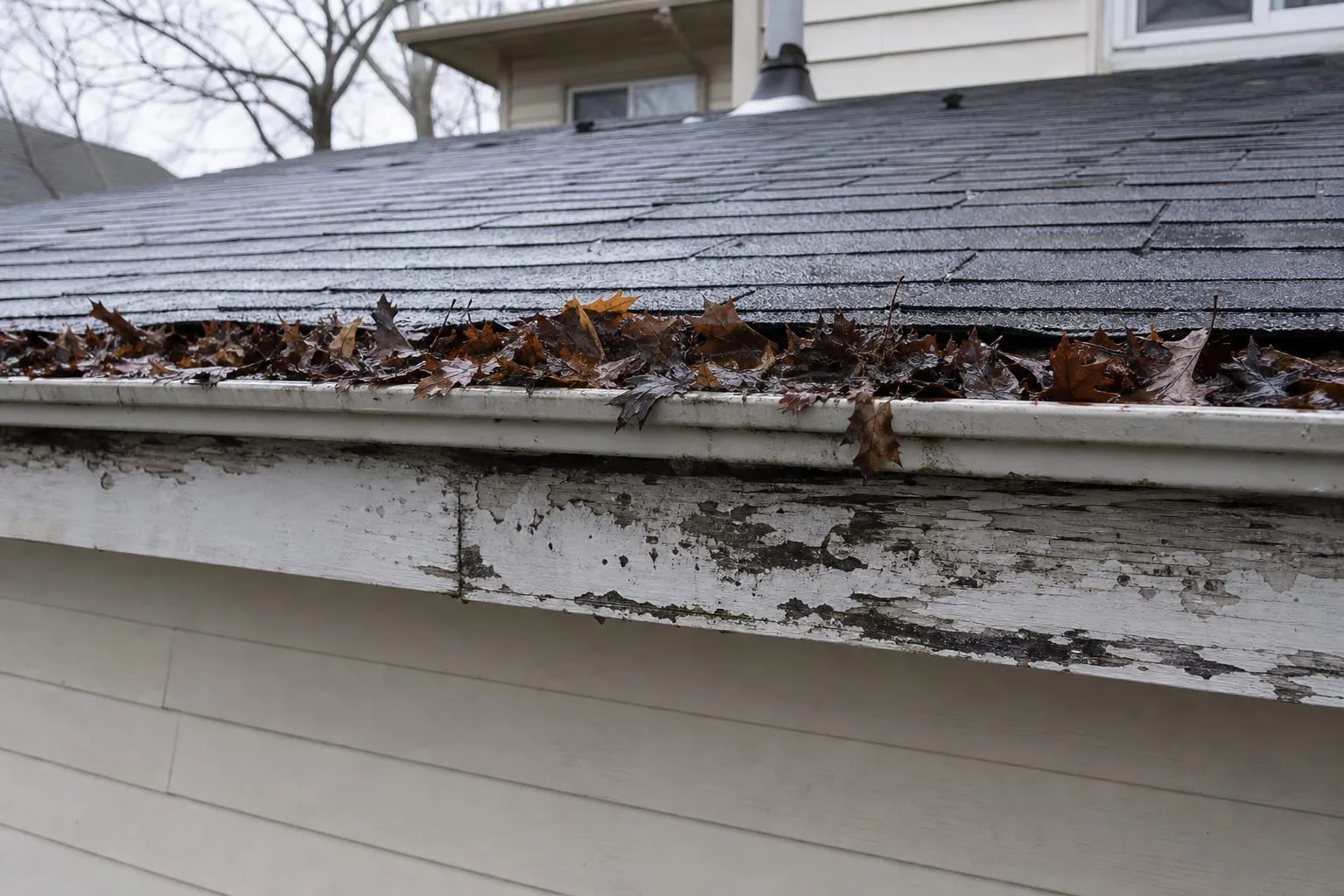
Leaves and shingle grit accumulate at the low end and around the outlet, and the gutter carries on working perfectly well in light rain, which is why nobody investigates. In heavy rain it fills and overflows at the front edge, a failure mode that goes unobserved because it only happens while everybody is inside. Standing water is considerably heavier than most people assume, and it is sitting in a channel hung on spikes or hangers driven into a wooden fascia board that was never asked to carry it.
The fasteners begin working loose at the section holding the most weight, so the gutter develops a slight backward pitch, and a backward pitch holds more water, which loosens the fasteners further. From that point the problem accelerates without any additional neglect on anybody's part, which is worth stating plainly, because the owners in this example did nothing new after the first year. They simply carried on not doing the thing they had already stopped doing, and the system took over from there.
Year Two: Water Goes Behind the Board Rather Than Over It
With the gutter tilted backward, overflow now runs behind it instead of over the front, down the face of the fascia and into the gap where the roof edge meets the board. That is the transition turning a maintenance item into a repair, and it happens without any visible change from the driveway. Fascia is usually a painted softwood board, and water standing against the back of it, shaded and slow to dry, gets past the paint at the joints and the end cuts first.
Rot therefore starts where nobody can see it, on the rear face, and it travels along the grain rather than spreading outward. By the end of a second wet season the board is soft across a run of several feet and the hangers holding the gutter are fixed into wood that no longer grips a fastener. Anybody putting a ladder up at that moment would still be looking at a gutter clean, a length of fascia and a repaint, which is a day of work for one competent person and the last cheap moment in the story.
Year Three: The Roof Edge, the Soffit and the Attic
Water tracking behind the fascia reaches the ends of the roof rafters and the underside of the roof deck at the eave, and in a house with vented soffits it reaches the soffit panels too, so the ventilation path meant to keep the roof edge dry begins carrying damp air into the attic instead. The bottom edge of the roof sheathing starts to delaminate, which shows up years afterward as a soft spot when a roofer walks the edge and wonders aloud what happened here.
In the attic, moisture arriving at the eaves finds cold surfaces and condenses, wetting the insulation nearest the exterior wall, which happens to be the insulation doing the most work in the house. Neither of these developments is visible from the ground, from the yard, or from any room the owners use. Their entire experience of the third year is that nothing has happened, which is precisely why the third year is where most of these sequences quietly pass the point of being a small job.
Year Four: The Ground, Which Is Where the Money Is
All the while, four years of overflow have been landing in the same narrow strip of soil at the base of the wall, concentrated in a line rather than spread across the yard the way roof water is supposed to be. That does three things at once. It erodes the grade beside the foundation, so ground that once sloped away now slopes back toward the house. It saturates the soil against the foundation wall repeatedly, and saturated soil is a load that wall was designed for only within limits.
And where the soil is clay, the repeated wetting and drying cycle moves it, which moves whatever happens to be sitting on it. The symptoms then arrive together and appear entirely unrelated to each other: a damp patch on a basement wall that was never damp before, a hairline stair step crack in the block at one corner, and a door upstairs that has started to catch on its frame. Nobody looking at those three things has any reason to think about a gutter.
What Each Stage Would Have Cost, and What It Actually Took
Year one wanted half a morning from one person with a ladder. Year two wanted a carpenter for a day. Year three wanted a roofer and an insulator for several days between them. Year four wanted multiple trades, regrading, drainage and an engineer's opinion on whether anything was still moving. The distance between the first of those and the last is not double or triple. It is a different order of magnitude, and the mechanism producing it is simply that each stage handed the damage to a more expensive trade.
The basement damp is what finally prompted the call, and the first two contractors quoted for waterproofing the wall, which would have treated the symptom at considerable expense. The third walked the outside of the house first and put a ladder up. What actually happened was gutters, fascia, a downspout extension carrying water ten feet out, and regrading one strip of yard, after which the basement wall dried over a season without being touched and a dated mark on the crack showed no further movement. Most of what looks like structural failure in a house of this kind is a drainage problem wearing a costume, and that house now has a gutter clean booked twice a year.
Tobias Renfrew
Tobias covers complaints, claims, and the paths open once something has gone wrong.