Homes
Buying Your First House? Four Things Get Called a Survey and Only One Is Yours
A home inspection, a mortgage location survey, a boundary survey and an ALTA survey do different jobs. Knowing which you are paying for decides what you can ask for later.
- Words
- 914
- Written by
- Alma Sandoval
- Filed
The word survey gets used for at least four different products in a single real estate transaction, and a first-time buyer usually hears all four inside two weeks. The inspector's report is a survey to some people. The lender's one-page sketch is a survey. The thing the fence company asks for is a survey. The document a title underwriter wants before it will insure the corners is also a survey. They cost different amounts, they are ordered by different parties, and critically, only some of them are made out to you.
That last point is where the money sits. The question is not just what level you need. It is who the work is performed for, because that determines who can rely on it and who can go back and complain when it turns out wrong.
The four documents, ranked by what they will actually defend
A home inspection looks at the condition of the structure and its systems. It is not a survey of land at all, and it will not tell you where your property ends. It is the cheapest, it is the one almost every buyer gets, and it is the one most often mistaken for broader protection than it offers.
A mortgage location survey (sometimes called a mortgage inspection or a location report, and not legal in every state) is a drive-up sketch that shows roughly where the house sits on the lot. Lenders order it to confirm the building is not sitting on the neighbor's land in some obvious way. Corners are not set. No monuments are placed. In most states it carries language saying it is not to be used for establishing boundaries, which is exactly what buyers then use it for.
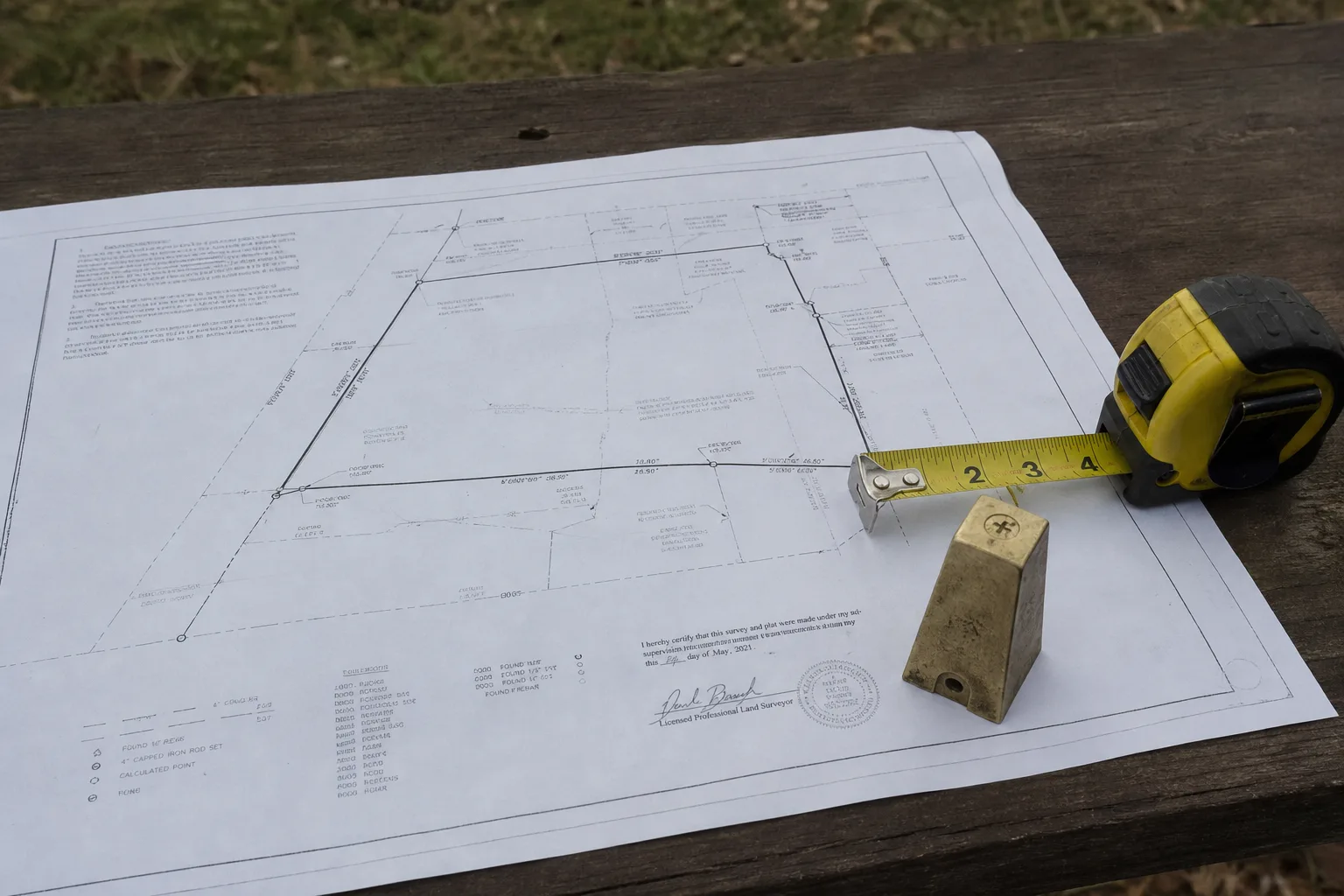
A boundary survey is the real article: a licensed surveyor researches the deed, the adjoining deeds and the recorded plat, goes to the field, finds or sets the corners, and signs a plat. You can build to it, fence to it, and argue from it.
An ALTA/NSPS land title survey is the commercial-grade version. It layers in easements, encroachments, access, zoning setbacks and anything in the title commitment that touches the dirt. On a residential purchase you rarely need it. On an odd lot, a shared driveway, or anything with a recorded easement crossing the yard, it earns its fee in one sitting.
Who orders it decides who it protects
The lender's survey exists to protect the lender's collateral. The seller's old survey, if one surfaces in the file, was made for the seller, often years and one addition ago. A surveyor owes a duty to the client who engaged them. If you relied on a plat addressed to somebody else and it was wrong, your position is weaker than you assume.
This is the leverage point most first-time buyers walk past. During the inspection period you are the party who can still withdraw, and that is the only window where asking for things is cheap. Ask the seller to produce any existing survey and the surveyor's name. Ask whether it can be recertified to you and to your title company, which is usually a modest fee rather than a new field survey. Ask the title company, in writing, what it will take to remove the standard survey exception from your owner's policy. That answer tells you precisely what level of survey the professionals handling the risk actually want, which is far more useful than a general rule.
When the standard level is not enough
Acreage, sloped ground, waterfront, old farm parcels and anything with a flood designation all push the requirement upward. Properties in mapped flood areas may need an elevation certificate prepared by a licensed surveyor; the Federal Emergency Management Agency is responsible for the flood mapping program those certificates are read against, and the difference between a correct and a missing certificate shows up on an insurance quote immediately.
Larger or more complicated sites increasingly get flown rather than walked for the first pass, and on rural tracts, mineral-interest parcels or land with suspected buried infrastructure, specialist firms offering geophysical drone surveying can map subsurface and topographic conditions across ground that would take a crew weeks to cover. That is not a first-time homebuyer product. It is worth knowing it exists, because if you are buying raw land rather than a house on a quarter acre, the right question shifts from "where are my corners" to "what is under this and can I build on it."
The consequences nobody traces back
Three years later, a buyer wants a fence. The contractor builds to the mortgage sketch, the neighbor pulls a real survey, and the fence moves at the buyer's expense. Or the permit office rejects a deck because the setback cannot be demonstrated. Or a shed sold with the house turns out to sit over a utility easement and has to come down when the line is serviced. Or the owner's title policy carries a survey exception and will not pay on a boundary claim, which was spelled out on a page nobody read at closing.
Each of those is a fully traceable consequence of a decision made during a week when the buyer was busy and the cheaper option was on the table. The fix at the time was a few hundred dollars and a sentence in the contract.
Get the title commitment early, read Schedule B, and ask what removes the survey exception. Whatever the answer is, that is your level.
Alma Sandoval
Alma writes about the parts of a deal that are still open.