Health
First Time Paying Out of Pocket for Fertility Care? The Paperwork That Gives You Leverage
What to ask for before you book a private fertility consultation, which documents actually carry weight, and how to read the first visit as information rather than commitment.
- Words
- 1,312
- Written by
- Alma Sandoval
- Filed
The first private fertility consultation is the one where you have the most leverage and the least information. That combination is uncomfortable, and most people resolve it by deferring: booking on a recommendation, showing up, and finding out what the arrangement is once they are already sitting in the chair. There is a better order. Almost everything you need to judge a practice can be requested before you hand over a card number, and almost all of it exists already, written down, because the practice needs it for its own operations.
What follows is organized around documents, because documents are what you can actually hold someone to. A warm phone call is not a commitment. A fee schedule is.
Three things to request before you book anything
Ask for these in writing, by email, from the front desk. A practice that answers all three without friction has told you something useful about how it runs.
The fee schedule, including what the first visit covers. The number you are quoted for an initial consultation often covers the practitioner's time and nothing else. Lab work, imaging referrals, supplements, and follow-up visits may each be billed separately. Ask specifically: what is the total expected cost of the first visit including any testing ordered that day, and is testing billed by you or by an outside lab? The answer splits practices into two groups immediately. One group has a printed sheet. The other improvises.
The credential, by name and number. Titles in this field vary by state, and so does scope of practice. A naturopathic doctor licensed in one state may have prescriptive authority that a practitioner in a neighboring state does not. Ask for the license type and the license number, then verify it yourself on the state board's online lookup. This takes about four minutes and is the single highest-value thing you will do in the whole process. You are not being suspicious. You are confirming a public record.
The referral and co-management policy. Fertility care frequently involves more than one provider: a reproductive endocrinologist, an OB-GYN, sometimes a urologist. Ask how the practice handles co-management. Does it send notes to your other physicians? Will it work alongside a clinic running an IVF cycle, or does it prefer to be the sole provider? There is no wrong answer here, but there is a wrong match. You want to know which one you are getting before you are three months in.
What to bring, and why it changes the visit
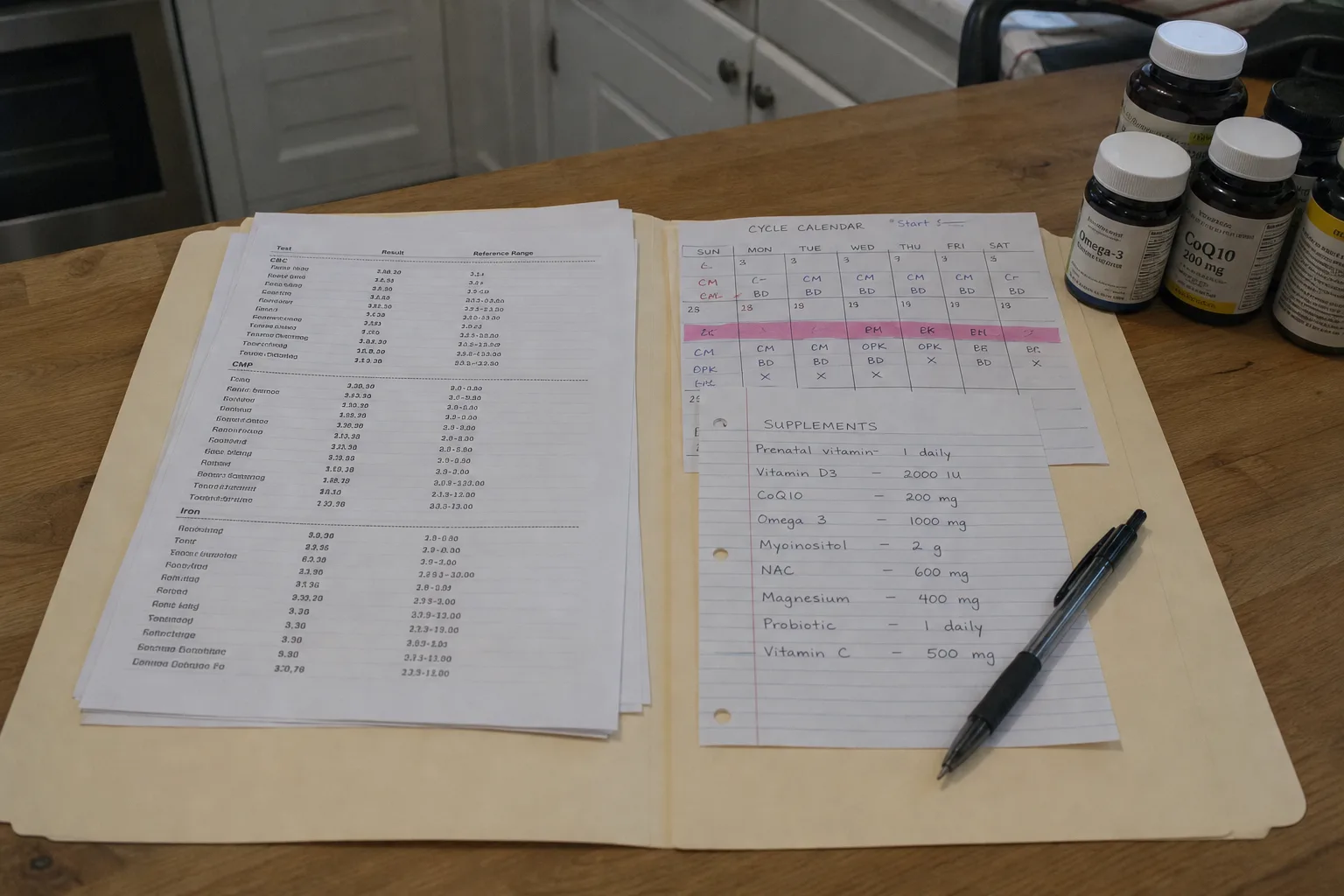
The difference between a productive first visit and an expensive intake interview is usually the folder you walk in with. Practitioners can only work from what is in front of them, and a first-timer tends to arrive with a verbal summary of two years of history, which converts poorly into a plan.
Assemble, in advance:
- Any lab results from the past eighteen months, with the actual numbers and reference ranges, not a doctor's summary of them. Request them through your existing provider's patient portal.
- Imaging reports: HSG, pelvic ultrasound, any saline sonogram. The written report matters more than the images.
- A semen analysis if one has been done, in full. Partial results get re-ordered.
- A cycle log, even a rough one. Dates of last several periods, length, any tracking data you already collect.
- A complete list of current supplements and medications with doses. Write it out. Brand names and milligram amounts.
- A one-page timeline: when you started trying, what has been tried, what was ruled out and by whom.
That last item is the one people skip and the one that earns the most back. A practitioner reading a clean timeline can spend the hour on interpretation instead of reconstruction.
Reading the first visit for what it produces, not how it feels
Rapport is real and it matters over a long course of care. But it is also the thing every practice is best at, and it is a poor basis for a decision made in the first sixty minutes. Judge the visit by its output.
A good first visit should leave you holding, or receiving within a few days, something close to a written plan: what the practitioner thinks is worth investigating, what tests are being ordered and what each one is meant to rule in or out, what interventions are proposed, and on what timeline you would expect to reassess. If the plan includes supplements or botanical protocols, you should be able to see the specific products, doses, and expected duration, along with the cost. The Food and Drug Administration regulates how dietary supplements are labeled and marketed, and the labeling on a product is a legitimate thing to read before you commit to six months of it.
Ask directly: what would tell us this is not working, and when would we know? A practitioner who has a clear answer has thought about the exit as well as the entry. That question is also the politest possible way to establish that you intend to evaluate the arrangement rather than simply continue it.
Watch for how testing is explained. There is a meaningful difference between a panel ordered because a specific finding would change the plan, and a panel ordered as a general survey. Both can be defensible. Only one is easy to explain in a sentence. If you are evaluating a naturopathic fertility doctor alongside conventional care, this is the point where the two approaches become comparable: both should be able to say what a result would change.
The money questions you are allowed to ask
First-timers systematically under-ask here, on the assumption that medical pricing is fixed. In private, largely cash-pay practice, a surprising amount of it is structured rather than fixed, and structure is negotiable at the point of entry and much harder to revisit later.
Reasonable things to raise in the first conversation:
- Package pricing versus per-visit. Many practices offer both. Ask what the per-visit total would be over the proposed timeline, then compare. A package is sometimes cheaper and sometimes just prepayment that makes leaving harder. Ask what happens to unused visits.
- Whether you can source supplements elsewhere. Dispensary margins are a normal part of the business model. You are still allowed to ask whether an equivalent product is acceptable and what the practitioner would and would not substitute.
- Superbills and HSA eligibility. Even where a practice does not bill insurance, it can usually generate an itemized superbill with diagnosis and procedure codes that you submit yourself. Ask whether they provide one as a matter of course. Ask which charges are eligible for payment from an HSA or FSA, and get the answer before you pay, not after.
- Cancellation and rescheduling terms. Fertility timelines move with cycles, and appointments get shifted. Know the window and the fee.
None of these questions are adversarial. They are the questions a practice that has its systems in order has already answered a hundred times, and asking them early signals that you are the kind of patient who keeps records. That tends to improve the quality of the documentation you receive afterward.
Keeping the file from here
Start a single folder, digital or physical, on day one. Every lab result, every plan, every receipt, every supplement label. Date everything. If you later move to a different practitioner, or add a reproductive endocrinologist, that folder is what makes the transition cost you weeks instead of months. It is also what lets you answer, honestly and with numbers, whether the money you are spending is producing anything.
The practitioner you choose first does not have to be the practitioner you keep. What you want out of the first visit is a documented starting position: what is known, what is being tested, what it costs, and when you look again. Get that on paper and the second decision becomes far easier than the first one was.
Alma Sandoval
Alma writes about the parts of a deal that are still open.