Education
Company-Paid CDL School, and the Payback Clause That Sets the Real Price
Tuition is the easiest number to compare and the least useful. In sponsored CDL training, the contract terms and the unpaid weeks decide what the route costs.
- Words
- 1,130
- Written by
- Tobias Renfrew
- Filed
A sponsored commercial driver's license program is one of the few training routes where someone hands you a printed price of zero. The school is paid by a carrier, you ride the training through, and you drive for that carrier afterward. Nothing on the flyer is false. It is just that tuition was never the number that governed the decision, and the people who sign without working out the rest tend to find that out in month four, when they want to leave and discover what leaving costs.
This is a narrow case, deliberately. Class A CDL training through a carrier-sponsored program has a structure you can see clearly: a fixed contract term, a stated dollar amount, a published set of federal training requirements, and a calendar with hard dependencies in it. Price it properly and you can price almost any training route the same way.
The assumption is that tuition is the variable. It is the constant.
Ask three people comparing driving schools what separates the options and you will get three answers about cost per week. Private schools publish a tuition figure. Community colleges publish a lower one. Carrier-sponsored programs publish nothing, or publish zero with an asterisk. So the comparison collapses into one column and everything else goes unexamined.
What actually varies between routes is time: how many weeks you are in training, how many of those weeks you earn nothing, how many you earn a reduced training rate, and how long after graduation before you are solo and on full mileage pay. A program that is four weeks shorter and pays a stipend during school can beat a free one by a wide margin, and a free one with a short finishing phase can beat both. None of that is on the flyer.
The second constant people miss is that sponsored tuition is real money that exists on a ledger somewhere with your name on it. It is not a gift. It is a loan or a service commitment, and it becomes payable on a schedule the carrier wrote. The number is usually in the low thousands. The term is usually somewhere around a year, sometimes longer. Those two facts together are the actual price.
Read the payback clause before you read anything else
Three questions settle most of what matters, and all three have answers in the contract. Get the contract before the orientation, not at it.
Is it prorated, and from when? A clause that reduces the balance month by month across the term is a different instrument from one that keeps the full amount payable until the last day. Both exist. Prorated from the date you start school is better than prorated from the date you go solo, because the gap between those two dates can be two months.
What triggers it? Voluntary departure, obviously. But also: termination for cause, failure to pass the road test, failure of a DOT physical, and in some agreements, refusal of a dispatch or a lane. The breadth of the trigger list tells you how much control you have kept over whether the balance comes due.
Who collects, and how? Some carriers hold the note themselves and deduct from final pay. Some assign it to a school, which may sell it on. A balance held by the employer you are negotiating with is a different problem from a balance sitting with a third-party collector who has no interest in your side of the story. Ask which it is and ask in writing.
One more line worth finding: what happens if the carrier lets you go in a downturn. A well-drafted agreement waives the balance on a company-initiated separation that is not for cause. A poorly drafted one is silent, and silence favors whoever drafted it.
The weeks that nobody puts on the calendar
School length is the number everyone quotes. It is rarely the longest part. Entry-level driver training standards for new Class A applicants are administered through a federal framework, and the Federal Motor Carrier Safety Administration oversees the registry of approved training providers that a school must appear on for your training to count. That registry entry is worth checking yourself before you enroll, because a provider who is not listed cannot deliver training that satisfies the requirement, and no refund fixes a lost month.
Then come the dependencies, each of which has a queue:
- The commercial learner's permit, which requires knowledge testing at your state DMV and a holding period before you can take the skills test.
- The DOT medical examination, which has to be done by a certified examiner and which occasionally sends someone off for follow-up testing that adds weeks.
- The skills test appointment, which in some states is the single longest wait in the sequence and is not controlled by your school.
- Endorsements, if the job needs them. Tanker and hazmat are not free and hazmat carries a background check with its own timeline.
- The finishing phase with a trainer, which is where sponsored programs vary most. Some are a few weeks. Some run considerably longer, at a training rate well below solo pay.
Write each of those on a calendar with a start and an end and you will have a picture no brochure provides: the date you stop paying out and start taking in. That date, not tuition, is what you are choosing between.
Build the comparison as a schedule, and get the answers in writing
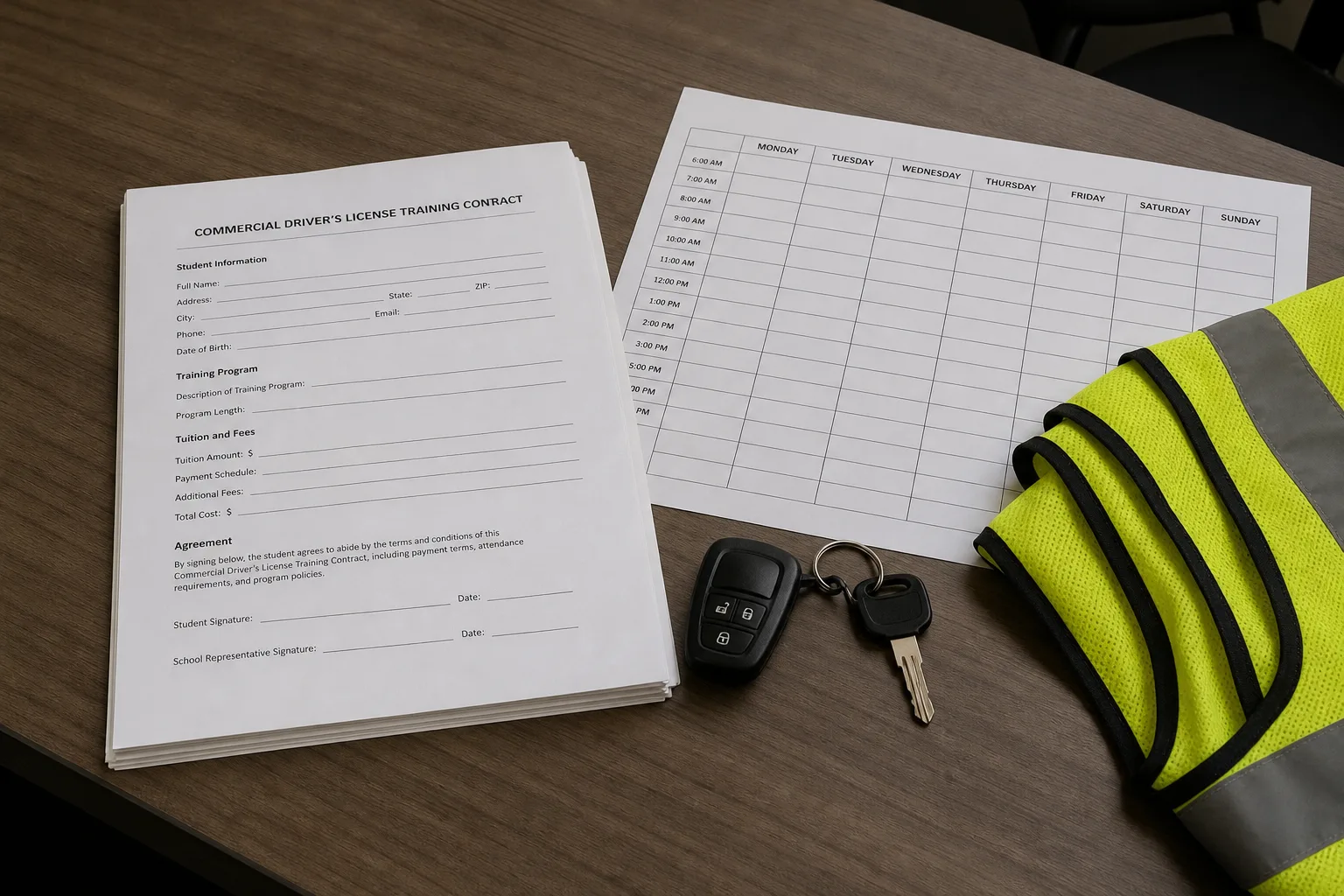
Two columns, one per route. Rows: weeks of classroom and range, weeks of permit waiting, weeks of finishing, pay rate in each phase, out-of-pocket costs (permit fees, physical, endorsements, lodging if the school is away from home, meals on the road during finishing), and the contract balance with its term.
Then send the recruiter a short email listing your understanding of each figure and asking for confirmation or correction. Recruiters answer email. The reply is the record, and a written representation that conflicts with the later contract is exactly the kind of thing that gets a disputed balance reduced or dropped without a fight.
If the balance is later asserted against you and you think it is wrong, you have ordinary routes: a written dispute to the holder, a complaint to your state attorney general's consumer division, and, if it was sold to a collector, the dispute rights that attach to collection activity. The leverage comes from documents you gathered before you started, which is the argument for gathering them.
Priced this way, a sponsored route often still wins, and wins clearly. The point is that you will know why it won, you will know the date your pay steps up, and you will know what it costs to walk away on a month you choose rather than a month that chooses you.
Tobias Renfrew
Tobias covers complaints, claims, and the paths open once something has gone wrong.