Family
Buying the Casket Separately? How That Line Item Came Unbundled, and What It Costs Now
The casket used to arrive inside the package price. Federal disclosure rules pulled it out, and that single change is where most of the savings in a funeral bill now sit.
- Words
- 1,061
- Written by
- Grant Weatherby
- Filed
Of all the lines on a funeral bill, the casket is the one most likely to be misread. Families assume it is bundled into whatever the funeral home quoted for the service, the way a hotel room includes the bed. For decades that was roughly true: the price you were given covered a package, the casket sat inside it, and the only real decision was which model in the selection room felt right. That arrangement is gone, and it went away on purpose. Understanding how it was taken apart is the fastest route to knowing which numbers on the estimate you can actually move.
The line item that was pried loose
The Federal Trade Commission oversees how funeral providers present prices to families, and the shift that matters came from requiring those prices to be broken out and handed over in writing before anyone is asked to choose anything. Once a provider had to state a separate figure for each good and service, the casket stopped being an invisible component of a single quoted number. It became a product with a price beside it.
Two consequences followed, and both are still working their way through the market. The first is that you can decline items. A package that once arrived whole can be taken apart, and a provider has to tell you which charges are truly non-declinable. The second is bigger: a funeral home cannot refuse to use a casket you bought somewhere else, and cannot add a fee for handling it. That single restriction created an entire retail category. Independent sellers, freight-shipped models, and manufacturer-direct suppliers only make sense as businesses because the receiving funeral home is obliged to accept the delivery on the same terms as its own inventory.
So the narrow case worth studying is the casket itself. It is the clearest example of a cost that used to be structural and is now genuinely optional in both amount and source.
What you are paying for inside that number
Strip away the showroom language and the price of a casket is driven by four things: the material, the gauge or thickness of that material, the interior finish, and the hardware. A hardwood shell costs more than a veneer over a softwood frame. Sixteen-gauge steel is thicker and costs more than twenty-gauge. Crepe interiors are cheaper than velvet. Swing-bar handles and adjustable bed mechanisms add money.
Then there is sealing. Many metal caskets are sold with a rubber gasket and a locking mechanism, usually described as protective or sealing. It is worth being plain about what that does and does not accomplish. A gasket resists the entry of water and air for some period. It does not preserve anything indefinitely, and no seller should tell you otherwise. If a sealed unit matters to you for reasons of your own, buy it knowingly. If it does not, the same casket without a gasket is a meaningfully cheaper object.
Cremation is its own case. If the body will be cremated, a casket is not required at all in the usual sense. A rigid, combustible container is what the crematory needs, and most providers offer a simple one. Some also rent a display shell with a removable insert for a viewing, which lets a family hold a traditional service without buying a casket that will be destroyed hours later. That rental line is often mispresented as a formality when it is in fact a choice with a price attached.
How to price it in an afternoon
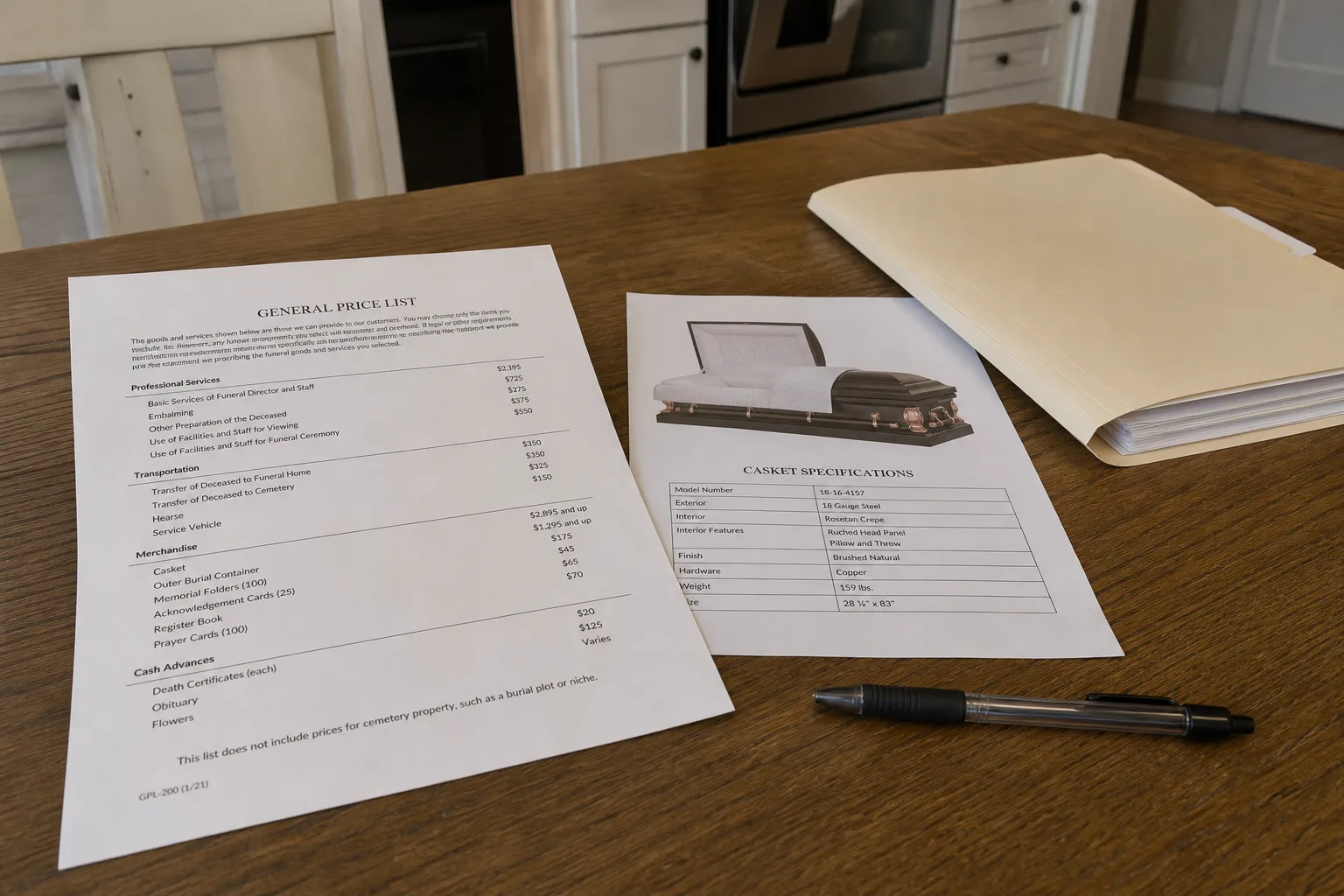
Start by asking the funeral home for its printed, itemized price list and its separate casket list. You are entitled to both, you do not have to explain why you want them, and you should not have to buy anything to get them. Read the casket list for model name, material, gauge, and price. Those four fields are what make comparison possible.
Next, take those specifications outside the building. An independent retailer listing a comparable funeral coffin will usually publish the same material and gauge details, which is exactly what lets you tell whether a price difference reflects a different product or just a different margin. Ask about delivery timing before you buy, confirm the funeral home's receiving address and hours, and get the expected arrival in writing. Shipping is the one real risk in an outside purchase, and it is manageable if the service date is not the day after tomorrow.
Then tell the funeral home what you are doing. A professional response is a shrug and a request for the tracking number. No handling fee, no requirement that you be present for the delivery, no insistence on inspecting the box first.
Which of the surrounding charges are actually optional
Once the casket is loose, the other lines separate more easily too. A short field guide:
- Basic services fee. Non-declinable. It covers planning, permits, coordination, and overhead, and it appears on every bill from that provider regardless of what else you choose.
- Embalming. Rarely required by law. It is commonly required by a funeral home's own policy for a public viewing with an open casket. Skip the viewing or hold a closed-casket service and the charge often goes with it. Refrigeration is frequently available and cheaper.
- Visitation, staff for the ceremony, hearse, limousine. All separately priced, all declinable. A graveside-only service removes several of them at once.
- Outer burial container. Not a legal requirement in most places. It is very often a cemetery requirement, because a vault or grave liner keeps the ground from settling. That is the cemetery's rule, not the funeral home's, and you can buy the container elsewhere as well.
- Cash advance items. Death certificates, clergy honoraria, obituary placement, flowers. These pass through the funeral home, sometimes with a markup, and you can usually arrange them yourself.
The pattern is consistent. Almost everything except the basic services fee and the provider's mandatory-by-policy items is a decision, and the casket is the decision with the largest dollar spread.
If you are working ahead of a death rather than in the days after one, spend an hour collecting price lists from two or three local providers and one outside casket seller. Put them in the same folder as the cemetery's written rules on outer containers. When the call comes, the arithmetic is already done and the only thing left to choose is the service.
Grant Weatherby
Grant writes about what has changed lately and what it means.