Family
Arranging a Funeral in the First Week, and the Order the Steps Actually Have to Happen In
Who has authority, how many death certificates to order, and what to bring to the arrangement meeting so the first week runs in the right sequence.
- Words
- 939
- Written by
- Tobias Renfrew
- Filed
Most of the trouble I get called about in a funeral does not start at the service. It starts in the first forty eight hours, when somebody signs something they had no authority to sign, or orders two death certificates when the estate needed twelve, or agrees to a package over the phone and then discovers the itemized list would have cost a third less. The week runs in a fixed order whether or not the family knows the order. Knowing it is most of the advantage.
Before anything is arranged, settle who decides
Funeral homes will not proceed far without a signature from the person with legal authority to direct disposition. Every state has a priority list. Typically it runs: an agent named in a written designation or advance directive, then the surviving spouse, then adult children as a group, then parents, then siblings. The detail varies enough that it is worth asking the funeral director to say out loud which statute applies and who it puts first.
Two things cause most disputes here. The first is a decedent who left written instructions naming an agent, and a family that never knew the document existed. Check the safe deposit box, the estate planning file, and the hospital or nursing facility chart before you assume the spouse or eldest child decides. The second is equal-priority relatives. Four adult children have equal standing, and in many states a cremation authorization needs all of them, or a documented reasonable effort to reach each one. If one sibling is unreachable in the first week, cremation may stall. Burial usually does not. That single fact has reshaped more first-week plans than any budget conversation.
Write down, in one place, who the legal decision maker is and who is being consulted as a courtesy. Those are different roles, and confusing them is how a family ends up relitigating a decision on the morning of the service.
Order more death certificates than feels reasonable
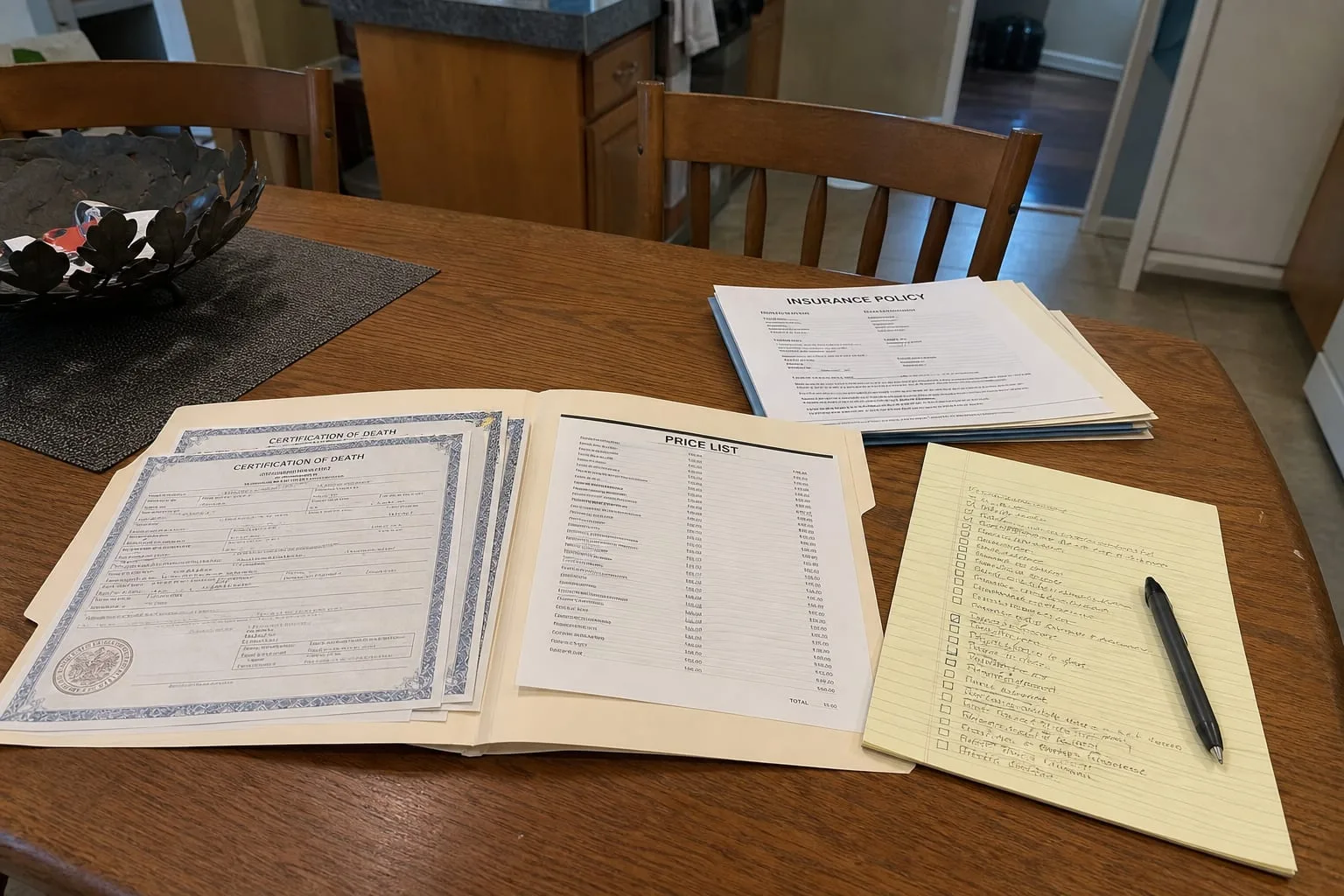
The certified death certificate is the document that unlocks everything downstream, and photocopies are rejected almost everywhere it matters. Each of the following typically wants its own certified copy: every life insurance policy, every bank and brokerage account, the pension or retirement plan administrator, the county recorder for real property, the state motor vehicle agency for a title transfer, the mortgage servicer, the probate court, and the Social Security Administration if the notification does not come through the funeral home electronically.
Counting the accounts before you order is the whole trick. Sit down with the last twelve months of statements and list every institution holding an asset or a policy. Add three. Ordering additional copies later is possible but slow, and it usually arrives after the deadline it was needed for. The certificate itself will not be issued until a physician or medical examiner signs the cause of death, which is why a delayed certificate is normal and not evidence of anyone dropping the ball.
Ask for the itemized list, not the package
The Federal Trade Commission oversees funeral pricing disclosure at the federal level, and its rule is the most useful consumer protection in this entire process. A funeral provider has to give you an itemized general price list, on paper, to keep, at the start of any in-person discussion of arrangements. Prices must be quoted over the phone on request. You are entitled to select individual goods and services rather than a package, and you cannot be required to buy a casket from the provider handling the service.
So the arrangement meeting has an order too. Take the price list first. Read it before choosing anything. Compare the package price against the sum of the items you actually want, because the two frequently differ, and not always in the package's favor. The one line that surprises families is the non-declinable basic services fee, which covers the provider's overhead and appears regardless of what else you select. Knowing it is there stops it from reading as an add-on.
Bring the folder to the first meeting
The families who get through the arrangement conference in ninety minutes rather than three visits arrive with a single folder. It holds: the decedent's full legal name, date and city of birth, parents' names including the mother's maiden name, Social Security number, marital status and spouse's name, occupation and employer, education level, and veteran status. The vital records clerk needs every one of those to issue the certificate, and the funeral home is filling that form on your behalf.
For a veteran, add the DD-214. It governs eligibility for a burial flag, a government headstone, and interment in a national cemetery, and finding it in the first week is much easier than reconstructing service records later. Add the cemetery deed if a plot already exists, the insurance policy numbers, and any preneed or prepaid funeral contract. A prepaid contract at a different funeral home than the one you called is worth discovering on day one rather than day five.
What has a deadline and what does not
Obituary submission has a real deadline, set by the publication, and it typically needs the service details locked. Notifying Social Security is time-sensitive because a benefit payment received for the month of death generally has to be returned. Insurance claims, account transfers, and probate filing all have longer windows.
The memorial itself has none. A service can be held six weeks out with the ashes present or the burial already completed. Separating the urgent paperwork from the gathering is what turns an impossible week into a manageable one, and it is the single choice experienced families make first.
Tobias Renfrew
Tobias covers complaints, claims, and the paths open once something has gone wrong.