Homes
The Adjuster at Your Door May Not Work for Your Insurer. Five Things to Establish First
The person inspecting your damage is usually one link in a larger chain, and knowing who signs off on their estimate changes what you can reasonably ask for.
- Words
- 1,147
- Written by
- Alma Sandoval
- Filed
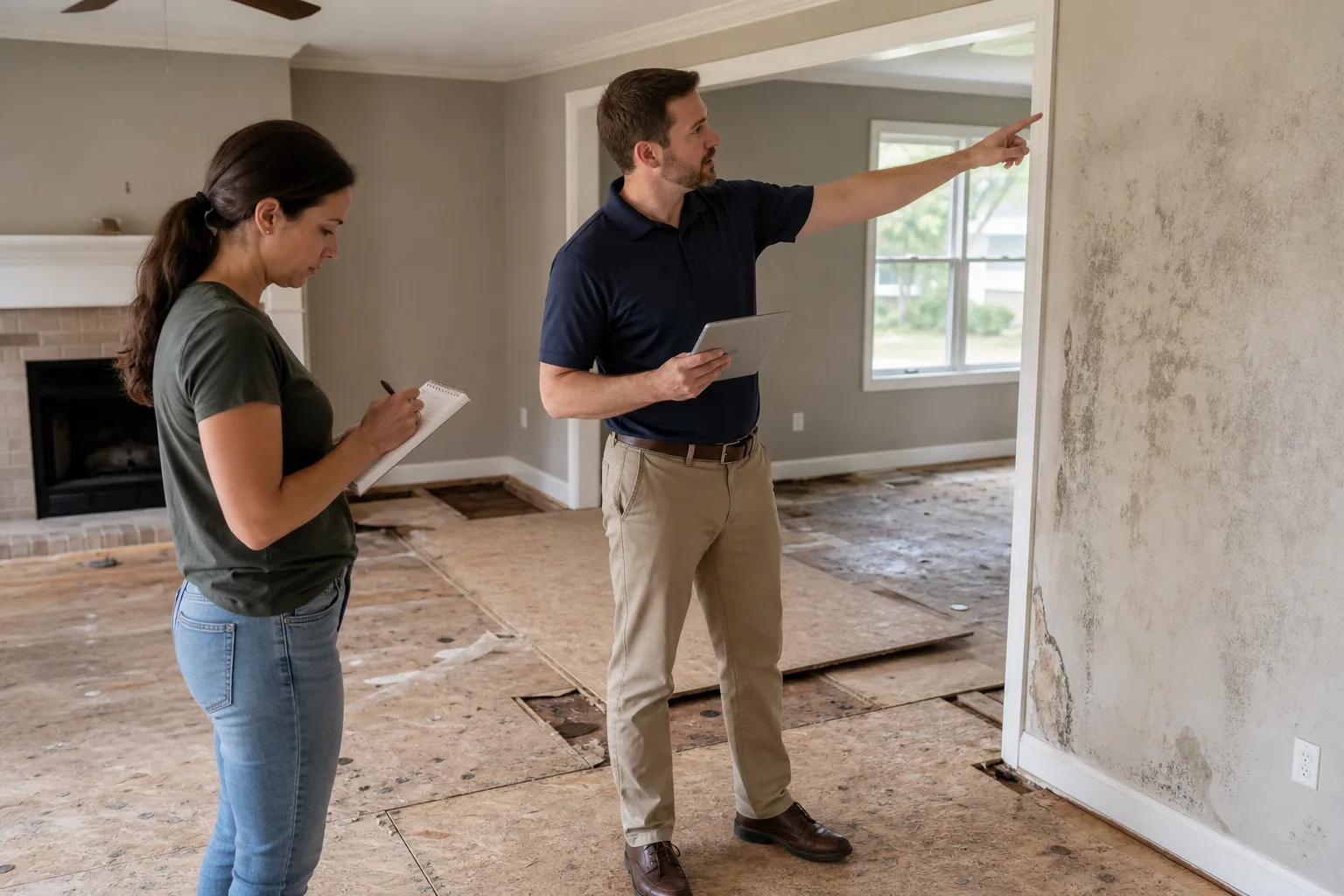
The person who walks through your flooded kitchen with a tablet and a moisture meter is doing fieldwork. They measure, photograph, and write. In a large number of claims, they do not decide anything. The decision sits with someone you will never meet, at a desk in another state, reading the file the field person uploaded. If you negotiate hard with the wrong person, you spend your energy on someone who agrees with you and still cannot help.
So the first job on a property claim is mapping the organization behind the clipboard. Five checks do most of that work.
1. Establish who pays them, because there are three different answers
Ask it plainly on the first visit: who employs you, and who signs off on your estimate? You will get one of three answers.
A staff adjuster is an employee of your insurance carrier. They carry a company email address and usually carry some settlement authority. A contract or independent adjuster works for an adjusting firm the carrier hires, often in volume after a storm when the carrier's own staff cannot cover the territory. They inspect and report; the carrier's in-house examiner reads the report and makes the call. A public adjuster works for you, is licensed by your state, and is typically paid a percentage of the settlement. That percentage is regulated differently state to state, and in some states capped after a declared disaster.
The distinction matters because it tells you where the friction will be. With an independent adjuster, the gap between what they saw and what gets paid is a document handoff. Things get lost in that handoff. Photos that mattered to you do not get captioned. A verbal acknowledgment at your kitchen table does not travel. Anything you want the file to reflect has to end up in the file in writing, with your claim number on it.
2. Find the authority limit, and the name directly above it
Adjusters work to dollar thresholds. Below a certain figure they can approve a payment themselves. Above it, the file goes to a supervisor, a large-loss unit, or a specialist. Nobody volunteers this number, but most adjusters will tell you if you ask conversationally: at what point does this go above you?
The answer reorganizes your approach. If your claim is plainly going to exceed their limit, the person to persuade is the examiner or supervisor, and the thing that persuades them is documentation in the file, not a good conversation in your driveway. If it sits under the limit, you have a decision-maker standing in front of you, and that is the moment to raise scope questions rather than save them for a follow-up call.
Get the examiner's name and direct line. Get the claim number written down and use it in the subject line of every email. Large carriers route by file, not by memory, and a file that is easy to find is a file that moves.
3. Ask which estimating platform and which price list
Most carriers and most restoration contractors write estimates in the same software, using regional price lists that are updated on a schedule. That is good news for you, because it means the argument is rarely about whether a given task is worth what it costs. It is about which tasks appear on the list at all.
An estimate that omits detaching and resetting the toilet before replacing a bathroom floor is not cheap, it is incomplete. Same for baseboard removal, contents manipulation, drying equipment days, dumpster and haul-off, and the sales tax on materials. These are line items with established prices. They either got entered or they did not.
So ask for the full itemized estimate as a PDF, not the one-page summary of what the check covers. Then ask your contractor to compare line by line and flag what is missing. A contractor who writes in the same software can hand you a list in an hour. That list, emailed to the examiner with photographs attached, is the single most effective document most homeowners ever send. Ask also which price list version and effective date was used; if material costs moved after a regional storm, a stale list is a fair thing to raise.
4. Understand what a managed repair program is offering you
At some point the carrier may offer a contractor from its own network, sometimes called a managed repair or preferred vendor program. The pitch is real: the work is usually warrantied by the carrier, pricing is pre-agreed so there is no scope fight, and payment flows directly to the contractor instead of through you and your mortgage servicer.
The trade is that the scope conversation happens between the carrier and its vendor, and you are not in the room for it. The vendor's relationship with the carrier is worth more over a year than your single job, which shapes how hard they push on a disputed item.
In most states and under most policies you can decline the network contractor and hire your own, though the carrier will then pay to its own estimate rather than to whatever your contractor charges. Read your policy language on this before you answer, and if you accept, ask in writing who warranties the labor, for how long, and who you call if a floor cups six months later. A clear answer to that question is the whole value of the program, and it is reasonable to require it in writing.
5. Know the two escalation routes that exist before a lawsuit
Nearly every homeowners policy contains an appraisal clause. If you and the carrier disagree on the amount of the loss (not on whether it is covered), either side can invoke it: you name an appraiser, the carrier names one, and the two select a neutral umpire. It is binding on amount, it costs money, and it is a genuine lever that does not require an attorney.
The second route is your state department of insurance, which licenses adjusters and handles consumer complaints. A filed complaint goes to the carrier's compliance group, which is a different and more attentive part of the organization than claims. Separately, flood damage runs on its own track: the National Flood Insurance Program is administered by the Federal Emergency Management Agency, and flood claims are handled by adjusters certified for that program under its own deadlines and proof-of-loss rules.
You can also ask for a reinspection, with a different adjuster or with an engineer, and carriers grant these more often than people expect when the request names specific disputed items rather than general dissatisfaction.
Three names, one claim number, one itemized PDF and one dated price list. That is the shape of a file that gets handled by the right person on the first pass, and it is all available for the asking in the first week.
Alma Sandoval
Alma writes about the parts of a deal that are still open.