Health
Adding a New Device to Your Treatment Menu? Where the Real Cost Lands After the Purchase Price
A state license, a manufacturer certificate and a medical director agreement each cover different ground. Knowing which one your insurer reads changes what you pay and what you can negotiate.
- Words
- 1,175
- Written by
- Alma Sandoval
- Filed
The invoice for a new piece of equipment is the smallest number in the file. Anyone who has brought in a fourth or fifth modality knows this already: the capital cost is fixed and visible, and everything that follows is variable, negotiable, and badly estimated by people doing it for the first time. Training. An insurance endorsement. A medical oversight arrangement, in some states. Staff hours spent in a classroom instead of on the floor. Credential renewals that arrive on a cycle nobody wrote into the pro forma.
The reason this keeps catching operators out is that the paperwork sits in four different places, issued by four different parties, and only one of them is a government body. Each covers a slice of risk. None of them covers the whole thing. Sorting out which document answers which question, before you sign, is where most of the available money is.
Four documents, four different promises
Treat these as separate instruments rather than a stack of qualifications. They do not substitute for each other, and a thick binder of certificates does not fill a gap in the one that your state board actually reads.
| Document | Issued by | What it actually settles | What it does not |
|---|---|---|---|
| State esthetics or cosmetology license | State board | That a person may legally perform services within a defined scope | Whether a specific device falls inside that scope, which is often a separate rule or advisory |
| Manufacturer or distributor certification | The company that sold you the device | That the operator was trained on this model, by this company, on this date | Any legal authority to use it. It is a training record, not a permission |
| Private modality certificate | Independent school or trainer | Depth of technique across a category rather than one machine | Recognition by the board unless the curriculum is separately approved |
| Medical director or supervision agreement | A licensed physician, by contract | Who holds clinical responsibility for treatments classed as medical | Day-to-day presence, unless the contract says so in writing |
The Food and Drug Administration is responsible for the clearance and marketing of aesthetic devices sold in the United States, and the paperwork that comes with a machine reflects that federal layer. What it does not do is tell you who in your state may hold the handpiece. That second question is answered locally, and the answers differ enough between neighboring states that a protocol which is routine in one is a disciplinary matter across the line.
The cost stack, in the order it bills you
Build the model in this sequence and it stops surprising you.
- Included training. Usually one or two days, usually for a set number of staff, usually at your site or theirs. The cost here is not tuition. It is closed treatment rooms and a payroll day with no revenue against it.
- Training for the people who were not in the room. This is the quiet one. Staff turnover means the person you certified in March may be gone by autumn, and the second and third rounds of training are rarely free.
- Insurance. Your professional liability carrier underwrites by modality, not by machine. Adding energy-based treatments to the schedule typically means a new endorsement, a new application, and sometimes a carrier that declines outright and sends you shopping.
- Medical oversight, if required. A monthly retainer plus whatever chart review the agreement specifies. Price varies with how much actual physician time you are buying versus how much name you are renting.
- Renewals. License renewal and continuing education on the state's cycle. Manufacturer recertification on the manufacturer's cycle, which is set by them and can change.
- Consumables and service. Tips, cartridges, gels, annual calibration. Known at purchase if you ask. Frequently not asked.
What drives the total is not the sophistication of the device. It is how your state classifies the treatment. A modality that sits comfortably inside an esthetician's scope carries training and insurance costs and stops there. The same device reclassified as a medical treatment pulls in a physician agreement, a different liability tier, and record-keeping obligations that cost staff time every week. Two clinics can buy identical equipment and carry annual compliance costs that differ by a multiple, purely on geography.
Where your leverage actually sits
It sits before the deposit clears, and it decays fast afterward. Sales teams have quarterly numbers and inventory. You have a signature they want. Everything below is routinely granted to buyers who ask and routinely withheld from buyers who do not.
- Training seats by headcount, not by head. Ask for certification of your whole treatment staff, including hires made in the following twelve months. Get the twelve-month window in the contract, not in an email.
- A named trainer and a named date. "Training included" with no scheduling commitment can mean a six-week wait while the machine depreciates in a hallway.
- Written scope support. Serious suppliers of facial machines for professionals keep current documentation on how each modality is classified state by state, and will put in writing what they know about yours. That document is what your carrier and your attorney will want to see.
- Recertification terms fixed at purchase. If the manufacturer requires periodic recertification, pin the price and the frequency now. Open-ended renewal obligations are a lever held by the other side.
- Consumable pricing with a cap. Equipment is often sold near cost on the understanding that the tips pay the margin. Negotiate the tips.
- Loaner or service-level terms. A device under repair with a booked schedule is a refund machine. Ask what happens in week two.
Reading a credential the way an underwriter does
Underwriters and state investigators ask narrower questions than clients do. The question is never whether your team is skilled. It is whether, on the date of the treatment, the named operator held the specific authority the state requires for that specific procedure, and whether the clinic can produce the document within a reasonable time of being asked.
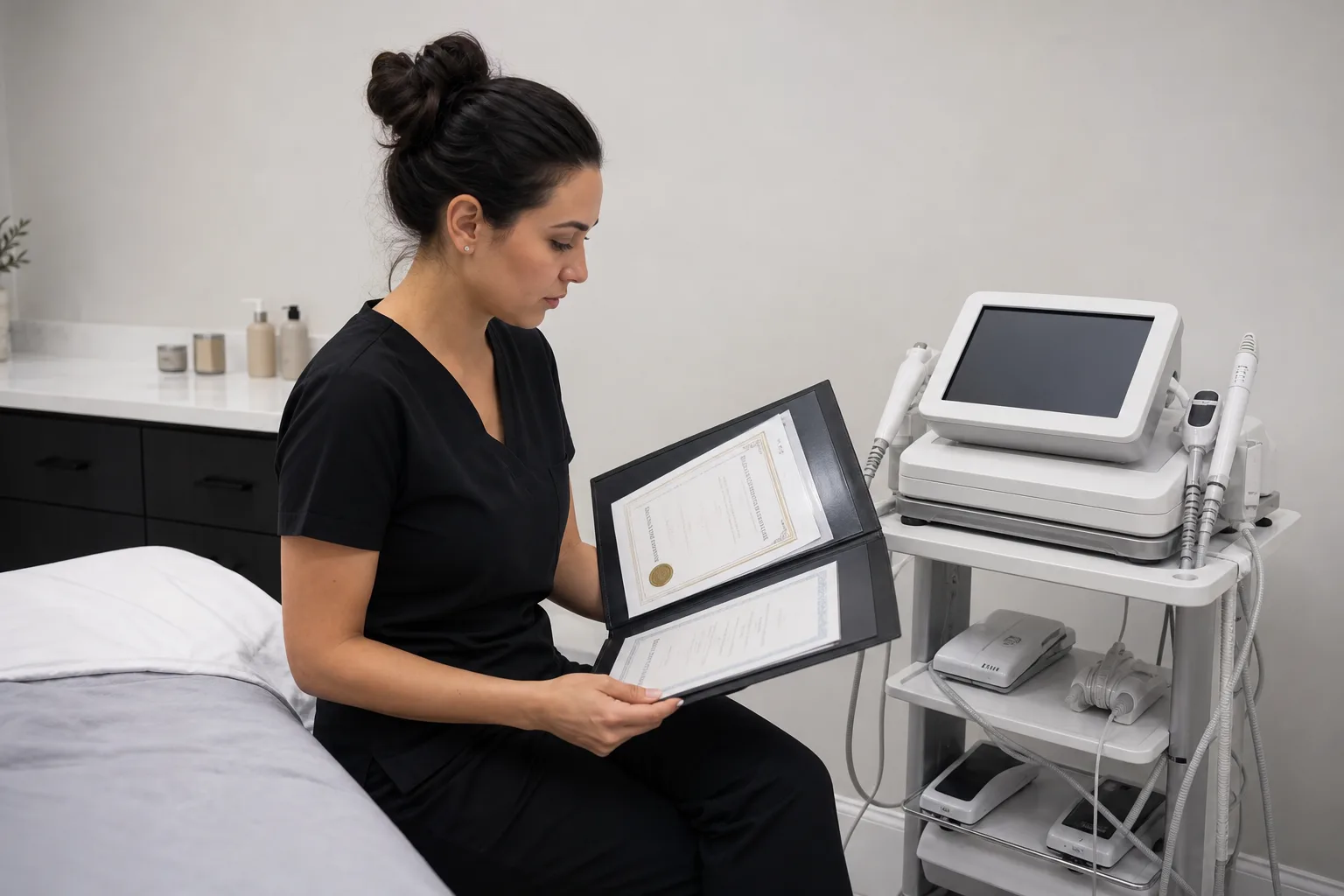
That reframes what you file and how. Keep per-operator records with issue and expiry dates, not a wall display. Date the manufacturer certificates, because they prove training on a model and a software version, and a device upgraded mid-life may need a fresh record. Keep the medical director agreement where staff can find it, with the supervision terms legible rather than buried in a recital clause.
Operators who have done this repeatedly tend to run one spreadsheet with a column for every credential and a renewal date beside each. It is unglamorous and it is the difference between a routine inspection and a long afternoon. It also doubles as the file you hand a buyer if you ever sell the practice, which is when clean credentialing turns into money.
The device decision and the compliance decision are the same decision, made at the same moment, and the window where you can shape both is the few weeks between the demo and the deposit. Ask the scope question first, price the credential stack second, and treat the machine itself as the part of the deal that was already settled.
Alma Sandoval
Alma writes about the parts of a deal that are still open.